
Food delivery has come a long way, evolving from a simple convenience into a massive global industry worth hundreds of billions. It’s not just about getting your meals anymore, it’s about transforming urban lifestyles and opening up new economic opportunities. As we look ahead and beyond, this sector is on the brink of a revolutionary shift, fueled by advancements in artificial intelligence, autonomous delivery systems, and hyperlocal strategies. Imagine AI powered kitchens that fine tune menus and streamline operations, drones that cut down delivery times, and hyperlocal trends that emphasize fresh, community focused food. These innovations promise not just quicker meals but also smarter, more sustainable, and deeply personalized food experiences that change the way we eat, shop, and connect with our neighborhoods.
This in depth exploration takes a closer look at the future of food delivery, breaking down the technologies, use cases, challenges, and opportunities that lie ahead. It also shines a light on how forward thinking businesses can spearhead this transformation.
AI Kitchens Revolutionizing Food Preparation
AI kitchens are at the forefront of food production automation, where machine learning, robotics, and data analytics come together to create ghost kitchens or dark kitchens that operate with unmatched efficiency, precision, and scalability. These facilities focus solely on delivery and takeout, eliminating the need for dine in seating.
The core technologies driving AI kitchens include:
- Robotic Chefs and Arms: These precise cooking robots can chop, stir, fry, and plate dishes with a consistency that outshines human variability. Companies like Moley Robotics and Picnic are deploying multi arm systems capable of preparing thousands of recipes.
- AI Menu Optimization: Machine learning analyzes order history, weather patterns, local events, and user preferences to dynamically adjust menus, predict demand, and reduce waste. For example, AI can anticipate a surge in spicy food orders during cold snaps or a spike in vegan meals on Mondays.
- Inventory and Supply Chain AI: Predictive analytics help track ingredient spoilage, automate reordering, and optimize supplier selection, cutting costs by up to 30 percent.
- Quality Control Vision Systems are revolutionizing the way we inspect food, ensuring that every item meets perfection. By flagging any defects or inconsistencies before packaging, these systems help maintain brand standards.
Leading the charge in this space are innovators like CloudKitchens, founded by Uber’s Travis Kalanick, which utilizes AI to manage thousands of virtual brands from a single location. Then there’s Reef Technology, with its modular kitchen pods that can be deployed anywhere, all powered by AI driven operations. In Asia, companies like Zomato’s Hyperpure and Swiggy’s kitchen networks are leveraging AI to serve millions of meals daily at an impressive scale.
The benefits of AI in kitchens go beyond just efficiency. These smart kitchens significantly reduce labor costs, operate around the clock, and can whip up hyper personalized meals, including custom nutrition plans or allergy safe dishes, all on demand.
Drone Deliveries Taking Food to New Heights
Drones are set to tackle traffic congestion and delivery delays, ensuring that food arrives hot and fresh in under 15 minutes. With regulatory approvals speeding up in the US, Europe, and Asia, what once seemed like science fiction is now becoming a part of our everyday lives.
Some key advancements in drone technology include:
- Autonomous Navigation: AI powered drones utilize GPS, LiDAR, computer vision, and 5G to avoid obstacles, optimize routes, and land precisely on rooftops or in backyards.
- Payload and Range Improvements: Today’s drones can carry between 5 to 10 pounds over distances of 10 miles, using thermal insulated pods to keep food at the right temperature and quality.
- Swarm Intelligence: Coordinated fleets of drones can handle high density urban deliveries, dynamically rerouting to avoid bad weather or air traffic.
- Returnable Packaging: Sustainable drone pods facilitate reverse logistics for packaging returns, helping to cut down on waste.
Pioneers in this field are making strides. Wing, a subsidiary of Alphabet, is already delivering in Australia, the US, and Finland, while Zipline focuses on delivering medical supplies, with plans to expand into food delivery. Amazon Prime Air aims for 30 minute delivery times, and Manna Aero Drone is serving suburban Europe with deliveries in under 10 minutes. In India, Swiggy and Dunzo are testing drone deliveries in tier 2 cities.
While challenges around regulations, battery life, and public acceptance still exist, the decreasing costs and advancing technology are positioning drones to become the backbone of last mile delivery by 2030.
Hyperlocal Trends Redefining Neighborhood Food Ecosystems
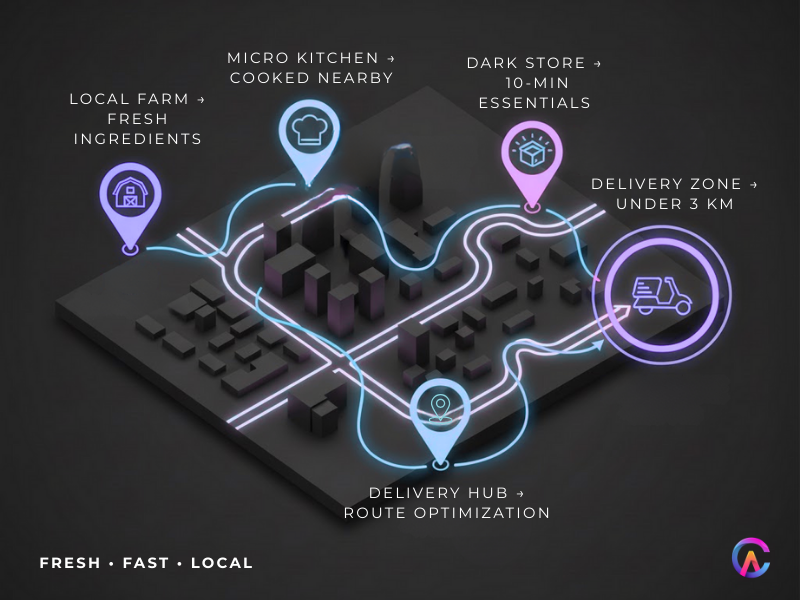
Hyperlocal delivery is all about sourcing, preparing, and delivering food within a tight radius, usually under 3 kilometers. This approach promotes fresh, sustainable, and community focused models.
Defining characteristics include
- Micro Kitchens and Cloud Kitchens: These small neighborhood facilities whip up fresh, hot meals, cutting down on transit time and ensuring food doesn’t go stale
- Local Sourcing Partnerships: By partnering directly with nearby farms, markets, and artisans, these models guarantee peak freshness while supporting local economies.
- Community Aggregators: Platforms that bring together multiple local vendors into a single app, offering a variety of menus all within one delivery area.
- Subscription and Meal Prep Models: Weekly hyperlocal boxes or chef curated meal plans help build customer loyalty and create predictable demand.
- Dark Stores and Quick Commerce: Tiny warehouses stocked for rapid fulfillment of groceries, snacks, and ready meals, often within 10 to 30 minutes.
India is at the forefront of hyperlocal innovation, with companies like Blinkit, Zepto, and Swiggy Instamart achieving delivery times of under 10 minutes thanks to their dense networks of dark stores. In the US, DoorDash and Uber Eats are expanding their hyperlocal services, while in Europe, Gorillas and Flink are focusing on speedy neighborhood deliveries.
Hyperlocal services also thrive on data. AI helps map demand density, optimize rider routes, and personalize offerings based on preferences at the block level, blending global reach with a personal local touch.
Integration Convergence and Broader Impacts
The real future lies in convergence. AI driven kitchens support drone fleets, hyperlocal networks utilize AI for dynamic pricing and rider assignments, and blockchain technology ensures transparency in the supply chain. Sustainability is a key driver, with electric vehicles, drones, and zero waste kitchens significantly reducing carbon footprints.
Economic changes are also on the horizon, with job roles evolving from drivers to drone operators, AI technicians, and local food curators. This shift is accompanied by substantial growth in dark kitchen real estate and logistics technology.
Consumer benefits are significant. Meals are delivered fresher, faster, and more tailored to individual preferences, all while cutting costs and minimizing packaging waste and traffic congestion.
Challenges and Pathways Forward
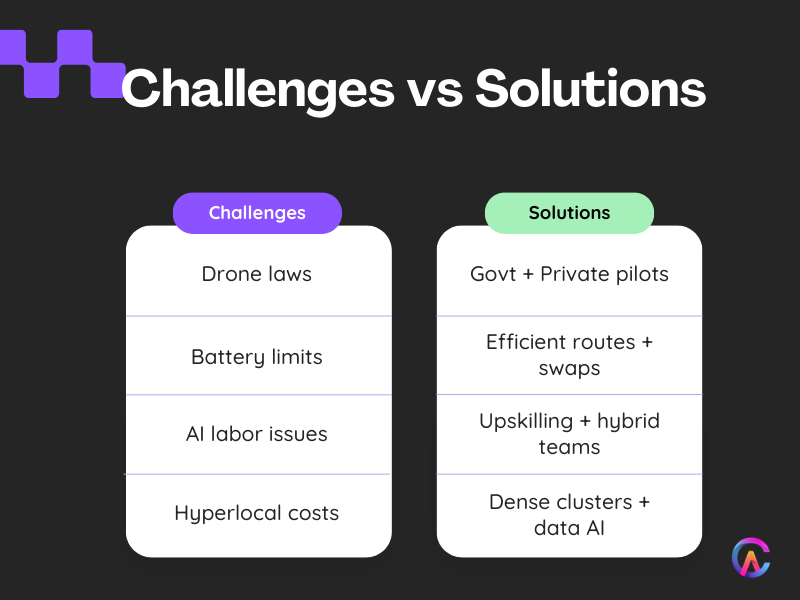
Regulatory challenges, particularly around airspace management and food safety standards, are slowing down the scaling of drones. AI kitchens are facing concerns about job displacement, and hyperlocal models often struggle to be profitable on a smaller scale. The way forward involves public private partnerships, workforce reskilling, and hybrid systems that combine human and AI efforts. Data privacy is also a major concern, as hyper personalization requires careful management of location, dietary, and behavioral data.
How Codearies Powers the Future of Food Delivery
Codearies empowers food businesses, restaurants, and delivery platforms with state of the art technology to excel in the age of AI, drones, and hyperlocal delivery.
Our comprehensive support includes
- AI Kitchen Orchestration: Tailored software that integrates robotics, inventory management, AI driven menu optimization, and quality control systems.
- Drone Delivery Integration: Comprehensive platforms that link drone fleets with order management, dispatch, and customer tracking.
- Hyperlocal Platform Development: Scalable applications, dark store networks, and rider optimization for deliveries in under 15 minutes.
- Data Analytics and Personalization: Machine learning tools for demand forecasting, personalized recommendations, and operational insights.
- Sustainability Tech: Route optimization, electric vehicle fleets, and zero waste tracking.
- Full Stack Implementation: From MVP pilots to large scale deployments, complete with training and ongoing optimization.
Join forces with Codearies to launch, deploy, and scale the next generation of food delivery solutions that not only satisfy customers but also lead the market.
Frequently Asked Questions
Q1: How can Codearies help startups enter the AI kitchen space?
We offer complete robotic integration software development and AI optimization, cutting the time to launch by 50%.
Q2: Are drone deliveries ready for widespread food use?
Yes, in approved areas with growing capabilities. We seamlessly integrate compliant drone systems with your current platform.
Q3: What makes hyperlocal delivery more profitable than broad delivery?
Shorter routes mean lower costs, fresher food, and higher order values driven by neighborhood loyalty, resulting in better economics
Q4: Can Codearies customize for specific cuisines or regions?
Absolutely! Our AI tailors itself to local tastes, dietary needs, and cultural preferences for a truly authentic and personalized delivery experience.
Q5: How does Codearies ensure sustainability compliance?
We incorporate carbon tracking, EV optimization, and waste reduction into every solution, ensuring we meet global green standards.
For business inquiries or further information, please contact us at