
Layer 1 blockchains are the backbone of Web3, taking care of essential tasks like consensus security and transaction processing for everything built on top of them. Over the last ten years, they’ve transformed from slow, experimental networks into high performance, multi chain ecosystems that balance three key goals: speed, security, and scalability. This transformation is changing the way dApps are created, how users interact with crypto, and how businesses view blockchain adoption.
From first generation chains to a multichain world
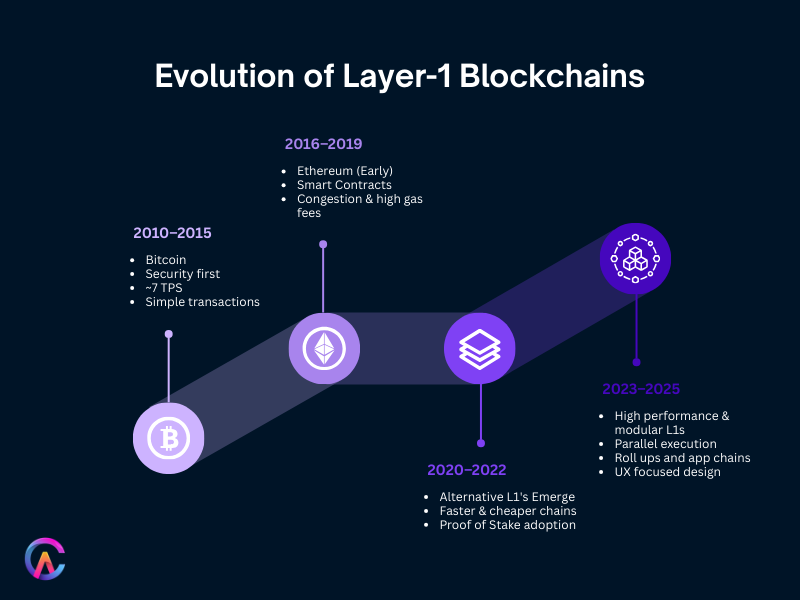
In the early days, layer 1s mainly prioritized security and decentralization, often sacrificing speed and user experience in the process. Bitcoin demonstrated that decentralized digital money was feasible, but it could only handle a limited number of transactions per second. Ethereum introduced programmable smart contracts but soon faced congestion during peak times, resulting in high fees and sluggish confirmations.
By the mid 2020s, this congestion led to fragmentation, as users and developers began moving away from overloaded networks to alternative layer 1s that offered better throughput and lower costs. Reports on crypto adoption highlight that this congestion and migration trend is a major factor driving the rapid growth of new base layer networks and their accompanying ecosystems. Meanwhile, established chains have been upgrading their architectures, focusing on innovations like staking, sharding, and rollups to scale up without compromising security.
Today, the layer 1 landscape is bustling with contenders, including Ethereum, Solana, BNB Chain, Avalanche, Cosmos based zones, Cardano, and a host of newer players, each carving out their own unique niches and trade offs.
The speed dimension how layer 1s got faster
Throughput and latency are super important for user facing applications like trading, gaming, payments, and social apps. A bunch of technical strategies have popped up to tackle these challenges.
Optimized consensus mechanisms
Instead of relying on the energy hungry proof of work, many modern Layer 1s have shifted to proof of stake or its variations, like delegated proof of stake and leader based protocols. These newer mechanisms help reduce block times and enhance finality while also cutting down on energy use. Guides on Layer 1 architectures for 2025 highlight the move towards faster BFT style consensus to better support consumer scale decentralized applications.
Parallel execution and VM design
Some blockchain networks have introduced parallel transaction execution and more efficient virtual machines, allowing them to process multiple transactions at the same time, as long as they don’t interfere with each other. This method enables order book style decentralized exchanges, gaming, and microtransactions to operate at much higher volumes than what earlier chains could handle.
Native support for high throughput
Networks like Solana, Avalanche based subnets, and certain application specific Layer 1s are designed with highly optimized networking and block propagation layers. Overviews of leading Layer 1 projects in 2025 emphasize these performance driven architectures as a major advantage for high frequency DeFi and real-time applications.
The bottom line is that while older chains might only handle tens of transactions per second, many of today’s Layer 1s boast the ability to manage thousands or even more under ideal conditions, opening the door to use cases that would have seemed impossible on chain before.
The security dimension decentralization and resilience
Security is absolutely essential for any base layer. As the value secured by Layer 1s increases, the temptation for attacks also rises. This evolution has several important facets.
Staking and Economic Security
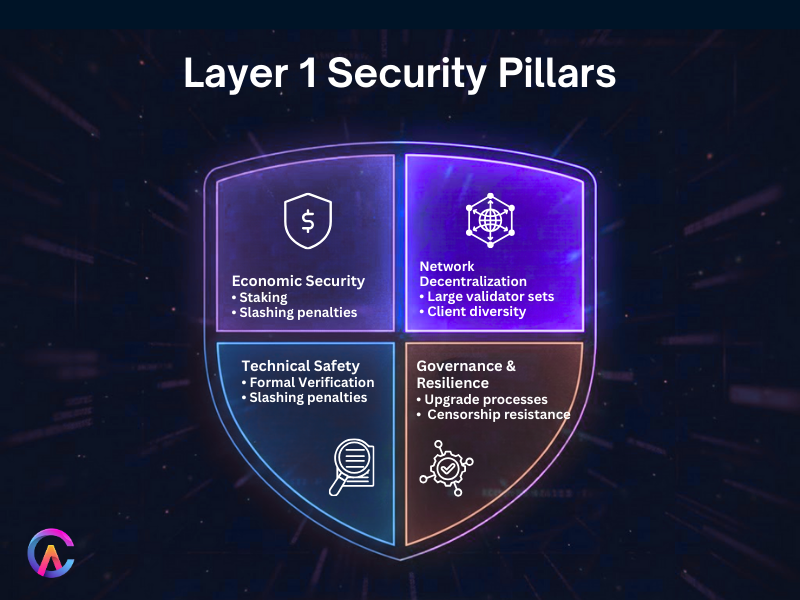
Layer 1s that use proof of stake link their network security to the value of staked tokens and penalize validators who misbehave. The strength of this model hinges on how well the stake is distributed, the incentives for validators, and the design of governance.
Client Diversity and Decentralization
Strong networks promote a variety of independent node implementations and a broad set of validators, which helps minimize the risk of bugs in a single client or collusion. Industry experts emphasize that censorship resistance and credible neutrality remain crucial reasons why developers favor certain Layer 1s, even if they offer slower raw throughput.
Formal Verification and Safer Languages
Some ecosystems pour resources into developing smart contract languages and frameworks that can be formally verified to reduce security risks. Others prioritize toolchain audits and runtime protections to mitigate the impact of contract bugs.
While performance focused chains sometimes get flak for their hardware requirements or validator concentration, many are working on light clients, cryptographic proofs, and protocol level safeguards to enhance decentralization over time.
The scalability dimension layer 1 versus modular architectures
Scalability goes beyond just raw transactions per second (TPS), it’s about maintaining global usage without compromising decentralization or incurring high costs. Currently, two main approaches are coexisting.
Monolithic High Performance Layer 1s
These chains strive to manage most activities on a single base layer, optimizing every component of the stack for maximum throughput. Their advantage lies in their simplicity and powerful composability, as everything exists within one global state. However, their challenge is to ensure long term decentralization as hardware demands continue to rise.
Modular and rollup centric ecosystems
When we talk about modular and rollup centric ecosystems, it’s interesting to see how different designs tackle scalability. Some approaches push scalability to secondary layers, allowing the base layer to concentrate on security and data availability. In this setup, rollups, sidechains, and app chains take care of execution while settling back to the main layer (L1). Various policy and technical papers highlight this modular strategy as a way to achieve internet scale usage without burdening every node with the task of processing every single transaction.
Looking ahead, the landscape is shaping up to be quite hybrid. Some ecosystems are building rollups on top of established L1s, while also trying out high performance, app specific base layers tailored for specific sectors like gaming or DeFi.
UX tools and developer experience in modern layer 1s
The growth of an L1 ecosystem really hinges on how easy it is for teams to develop and for users to get on board. Here are some current trends making waves:
Better SDKs and frameworks: L1 platforms are rolling out language SDKs, templates, and higher level frameworks that simplify the process by taking care of the boilerplate and low level details. This allows teams to zero in on product logic instead of getting bogged down in protocol plumbing.
Wallets and account abstraction: Enhanced wallets, gas fee abstractions, and social recovery options are making it less daunting to interact with L1s. Some designs even allow gas fees to be sponsored or paid in various tokens, which is a game changer for mainstream dApps.
Indexing and data tooling: With analytics dashboards, indexers, and API services, raw blockchain data is transformed into usable feeds for products. As L1 ecosystems evolve, these off chain services are becoming just as crucial as on chain components for boosting developer productivity.
Thanks to these advancements, businesses no longer need to have deep protocol expertise to launch functional apps on a base layer network.
How businesses choose between layer 1 options
When it comes to choosing among the many viable Layer 1 blockchains, the real question isn’t whether to use blockchain technology, but rather which stack aligns best with your specific use case. Here are some typical factors to consider:
- The volume of transactions and how quickly they need to be processed
- The maturity of regulations and ecosystems in the relevant region or industry
- The availability of developer talent and the tools that support the preferred programming languages
- The security history, level of decentralization, and economic incentives of the blockchain
- The existing liquidity and user base on that chain, especially for DeFi, NFTs, or gaming projects
Recent reports highlighting the top Layer 1s to keep an eye on point out that many teams are adopting a multi chain approach right from the start. They’re deploying their core logic where security and liquidity are at their strongest, while leveraging performance chains or app chains for specific features.
How Codearies helps you navigate and build on modern layer 1 blockchains
Codearies partners with startups and enterprises eager to harness the power of layer 1 blockchains without getting bogged down by the complexities of various protocols.
What Codearies typically does
Architecture and chain selection
- We assess your use case, including throughput requirements, regulatory considerations, and user demographics.
- We recommend the most suitable layer 1 blockchains or modular stacks and, when necessary, design a multi chain or app chain strategy.
End to end dApp and protocol development
- Our team builds smart contracts and on chain logic, adhering to best practices for security, performance, and upgradability.
- We create user friendly frontends and mobile applications that minimize blockchain friction for everyday users.
- We integrate wallets, payment systems, and account management tailored to each specific layer 1.
Security scalability and monitoring
- We conduct thorough testing and collaborate with auditors to reduce contract risks.
- We design for horizontal scalability, utilizing layer 1 features or rollups as needed.
- We establish observability dashboards to track usage, costs, and anomalies across different chains.
Ecosystem integration and growth
- We connect your product to existing DeFi liquidity, NFT markets, or identity systems on the selected layer 1s.
- We assist with partnerships, grants, and listing strategies within those ecosystems
In a nutshell, Codearies helps you choose the right foundational layer for your objectives and delivers production ready applications that truly leverage the strengths of that blockchain.
Frequently asked questions
Q1: How do we decide which layer 1 blockchain to use for a new project?
Start by considering your performance needs and the audience you’re targeting. If you’re diving into high value DeFi, security and ecosystem liquidity are crucial. On the other hand, for real time gaming or social applications, speed and transaction fees take precedence. At Codearies, we conduct a thorough discovery process to weigh your options and often suggest a mix of chains instead of sticking to just one.
Q2: Is it still worth building directly on a layer 1 if rollups and app chains are on the rise?
Absolutely, Base layers are still essential for settlement security and core liquidity. Many successful projects keep their critical logic and assets on an L1 while shifting heavy interactions to specialized layers. Codearies designs this split to ensure you benefit from both security and scalability.
Q3: Will one layer 1 dominate, or is the future definitely multichain?
Current trends and ecosystem reports strongly indicate a multichain future, with various L1s and modular stacks catering to specific niches. That’s why Codearies is all about creating portable architectures and tools that make it easier to expand across different chains as time goes on.
Q4: How does Codearies ensure security when working with newer layer 1 networks?
We stick to conservative design patterns, conduct independent testing, implement strong access controls, and, whenever possible, engage third party audits. For less proven L1s, we keep critical assets on more established chains and treat the newer networks as layers for execution or experimentation.
Q5: Can Codearies assist in migrating an existing project from one layer 1 to another?
Definitely, Migration is a frequent request we handle. We strategize token bridges, redeployments, data migration, user communication, and liquidity bootstrapping to ensure your community can transition smoothly with minimal friction and risk.
For business inquiries or further information, please contact us at