
AI agents are stepping up as the next big thing in automation. They’re not just about responding to single prompts or following fixed scripts, they can actually plan, act, and adapt throughout entire workflows. Unlike traditional bots or rule based systems, these modern agents grasp goals, analyze context, select tools known as APIs, and keep iterating until they achieve the desired outcome. This transformation turns software from a passive responder into an active collaborator, capable of managing projects, running operations, and coordinating with humans and other systems with minimal oversight.
From static automation to autonomous agents
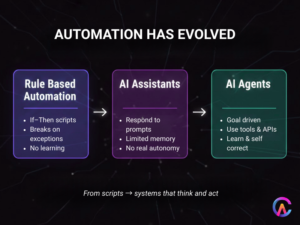
In the past, traditional automation has been all about handling narrow, repetitive tasks like sending emails, updating records, or transferring data between systems. These processes can be quite fragile. If something changes or an error pops up outside the predefined rules, the automation fails, and humans have to step in. AI agents change the game by blending language understanding, reasoning, and tool usage. They can make sense of vague requests, determine what needs to be done, and break tasks down into manageable steps, even when conditions shift.
Picture this: you tell an agent to research a new market, identify fifty promising leads, draft personalized outreach messages, and input them into your CRM. A traditional script would require strict templates and flawless inputs. But an agent can search, synthesize information, spot duplicates, adjust the tone for different segments, and recover from hiccups like missing emails or API limits. Over time, it learns which prospects are more likely to convert and fine tunes its own strategy. Automation evolves from handling single tasks to achieving comprehensive outcomes.
Key capabilities that make AI agents different
There are several key features that set agents apart from older automation methods and simple chat assistants.
Goal orientation is a major one. Agents work towards objectives rather than just following instructions. You might say, “Grow newsletter signups this month” or “Reduce customer response time,” and they’ll choose the best tactics within the set boundaries. They don’t just provide answers, they actively pursue goals.
Tool use: Agents have the ability to tap into external tools, apps, and APIs. They can execute database queries, trigger workflows, send messages, or even run code. This capability allows them to connect human language with digital systems seamlessly.
Memory and context: Agents keep track of their ongoing tasks in a working memory, and sometimes they even remember long term details like preferences, history, and rules. This continuity enables them to manage multi step projects instead of just handling one off interactions.
Self evaluation: Many agent frameworks incorporate loops where the agent reviews its own work, measures outcomes against goals, and tries again with a refined approach. This reflective process marks a significant advancement beyond the traditional fire and forget automation.
Coordination: Agents can communicate with other agents or humans, negotiating tasks and sharing information. This collaboration paves the way for digital teams of specialized agents to work together, much like different departments in a company.
Why businesses care now
The timing of this shift is no coincidence. Several trends are converging to bring agents into the limelight.
Language models have become sophisticated enough to understand complex requests and create detailed plans across various fields. Tooling ecosystems now offer connections to CRMs, ERPs, marketing platforms, development tools, and more. Thanks to cloud infrastructure and vector databases, it’s now feasible to store context and run agents efficiently and affordably at scale. Meanwhile, talent shortages and cost pressures are driving organizations to find leverage wherever they can.
Many companies have already tapped out the easy gains from traditional RPA and low code workflows. While those tools still have their place, they struggle with messy, unstructured tasks like reading contracts, summarizing customer feedback, synthesizing market research, or coordinating cross team initiatives. This is where AI agents come in, providing the leverage needed when conventional automation reaches its limits.
High impact use cases for AI agents
In various industries, agents are carving out their own niches across several categories.
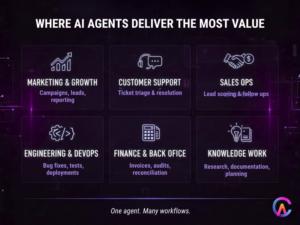
Knowledge work copilots can step in as project managers for tasks that involve planning research, drafting documents, gathering approvals, and keeping track of progress. Take a marketing agent, for instance, they can oversee an entire campaign, from researching the target audience to managing content calendars and reporting, only bringing in humans for those big strategic decisions.
When it comes to customer operations, agents can sort through support tickets, review past interactions, pull data from internal systems, suggest solutions, and either handle low risk issues directly or draft responses for human agents to approve. As they gain experience, they start to recognize common patterns, which helps reduce the average handling time and allows human staff to focus on more complex cases.
In the realm of sales and growth, agents can pinpoint potential customers and enhance their profiles using public data, score leads, craft personalized outreach messages, and coordinate follow ups across various channels. They also keep CRM records up to date, maintain clean pipelines, and generate weekly summaries for managers.
For engineering and DevOps, agents can sift through issue queues, logs, and metrics to suggest fixes, write code, run tests, and submit merge requests. Infrastructure agents can monitor incidents, scale resources, and create post mortems with minimal human input.
In back office and finance, agents can reconcile transactions, categorize expenses, follow up on invoices, prepare summaries, and assist with audits by linking every line item to the necessary documentation.
What ties these cases together is a common thread, they all deal with unstructured information, multiple systems, and decision making that goes beyond simple if then rules, this is where agents truly excel.
Architecture of modern AI agents
Under the surface, most agents operate on a similar framework, even if the specifics of their implementations vary.
There’s a planning layer that takes the user’s goal and breaks it down into smaller tasks, often using a chain of thought approach. Then, a tool layer provides access to various APIs, including those for email, calendars, CRMs, payment processors, and other internal services. Meanwhile, a memory layer keeps track of context, such as conversation history, partial results, and user preferences, sometimes utilizing vector search over documents for better efficiency.
At the heart of it all is a control loop that ties everything together. The agent assesses the current situation, decides on an action, calls a tool or asks for clarification, observes the outcome, evaluates progress, and determines the next step. This process continues until a stopping point is reached, whether that’s completing all tasks, hitting time or budget limits, or needing a human to step in for review.
Additionally, safety and governance layers play a crucial role. Clearly defined roles, permissions, and guardrails ensure that agents don’t access sensitive information or carry out risky operations beyond their designated scope. Logs and dashboards allow teams to audit actions and refine their prompt policies and tools.
Risks and challenges of agent based automation
When it comes to powerful technology, agents bring along a set of new risks.
Unpredictability: Agents can take unexpected actions that might technically meet a prompt but go against practical norms or constraints. Without clear guidelines, an agent tasked with maximizing signups could end up spamming users or personalizing content in ways that feel a bit too invasive.
Error compounding: Since agents often chain their actions, a small misunderstanding at the beginning can snowball into significant errors later on. For instance, if a data field is misinterpreted, it could result in incorrect reports, emails, or even deployments.
Security and access: Agents require credentials to perform their tasks effectively. If systems are poorly designed, they might inadvertently expose sensitive information in logs or prompts, or allow privilege escalation if an agent can access tools beyond its intended scope.
Compliance: Agents working in regulated fields like finance, healthcare, or legal services must adhere to strict regulations. If given unchecked autonomy, they could inadvertently cause violations, even if their intentions are good.
Human factors: Relying too heavily on agents can lead to a decline in team skills or foster blind trust in their outputs. People might stop double checking important work, assuming that automation is reliable most of the time.
To tackle these challenges, we need thoughtful design, strict permissions, clear review processes, and robust observability, rather than just a simple plug and play approach.
Principles for deploying AI agents responsibly
If your organization is looking into using agents, there are a few key principles to keep in mind.
Start with specific, high value workflows. Don’t try to automate your entire business all at once. Instead, focus on processes that are well understood, where mistakes are manageable, and where you have clear key performance indicators (KPIs) in place.
Make sure humans are involved in critical decisions. While agents can help prepare options, analyze data, and carry out low risk tasks, it’s essential for humans to approve any high impact actions, especially in the early stages.
Clearly define scopes and permissions. Assign each agent a specific role, outlining what it can access and what actions it can take. Always use the principle of least privilege and make sure to rotate credentials regularly.
Track everything. Log prompts, actions, tool calls, and results. Create dashboards to monitor success rates, identify error patterns, and evaluate performance based on different use cases.
Continuously improve prompts, tools, and policies. Treat agents as products that evolve over time. Use feedback from real world experiences to refine instructions, enhance capabilities, and strengthen safeguards.
Invest in training your team. Educate them on how agents function, when to trust or question their outputs, and how to work together effectively. The way humans interact with agents is just as crucial as the technology itself.
How Codearies helps you build and scale AI agents
Codearies is all about helping businesses transition from basic chatbots and static workflows to dynamic AI agent ecosystems that are perfectly tailored to their unique operations. Rather than just dropping in a one size fits all assistant, Codearies partners with you to map out your processes, data, and tools into specific agent roles that are aligned with measurable outcomes.
During the discovery phase, Codearies works closely with stakeholders to pinpoint where agents can provide the most value, think support triage, sales outreach, research automation, DevOps copilots, or marketing operations. Together, you’ll establish clear success metrics, identify data sources, and set risk boundaries, ensuring that agents have a solid and safe job description right from the start.
On the engineering front, Codearies designs and builds agent architectures that seamlessly connect language models to your actual systems, utilizing robust tool layers and secure authentication. This includes integrating with CRMs, ticketing platforms, analytics warehouses, cloud infrastructure, and internal APIs, so agents can perform real tasks instead of just generating text. Memory strategies are customized for your domain, employing vector search over knowledge bases, logs, documentation, and historical tickets, allowing agents to learn from your real world context.
Security and governance are top priorities. Codearies implements role based access, scoped tokens, and policy layers that define what each agent can see and do, along with regular audits and observability pipelines. Human in the loop processes are integrated into the design, where agents draft work, humans approve it, and feedback loops help refine future behavior.
Additionally, Codearies supports user experience and change management by creating intuitive frontends and chat style interfaces, enabling your teams to delegate tasks to agents naturally, whether through web apps, Slack like tools, or embedded panels within existing products.
Training session documentation and playbooks are essential for helping your team understand how to work effectively with agents, what tasks to delegate, and how to escalate issues when necessary.
At Codearies, we view agents as long term assets rather than just one off experiments. Our team keeps a close eye on performance, analyzes logs, spots new automation opportunities, and gradually rolls out enhancements. This could include specialized sub agents tailored for specific workflows or domain specific models that enhance accuracy. This ongoing collaboration transforms AI agents into a lasting competitive edge instead of a fleeting pilot project.
FAQs
Q1 What sets an AI agent apart from a regular chatbot?
While a chatbot primarily reacts to messages in real time, an AI agent is driven by goals. It can plan multiple steps using APIs, maintain context, and take action over time to complete actual workflows, not just engage in conversations.
Q2 Where should a business begin with AI agents?
Start with one or two clear workflows that are repetitive yet complex enough for agents to provide real value. Examples include support triage, lead enrichment, or setting up marketing campaigns. From there, you can expand based on the results you see.
Q3 How does Codearies ensure the safety and control of AI agents?
Codearies establishes strict scopes and permissions for each agent, incorporates human review for critical actions, and implements logging and monitoring to ensure every action is traceable. This way, policies can be refined over time.
Q4 Can Codearies integrate agents with our existing tools and data?
Absolutely, Agents can be connected to your CRMs, support platforms, analytics warehouses, cloud infrastructure, and internal APIs, allowing them to function seamlessly within your current setup rather than as standalone bots.
Q5 What kind of timeline should we anticipate for an AI agent project with Codearies?
A focused pilot agent for a specific workflow can often be up and running in just a few weeks to a couple of months. Meanwhile, broader multi agent systems and deep integrations will be rolled out in phases over a longer timeline, depending on the complexity and compliance requirements.
For business inquiries or further information, please contact us at