

Technology in 2026 is all about an AI first approach, where smart agents, interconnected infrastructure, and sustainable engineering are transforming the way we live, build, and grow businesses. The key trends have evolved beyond mere buzzwords, they now work together as systems. AI agents are coordinating tasks, cloud and edge computing are powering operations, secure blockchains are tracking value, and green technology is ensuring everything stays aligned with climate goals.
Here are the top ten technology trends that will shape 2026, along with how Codearies can help companies turn these trends into innovative products and growth.
1 AI agents and autonomous workflows
AI agents are taking traditional AI to the next level, evolving from simple question answering tools into goal oriented digital workers that can plan, act, and coordinate across various applications. Businesses are deploying fleets of specialized agents for support, finance, DevOps, marketing, and operations, seamlessly integrating them with CRMs, ticketing systems, and cloud platforms.
Key points
- These agents understand business objectives and break them down into tasks, calling APIs and looping until everything is completed, rather than just handling one prompt at a time.
- According to Gartner and McKinsey, agentic AI and multi agent systems are emerging as essential strategic trends that will permeate most enterprise stacks by 2026.
- Companies that blend human expertise with AI agents in hybrid teams experience quicker execution, reduced costs, and round the clock operations.
2 Generative AI everywhere
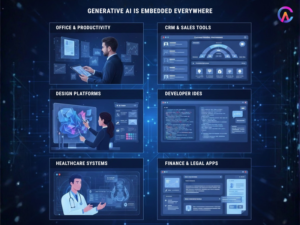
Generative AI is moving from pilot projects to becoming a core part of the infrastructure across content creation, design, coding, and analytics. These tools are now available on devices, in browsers, and within vertical SaaS applications, meaning most users will interact with generative AI through their existing apps rather than standalone models.
Key points
- Generative AI is driving the creation of text, images, videos, and code, all integrated into office suites, CRM tools, design platforms, and developer IDEs.
- Application specific models and domain tuned language models are emerging for sectors like legal, finance, healthcare, retail, and gaming, enhancing accuracy and building trust.
- Companies are making significant investments in AI safety, data governance, and copyright aware tools to leverage generative AI at scale without legal complications.
3 Cloud plus edge computing
Cloud computing continues to be the backbone of AI, but edge computing is making significant strides as models are executed closer to devices, enhancing speed, privacy, and reliability. Companies are now crafting architectures where intensive training takes place in large data centers, while inference and decision making happen on smartphones, vehicles, factories, and IoT devices.
Key points
- According to McKinsey, global demand for data center capacity is expected to grow by about 19 to 22 percent each year through 2030, largely fueled by AI workloads.
- Edge AI helps cut down on latency and bandwidth costs, enabling predictive maintenance, real time monitoring, and offline capabilities in sectors like manufacturing, automotive, and healthcare.
- Hybrid cloud and edge computing patterns are becoming the go to reference architectures for CIOs looking to implement AI on a large scale.
4 Advanced connectivity 5G and early 6G
Advanced connectivity through mature 5G private cellular networks and early research into 6G is laying the groundwork for many trends expected in 2026, connecting sensors, robots, vehicles, and AR devices. Network slicing and satellite connectivity are helping to provide high quality coverage even in remote areas.
Key points
- 5G private networks are being deployed across factories, ports, hospitals, and campuses, allowing for low latency control of machinery and mission critical IoT applications.
- Research into 6G is concentrating on AI driven network management, ultra high bandwidth, and the integration of digital twins for smart cities and enhanced mobility.
- Satellite to smartphone services are bridging the last mile connectivity gaps, making the dream of global, always on connectivity a more achievable reality for both consumers and businesses.
5 Cybersecurity digital trust and provenance
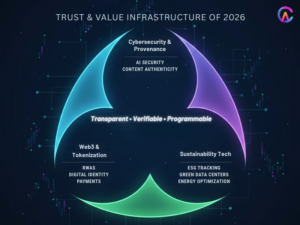
In today’s world, as AI and connectivity grow, so does the potential for cyberattacks, making cybersecurity and digital trust technologies top priorities for boards. Organizations are now embracing confidential computing, AI driven threat detection, and digital provenance systems to ensure the authenticity of their data and content.
Key points
- According to Gartner, digital trust, cyber resilience, and digital provenance are among the essential strategies for safeguarding enterprise value in an AI driven future.
- AI powered security tools can sift through logs, emails, and network flows on a large scale, spotting anomalies much quicker than traditional human only SOC teams.
- Techniques like cryptographic proofs, watermarks, and on chain records play a crucial role in verifying the origins of data models and media, helping to mitigate risks associated with deepfakes and fraud.
6 Decentralized and digital trust technologies Web3 and tokenization
Decentralized tech is evolving beyond mere speculation, as blockchains now facilitate identity verification, payments, DeFi, and asset tokenization across finance, supply chains, and media. Real world asset tokens, utility tokens, and digital identity solutions are establishing ownership and provenance in multi cloud, multi agent environments.
Key points
- The tokenization of real world assets, ranging from treasuries to real estate and carbon credits, is becoming a significant trend in institutional finance and infrastructure.
- Utility tokens and stablecoins are the backbone of many payment and loyalty systems, connecting Web2 applications with Web3 frameworks.
- Companies are looking into permissioned or hybrid blockchain solutions that maintain compliance while reaping the benefits of programmability and transparency.
7 Robotics 2.0 and physical AI
Robotics is stepping up its game by merging with AI sensors and computer vision, making it possible to automate more intricate tasks across warehouses, factories, retail spaces, and healthcare settings. Now, cobots and autonomous mobile robots are teaming up with humans, moving beyond just working in isolation.
Key points
- Physical AI empowers robots to sense their surroundings, grasp tasks, and adjust to new situations rather than sticking to strict scripts.
- Robotics 2.0 platforms offer modular automation cells that can be easily reconfigured for new products, which helps cut down on capital expenditures and speeds up deployment.
- Drones and robots are becoming essential in logistics, inspection, agriculture, and emergency response as regulations and safety systems continue to evolve.
8 Digital twins simulation and immersive tech
Digital twins and simulation technology are revolutionizing how we model products, factories, supply chains, and even entire cities in virtual spaces before any changes are made in the real world. When paired with immersive tools like AR, VR, and 3D visualization, they provide operators with a real time cockpit for managing complex systems.
Key points
- Businesses are leveraging digital twins to enhance energy efficiency, anticipate failures, and explore various scenarios in manufacturing and utilities.
- AR assisted workflows are helping technicians and warehouse staff by providing contextual instructions, which cuts down on errors and reduces training time.
- Smart city and mobility initiatives are using simulations to plan for traffic, infrastructure, and climate resilience strategies before allocating real world budgets.
9 Biotech health tech and human augmentation
The world of biotech and digital health is rapidly evolving, thanks to AI driven advancements in drug discovery, personalized medicine, and remote care platforms. Wearable devices and implants are continuously gathering data, which feeds into models that help manage chronic diseases and enhance performance.
Key points
- AI models are revolutionizing drug discovery, slashing timelines from years to just months by screening compounds and simulating interactions in a virtual environment.
- Telehealth platforms are seamlessly integrating diagnostics, wearables, and electronic health records to ensure continuous patient management and proactive care.
- The intersection of biotech with ethics and privacy is becoming increasingly significant as gene editing, brain computer interfaces, and the monetization of bio data gain traction in mainstream discussions.
10 Sustainability tech and future of energy
Sustainability technologies are shifting from mere talking points in corporate social responsibility to essential investment themes as companies work to decarbonize their supply chains, processes, and data centers. Innovation is thriving in areas like energy storage, smart grids, carbon accounting, and climate resilient materials.
Key points
- McKinsey is integrating climate tech and energy transformation into a broader trend focused on the future of energy and sustainability, which encompasses renewables, grid optimization, and electrification.
- ESG data platforms and IoT sensors are playing a crucial role in tracking emissions across factories, logistics, and products, enabling reliable sustainability reporting.
- As the demand for AI power surges, green computing and efficient data centers are becoming key differentiators, especially as regulators begin to scrutinize energy footprints more closely.
How Codearies helps you build on 2026 technology trends
Codearies is all about teaming up with startups and enterprises to transform big trends into real products, platforms, and revenue streams, no more just fancy presentations. With a solid background in AI, Web3 app development, and digital product strategy, Codearies serves as a powerhouse for innovative ideas.
How Codearies supports your 2026 roadmap
- AI agents and automation
At Codearies, we create tailored AI agents that enhance operations, boosting sales and analytics by seamlessly integrating with your existing SaaS tools, APIs, and data warehouses. This means you can expect real productivity improvements. - Web and mobile products on modern stacks
Our teams are dedicated to crafting fast, secure web and mobile applications that incorporate generative AI features, real time connectivity, and user friendly designs, all set for global scalability. - Web3 and tokenization
Codearies specializes in designing and implementing smart contracts, tokens, DeFi integrations, and digital identity layers for utility tokens, real world asset projects, loyalty ecosystems, and transparent supply chains. - Cloud edge and integrations
We guide you in selecting and implementing the perfect blend of cloud, edge, and connectivity solutions, building APIs, microservices, and data pipelines that can support AI agents, robotics, or IoT deployments. - End to end product strategy
From brainstorming and market research to design, development, launch, and iteration, Codearies organizes projects to ensure they ship quickly, align with your business goals, and remain flexible as trends evolve in 2026.
By merging deep technical expertise with insights into AI, automation, Web3, and sustainability, Codearies empowers you to not just keep pace with the leading technology trends of 2026 but to leverage them for a competitive edge.
FAQs
Q1 What is the single most important technology trend for 2026?
AI, particularly AI agents, stands out as the key trend because it enhances nearly every other field, from cloud computing and robotics to cybersecurity, biotech, and energy optimization.
Q2 How can a non tech business benefit from these trends?
Even businesses that aren’t tech focused can leverage AI agents for customer support, automate back office tasks, utilize data driven digital twins for their operations, or implement tokenized loyalty and payment systems to boost efficiency and engagement.
Q3 Where does Codearies usually start with a new client?
Codearies typically kicks things off with a discovery and strategy phase, aligning your goals and constraints with specific initiatives in AI, Web3, or app development. They then prioritize a pilot project that can show tangible results in just a few months.
Q4 Can Codearies handle both AI and Web3 work in the same project?
Absolutely, Codearies excels at integrating AI with Web3 and modern app stacks. For instance, they can create AI powered DeFi dashboards, tokenized platforms with recommendation engines, or smart workflows that trigger on chain actions.
Q5 How future proof are solutions built around these 2026 trends?
While no solution is everlasting, Codearies builds on open standards, modular architectures, and widely accepted ecosystems. By designing for continuous iteration, they ensure your products can adapt as AI infrastructure, connectivity, and digital trust technologies evolve.
For business inquiries or further information, please contact us at