
Utility tokens are gearing up for 2026, poised to become the driving force behind real world crypto adoption. They’re transforming blockchains from mere speculative playgrounds into robust platforms that facilitate payments, identity verification, supply chains, advertising, gaming, and AI infrastructure. Instead of just gathering dust in wallets, utility tokens are now intricately woven into products, where they handle fees, unlock features, reward users, and secure networks across finance, logistics, media, and Web3 applications.
Let’s take a closer look at what defines a top utility token in 2026, which projects are making waves with real world applications, and how Codearies is helping founders create and launch impactful utility token ecosystems
What makes a top utility token in 2026
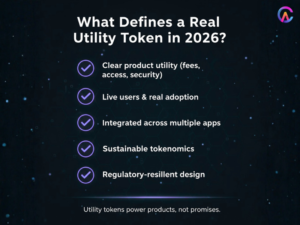
Not every token with a whitepaper can claim the title of a top utility token. The standout tokens of 2026 share several key traits that set them apart from the noise. Analysts and industry experts have pinpointed these characteristics among their top picks.
Key characteristics
- Clear core utility
A top utility token has a clear purpose within its product, whether that’s covering gas fees, securing the blockchain, enabling governance, or purchasing specific services, no vague promises about the future here. - Real user adoption
These tokens have real users and partners actively utilizing them for payments, staking, or accessing services, rather than just traders speculating on centralized exchanges. - Strong ecosystem integrations
A leading utility token is integrated across various applications, partnerships, or enterprise deployments, making it part of a larger ecosystem rather than a standalone dApp. - Sustainable Tokenomics
The tokenomics are designed to prevent runaway inflation, featuring emissions burn mechanics and fee flows that reward long term usage instead of just catering to early airdrop hunters. - Regulatory and narrative resilience
The design emphasizes utility over unregistered profit promises, aligning with the emerging frameworks for classifying tokens into utility, security, stablecoin, and real world asset categories.
With this perspective, let’s explore some of the most significant utility tokens with real world applications to keep an eye on in 2026 across various sectors.
BNB powering one of the largest ecosystems
BNB started out as a simple discount token for trading fees, but it has since transformed into a powerhouse for one of the most dynamic multi chain ecosystems. This includes the BNB Smart Chain, BNB Beacon Chain, and an expanding Web3 stack. It blends the features of both currency and utility tokens, serving purposes like gas fees, staking, participation in launchpads, and making payments across thousands of decentralized applications (dApps).
Why BNB matters in 2026
- Core utilities
BNB plays a crucial role in transaction fees for DEX swaps on the BNB Smart Chain, staking, validator delegation, launchpad allocations, and even offers fee discounts within the Binance exchange ecosystem. - Real world and Web3 reach
You’ll find that merchants, Web3 games, and DeFi protocols readily accept BNB, while the chain itself boasts a significant portion of global on chain users, making it a go to option for many new projects. - Ecosystem effect
With a robust array of tools, wallets, centralized exchange (CEX) support, and developer infrastructure, BNB stands out as one of the easiest tokens to integrate for payment solutions and access features.
For builders, BNB is a shining example of how a token can evolve from a one dimensional discount coin into a versatile utility asset within a thriving ecosystem.
Ethereum ETH the programmable money standard
ETH is often seen as a blue chip asset, but it’s also one of the most crucial utility tokens out there. Why? Because it’s needed to pay gas fees and interact with smart contracts throughout the Ethereum ecosystem. As rollups and Layer 2 solutions grow, ETH continues to play a vital role in settling transactions and securing the network.
Why ETH is still a top utility token
- Gas and settlement
Every transaction on Ethereum requires ETH as gas, making it indispensable for DeFi, NFTs, and a multitude of dApps, even when those interactions occur through rollups that eventually settle back on Ethereum. - Collateral and staking
ETH helps secure the network through proof of stake and serves as high quality collateral in lending protocols, derivatives markets, and restaking products. - Composability
Since Ethereum is the primary settlement layer for many protocols, ETH is intricately woven into the fabric of DeFi, Web3 infrastructure, and real world asset tokenization.
ETH exemplifies how a native gas token with substantial liquidity can become the cornerstone of an entire smart contract economy.
VeChain VET enterprise supply chains and sustainability
VeChain’s VET token stands out as one of the most reliable enterprise focused utility tokens, with applications in supply chain traceability, carbon tracking, and compliance. VeChain ToolChain enables businesses to implement use cases without needing extensive blockchain knowledge, while VET and its associated tokens facilitate transactions and promote data integrity
Why VET is compelling in 2026
- Real world deployments
VeChain has partnered with major players like Walmart China, BMW, Renault, DNV, and San Marino to track food supply chains, vehicle maintenance, ESG reporting, and national carbon credit initiatives. - Utility in logistics and compliance
VET anchors data authenticity, rewards ecosystem participants, and covers operational costs on the VeChainThor blockchain. - Sustainability narrative
As ESG requirements become more stringent, tokens that effectively track emissions and compliance data are drawing interest from both enterprises and regulators.
VET illustrates that utility tokens can support real supply chain events and government programs, not just digital transactions.
Basic Attention Token BAT fixing digital advertising
BAT is integrated into the Brave browser and stands out as a prime example of a utility token that transforms the digital advertising and attention industry. It rewards users for engaging with privacy focused ads, ensures fair compensation for publishers, and allows advertisers to run campaigns with clear metrics.
Why BAT still matters
- User rewards
Brave users can earn BAT by choosing to view ads, turning their attention into a valuable resource that they control. - Payments and tipping
Users have the option to tip YouTubers, bloggers, and websites directly in BAT through Brave Rewards, supporting creators without the need for invasive tracking. - Advertiser use
Big names like Amazon, Verizon, and various crypto companies have launched campaigns paid for in BAT, creating a dynamic ad economy.
BAT demonstrates that by tokenizing attention, we can establish a new value loop for users, advertisers, and creators, all while prioritizing privacy.
Stellar XLM utility in payments and remittances
XLM serves as the native utility token for the Stellar network, which is designed for quick and affordable cross border transactions. It helps prevent spam, sets base reserves, and facilitates path payments and asset issuance.
Key real world use cases
- Cross border banking infra
IBM World Wire utilized Stellar to transfer value across more than fifty countries, assisting banks in developing faster remittance systems. - Retail remittances
MoneyGram has integrated USDC on Stellar, allowing users to move funds on chain and cash out at over thirty thousand locations worldwide. - Humanitarian aid
The UNHCR employed Stellar wallets to deliver over ten million dollars in aid to Ukrainian refugees, showcasing how utility tokens and stablecoins can distribute relief more effectively.
XLM is a compelling example of a utility token that is quietly driving real cross border payments and humanitarian initiatives.
Emerging high utility tokens to watch
Beyond the well known names, there are several emerging tokens in 2026 that are all about deep utility in AI DeFi and cross chain infrastructure.
Some notable patterns
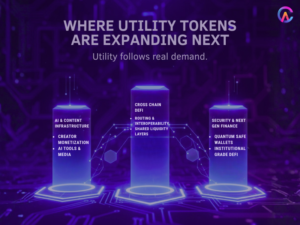
- AI and content infra
Tokens like SUBBD and VFX are making waves in 2026, focusing on AI content generation, creator monetization, and Web3 video VFX tool stacks. - Cross chain DeFi infra
Tokens such as LiquidChain (LIQUID) are aiming to be the go to fee and governance asset for cross chain DeFi infrastructure, connecting ecosystems like Bitcoin, Ethereum, and Solana. - Quantum secure and next gen finance
Tokens like BMICai are funding quantum secure wallets, staking, and payment architectures, specifically targeting users and institutions that prioritize security
These early stage projects are paving the way for future utility, linking blockchains to AI, secure hardware, and multi chain routing.
How Codearies helps you build real utility tokens not just hype
Codearies is all about helping founders and businesses create and launch utility tokens that genuinely power real products, rather than just jumping on the bandwagon of fleeting speculative coins. In a landscape where analysts and regulators are increasingly on the lookout for tangible use cases and clear roles for tokens, Codearies zeroes in on utility architecture and long term sustainability.
What Codearies brings to utility token projects
Deep utility and product mapping
At Codearies, we collaborate closely with your team to pinpoint exactly where the token fits into your product, whether it’s for payments, gas, access tiers, loyalty, staking, governance, or data usage. This way, every action tied to the token delivers real value to users and aligns with clear KPIs.
Secure token and dApp development
Our engineers at Codearies are dedicated to building audited token contracts, staking modules, fee logic, and access control that integrate seamlessly into your applications on Ethereum, EVM chains, or next gen L1s. We adhere to best practices for security and upgradeability to ensure everything runs smoothly.
Real world integration patterns
Taking inspiration from successful examples like VeChain, BAT, Stellar, and BNB ecosystems, Codearies crafts flows that connect tokens to off chain events, payments, identity, and partner systems. This approach allows you to demonstrate tangible utility to users, investors, and regulators alike.
Compliance aware design
While legal counsel handles classifications, Codearies takes care of the technical aspects to support a utility first narrative. We separate revenue sharing when necessary, log usable data for reporting, and support KYC, KYB controls, or geo restrictions for regulated deployments.
Analytics and iteration
Once your token is launched, Codearies assists you in tracking token velocity, retention, staking behavior, and real usage. We then iterate on incentives and user experience, ensuring your utility token remains a vital part of your ecosystem as it grows into 2026 and beyond.
With our support, your token can transform into a high utility asset that makes it onto future watch lists by addressing real challenges, rather than just spinning a tale.
FAQs
Q1: What makes a utility token worth keeping an eye on in 2026?
A utility token that stands out has clear product functions, real users, partners, and transactions, along with sustainable tokenomics and integrations that tie it to real world industries like payments, supply chains, advertising, or AI tools.
Q2: Are tokens like BNB, ETH, BAT, and VET still relevant, or is it all about the new presales?
Established tokens with proven use cases and enterprise integrations, such as BNB, ETH, BAT, and VET, continue to be essential because they already support real networks. Meanwhile, a handful of new tokens are carving out value in emerging niches like AI and cross chain infrastructure.
Q3: How can Codearies help my project evolve into a genuine utility token story?
Codearies assists in designing tangible utilities, building smart contracts and dApps, integrating tokens into user experiences and partner flows, and refining tokenomics so your project can showcase the same kind of real world traction seen in leading utility tokens.
Q4: Which chains does Codearies suggest for launching utility tokens?
The best choice depends on your target audience and use case, but Codearies typically collaborates with Ethereum, BNB Chain, Polygon, Solana, and other EVM compatible or high performance L1s, selected based on fees, ecosystem depth, and
Q5 How long does it take with Codearies to go from idea to live utility token?
A focused project with clear utilities can move from design to deployed and integrated token in a few months while more complex ecosystems with staking governance multichain bridges and real world integrations follow a phased roadmap across multiple releases.
For business inquiries or further information, please contact us at