
Early 2026 is gearing up to be a crucial year for the crypto world, with institutional capital flowing into ETFs and real world applications changing the landscape of which coins truly matter. Instead of getting caught up in every new meme, serious investors and builders are honing in on a select group of cryptocurrencies that boast robust networks, clear narratives, and increasing adoption across DeFi, payments, Web3, and tokenization.
Here’s a look at key categories and the top cryptocurrencies to keep an eye on, along with how Codearies supports founders in these ecosystems. Remember, this isn’t investment advice, always do your own research and manage your risks.
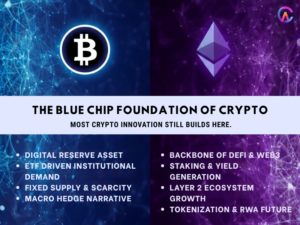
Bitcoin and Ethereum the blue chip foundation
Bitcoin and Ethereum continue to be the backbone of the market, influencing nearly every other crypto trend in 2026.
Bitcoin BTC
- Digital reserve asset
Many analyses still regard Bitcoin as the market’s bellwether, holding about sixty percent of the total crypto market cap and enjoying strong institutional demand through spot ETFs. - Institutional flows and supply squeeze
Reports indicate that ETFs are set to absorb more than one hundred percent of new BTC supply, while exchange reserves are hovering near multi year lows, reinforcing the long term hold narrative. - Macro positioning
With central banks easing liquidity and a more crypto friendly policy stance in the U.S. for 2026, BTC is positioned as a prime risk asset and a hedge in many investment portfolios.
Ethereum ETH
- Backbone of Web3
Ethereum remains the foundational layer for DeFi, NFTs, DAOs, and tokenization, supported by the largest developer community in the crypto space. - Staking and L2 growth
Following the proof of stake upgrades, staking yields are transforming ETH into a yield bearing asset, while rollups like Arbitrum and Optimism enhance throughput and draw more activity into the Ethereum ecosystem. - Institutional narrative
Outlook reports suggest that Ethereum based real world asset tokenization and staking ETFs will be significant catalysts in 2026.
High performance smart contract L1s Solana Avalanche and Sui
Fast Layer 1s that prioritize user experience and consumer applications are set to be a major focus in 2026, as chains lacking real users are likely to fade away.
Solana SOL
- Consumer and DeFi chain
Solana stands out as a lightning fast blockchain geared for mass adoption, offering incredibly quick and affordable transactions that are boosting NFT gaming, DeFi, and mobile centric applications. - Institutional validation
With the CME launching SOL futures and options, along with a growing interest in ETFs, it’s clear that institutional confidence in Solana is on the rise following its resurgence in 2025.
Avalanche AVAX
- Custom chains and tokenization
Avalanche is making waves in various 2026 predictions as a frontrunner in custom blockchains and tokenization subnets tailored for enterprises and institutions. - Real world assets
Its ability to create specialized subnets aligns perfectly with the current trends in institutional RWA tokenization and regulated DeFi, driving this cycle forward.
Sui SUI
- New generation performance chain
Sui is gaining attention as one of the top coins to watch, thanks to its object centric design and a strong push from developers in the DeFi gaming and consumer dApp space. - Growing ecosystem
With its modular architecture and strategic partnerships, Sui is positioning itself as a serious player in the high TPS Layer 1 arena.
Scaling Ethereum Polygon and Arbitrum
Layer 2 and scaling focused projects are becoming increasingly vital as demand for Ethereum continues to rise.
Polygon POL formerly MATIC
- Scaling Ethereum for the world
Polygon consistently appears on 2026 watch lists as a leading platform for scaling and building ecosystems for mainstream brands, DeFi, and Web3 gaming. - Enterprise and brand adoption
Collaborations with major brands, along with advancements in zk rollups, reinforce the idea that Polygon will remain essential in bridging Web2 to Web3.
Arbitrum ARB
- Leading L2 for DeFi
Arbitrum is recognized as one of the top Ethereum Layer 2 solutions, thanks to its significant DeFi adoption, Ethereum’s security, and lower transaction costs. - DAO influence
With a substantial DAO treasury and a strong governance role, ARB is a token to keep an eye on for ecosystem coordination and governance.
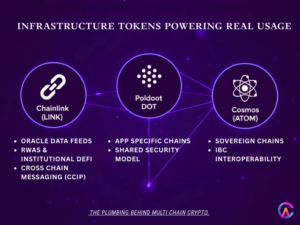
Interoperability and data Chainlink Polkadot and Cosmos
Connecting data and applications across different chains is essential as the ecosystem becomes more fragmented with multiple chains.
Chainlink LINK
- Real world data bridge
Chainlink is often highlighted as a utility token to keep an eye on because it secures oracle data feeds for DeFi, real world assets (RWAs), insurance, and more. - CCIP and tokenization
With the Cross Chain Interoperability Protocol and partnerships in RWA tokenization, LINK is positioned right at the intersection of institutional DeFi and on chain finance.
Polkadot DOT
- Interoperability at scale
Polkadot is making waves in 2026 as a leading multi chain framework, featuring parachains and shared security for specialized blockchains. - Modular future
Its long term vision of connecting numerous app specific chains through a central relay aligns perfectly with trends in institutional tokenization and modular stacks.
Cosmos ATOM
- Internet of blockchains
Cosmos is all about sovereign chains linked through IBC, boasting a modular architecture that optimizes zones for DeFi, gaming, and infrastructure. - Interchain expansion
As more projects embrace IBC and app chains, the ATOM and Cosmos ecosystem continue to play a pivotal role in the interoperability narrative.
Payments stablecoins and real world value
Stablecoins and payment focused networks are emerging as one of the most significant structural trends heading into 2026, as they evolve into the internet’s dollars and settlement rails.
Ripple XRP
- Cross border and enterprise rails
XRP is making its mark on top 2026 lists thanks to its cross border payment use cases and legal clarity milestones that have sparked renewed interest from institutions.
Stablecoin and RWA ecosystems
- ONDO and RWA platforms
Tokens like ONDO are gaining attention as key players in tokenized treasuries and the adoption of institutional RWAs, which are expected to surge as banks begin to tokenize assets and utilize on chain settlement.
Meme and culture coins Dogecoin and Shiba Inu
Even in an institution led structure retail driven culture remains a significant force and some meme coins keep their place on watch lists.
Dogecoin DOGE and Shiba Inu SHIB
- Network effects and culture
Both appear in top coins by market cap and watch lists due to strong communities listings and occasional real world payment experiments even if fundamentals are weaker than infrastructure coins. - High risk high volatility
They remain speculative cultural assets more than infrastructure backbones but still influence flows and social sentiment.
How Codearies helps you build on 2026’s leading crypto ecosystems
Codearies collaborates with founders, traders, and businesses eager to create products that leverage leading networks instead of merely holding onto coins. In a market that’s diverging into two realms, one centered on genuine utility and the other on speculation, Codearies is firmly planted on the utility and execution side, assisting clients in launching apps, protocols, tools, and automation.
Ways Codearies supports crypto projects in 2026
-
Protocol and dApp development
Codearies crafts DeFi protocols, NFT platforms, prediction markets, and social and gaming dApps on networks like Ethereum, Solana, Polygon, BNB Chain, Avalanche, and Sui, customizing each project to harness the unique strengths of these chains.
-
Web3 product strategy
The team helps pinpoint where your idea fits best, for instance, using ETH plus Arbitrum for DeFi, Solana for high throughput consumer applications, Polygon for brand facing Web3, or Cosmos and Polkadot for app chains and interoperability.
-
Smart contract security and integrations
Codearies adheres to best practices in contract design, testing, and coordination with auditors, along with integrating oracles like Chainlink, bridges, RWAs, and institutional grade custody or KYC when necessary.
-
AI and automation on chain
By merging your AI concepts with crypto, Codearies can develop AI agents for trading analytics or on chain operations, orchestrating interactions with DeFi protocols based on specific rules and models.
-
End to end delivery
From crafting whitepapers and tokenomics to architecture, MVP launches, dashboards, and post launch iterations, Codearies is dedicated to transforming the 2026 crypto landscape into tangible products and revenue.
With this strategy, your project can tap into the narratives surrounding BTC, ETH, high performance L1s, L2s, interoperability, and tokenization by actually creating valuable solutions instead of just speculating on prices.
FAQs
Q1: Which cryptocurrencies should we keep an eye on in early 2026?
Market wide lists consistently point to Bitcoin, Ethereum, Solana, BNB, Avalanche, Polygon, Arbitrum, Chainlink, Polkadot, Cosmos, and major players like XRP and Cardano as essential networks. Their adoption, liquidity, and narratives make them stand out.
Q2: Are meme coins still worth tracking in 2026?
Meme coins like DOGE and SHIB continue to show up in the top market cap rankings and sway social sentiment. However, they carry higher risks and are more speculative compared to infrastructure and real world asset focused tokens, so it’s wise to approach them with caution.
Q3: Can Codearies assist in launching a token and a complete product on these chains?
Absolutely, Codearies can craft tokenomics, build and audit smart contracts, develop front ends, integrate wallets and oracles, and deliver full stack products on Ethereum, Solana, BNB Chain, Polygon, Avalanche, Sui, and more, depending on your strategy.
Q4: How does Codearies choose which blockchain to use for a new project?
The choice hinges on the use case and target audience. For instance, DeFi and real world assets often align with Ethereum and its Layer 2 solutions, while consumer apps and those needing high transactions per second tend to favor Solana or Sui. Brand and retail projects frequently opt for Polygon, while ideas that require heavy interoperability might be better suited for Cosmos or Polkadot. Codearies carefully maps out requirements to find the best ecosystem fit.
Q5: What’s a realistic timeline for moving from an idea to a live crypto product with Codearies?
For a focused MVP, like a DeFi app, NFT marketplace, or utility token platform on a well established chain, you’re typically looking at a few months. However, for more complex cross chain or institutional grade products, the rollout happens in phases over a longer timeline, depending on the scope, security, and compliance needs.
For business inquiries or further information, please contact us at