
By 2026, progress isn’t driven by sheer size of AI models but by clever networks linking real world machines, data spaces, and people. What stands out is how these systems coordinate, less hand holding needed thanks to better design. Efficiency gains come through tighter coordination between smart agents doing distinct jobs. Real environments gain intelligence through embedded tools acting on their own. Oversight keeps pace, allowing companies to roll out solutions widely while staying in control
Look ahead to 2026, these AI leaps stand out. Codearies supports firms using them in tools and daily operations.
1 Agentic AI autonomous and multi agent systems
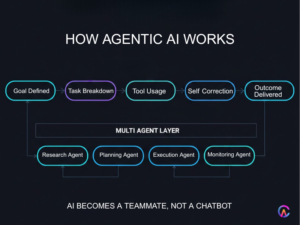
Out here in 2026, AI stops just replying and starts doing, nudging tasks forward through apps, routines, aims. One kind digs deep into a single area. Others? They link up, swarm together under shared purpose, passing pieces like a quiet team at work. Learn more about Agentic AI here.
Key points
- Few years back, barely any company used smart assistants in their software. Now experts like Forrester and Gartner expect a sharp rise. By 2026, between one third and two fifths of business tools might include them. That shift marks a notable jump from where things stood before
- One way agents work is by organizing steps for jobs such as helping customers or fixing tech issues. Tasks in sales follow up or digging into data get split up smartly. Even making creative stuff becomes manageable when they map it out. They grab whatever tools fit the moment. Mistakes? They adjust on their own without needing a push
- A single system might split work among separate agents instead of one big unit. These pieces talk through set rules, allowing updates between each other while moving jobs forward. One part finishes something, another steps in without confusion. Communication keeps things aligned even when roles differ across the network
Folks see it more like a partner now instead of just backup. What once felt distant acts alongside them today.
2 Small language models and efficient inference
Fresh off long stretches of growth, compact expert systems now lead, quick, lean, running right where they’re needed
Key points
- When it comes to focused jobs, like spotting diseases or handling bank trends, specialized models often do better than broad ones. These tailored systems need far less power, sometimes just a tenth of what big models demand. Legal document review? They handle that smoothly. Customer queries get answered faster too. Efficiency isn’t the only win, they’re sharper within their lane. Less computing muscle, more precision where it counts
- On phones, laptops, and smart gadgets, Edge AI now runs locally, cutting delays for robots, augmented reality, and wrist tech while supporting digital helpers without internet.
- Faster chips built from smaller parts now power smart devices without draining batteries. These tiny modules work together using older style electrical signals, helping phones learn on the fly. Efficiency jumps when computation shifts close to where data lives. Miniaturized setups thrive even in compact gadgets people carry daily
Now regular folks can use AI without huge servers. Tiny brainy programs run on everyday devices, opening access far beyond tech hubs.
3 Physical AI robotics and embodied intelligence
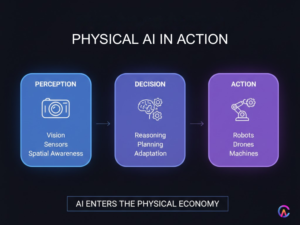
Out there, where things move and change, Physical AI gives life to machines. These systems see what’s around them, respond in real time, one moment at a time. Drones shift course mid flight when obstacles appear. Robots adjust grip based on texture, not code. Each action shaped by surroundings, not scripts. Adaptation happens without warnings or prompts. Interaction feels natural because it follows context, not commands. Unplanned moments become part of learning. The physical world stops being a challenge, it becomes the teacher
Key points
- Folks like IBM think machines that move might get smarter faster once they learn how spaces work, reacting on the fly. Real progress could come when bots understand where things are while adjusting without delay
- Fifty years ago, nobody predicted machines would work alongside people like teammates. Now factories run smoother because robots handle repetitive tasks without slowing down. Medical centers get more done when automated helpers move supplies fast. Care homes notice better routines since smart devices assist staff with daily chores. In each case, output climbs by about one fifth thanks to these tools sharing the workload
- A robot might watch, listen, then feel its way through a task, learning each move by example. When chaos strikes during rescue work or someone needs help at home, these systems adapt on the spot. Vision blends with sound, touch follows speech, actions form from many signals at once
Floating out of glowing monitors, intelligence begins shaping real world work.
4 AI infrastructure and supercomputing
What’s powering today’s tech boom? A surge in AI needs has pushed companies to build bigger, smarter systems. These setups mix high speed computing with leaner designs. Instead of just stacking power, they balance speed and efficiency. The result is a shift, hybrid models now lead the way. Performance matters more than raw size. Efficiency shapes every decision. This isn’t about flashy upgrades. It’s quiet progress behind the scenes. Infrastructure evolves because it must. New standards emerge without fanfare
Key points
- Fueled by demand, Gartner spots AI supercomputing rising where systems blend GPUs, TPus, and new chip types. Workloads shape the mix. Not one size fits all, it adapts
- Year by year till 2030, the world needs nineteen to twenty two percent more data center space. Much of that hunger comes from artificial intelligence workloads
- Far beyond single sites, networks of smart factories tie together learning, response tasks, plus adjustments, slashing expenses while lifting performance.
Fences around roads slow things down, yet they show where change could start.
5 Digital provenance and AI content authenticity
Floods of machine made text now swirl across the web. Watermarked trails tag each piece, showing where it truly began. These markers help spot fakes by tracing steps back. Proof of source grows vital when so much seems real but is not. Tracking origins fights deception without needing trust in the speaker
Key points
- Fresh on Gartner’s list, digital provenance matters more now, trust hinges on showing how data models hold up. Proof isn’t just about results, it’s about tracing every step behind them
- From pixels to proof, digital markers now trace back to their source through secure codes. A web of trust forms when records anchor into decentralized systems. These trails show who made what, leaving little room for doubt. By chaining data tightly, tamper resistance becomes built in. Creators gain a way to claim ownership without relying on middlemen
- Firms turn to tracking tools when rules demand proof, safeguarding inventions matters, yet confidence in artificial results counts too
Trust in a world of synthetic media.
6 Domain specific and multimodal models
Sideways shifts happen when broad systems bow to niche builds, shaped by job demands.
Key points
- When it comes to healthcare, finance, law, creativity, or science, specialized systems tend to get better results while using fewer resources compared to broad ones
- Putting text, images, videos, speech, and numbers into one system makes tools smarter. These combined inputs improve how machines assist people. Medical checks gain accuracy when multiple data types work as one. Insights grow sharper through mixed information streams
- Businesses adjust systems using their own information to get ahead in support tasks plus daily workflows
Focusing on one thing works better than simply being big. Size without skill doesn’t win.
7 AI governance safety and ethics
Fueled by widespread AI adoption, how companies steer decisions now sets them apart.
Key points
- Fewer than one in five businesses in controlled sectors will slide past rules by 2026, ethical AI standards must be followed, or fines follow.
- When tools that spot bias show how decisions are made keep records of actions and prevent errors they start being normal
- When companies start handling AI like tightly controlled systems, fresh jobs appear focused on oversight, risk control, stability checks. These positions deal less with building models, more with tracking behavior, enforcing rules, making sure nothing slips past limits set by law or policy
Trust builds when AI acts responsibly, gaining favor over time. Market position grows stronger as a result of dependable choices made behind the scenes.
8 Edge and Distributed AI
Faster decisions happen when tech stays local. Privacy improves because data does not travel far. Devices work better without constant internet checks. Smarter tools now live right where people use them. Distance shrinks between user and machine thinking
Key points
- Faster responses happen when phones, watches, and smart gadgets handle tasks themselves instead of sending data away. Cutting down on outside connections also lowers how much it costs to move information around
- A single phone learns alongside others, yet keeps its info tucked away locally. Training spreads out instead of piling up in one spot
- Machines that think on their own now run robots, fly drones, while quietly shaping roads and power systems behind the scenes
Now it’s everywhere, tucked into quiet moments. Personal too, shaped by who you are.
How Codearies helps you build and integrate 2026 AI advancements
Codearies is all about helping both enterprises and startups harness the latest AI trends to create effective product workflows and gain a competitive edge. Instead of trying to keep up with every new model out there, Codearies zeroes in on integrating architecture and ensuring good governance.
How Codearies supports 2026 AI projects
-
Agentic and multi agent systems
Codearies crafts tailored AI agents that enhance sales operations and analytics, seamlessly connecting with your tools, CRMs, APIs, and data to provide comprehensive value from start to finish.
-
Edge AI and multimodal apps
Develop on device and hybrid models for mobile AR, robotics, and vision language applications, all while prioritizing privacy and performance.
-
AI infrastructure and platforms
Design efficient pipelines for training, inference, and deployment by leveraging hybrid cloud, edge, and supercomputing strategies.
-
Governance and provenance
Put in place bias detection, explainability, watermarking, and compliance tools to ensure your AI meets both internal standards and regulatory requirements.
-
Full stack delivery
From strategy and discovery to MVP launch, training, and ongoing iteration, Codearies ensures that AI works for your business, not the other way around.
FAQs
Q1 What’s the most significant AI breakthrough we can expect in 2026?
We’re anticipating a major shift towards Agentic AI and multi agent systems, which will take AI beyond just answering questions. Instead, it will be about executing workflows and collaborating with humans and other systems.
Q2 Are smaller models going to take over large language models?
Absolutely, Smaller language models (SLMs) and domain specific models are set to lead in many scenarios because they’re faster, cheaper, and more reliable on edge devices. However, large models will still play a crucial role in research, training, and general reasoning.
Q3 How does Codearies make sure AI projects are safe and compliant?
Codearies incorporates governance layers, bias checks, explainability watermarking, and human in the loop controls right from the beginning. They also design for regulatory alignment in industries that are heavily regulated.
Q4 Can Codearies connect AI with robotics or edge devices?
Definitely, Codearies is capable of creating multimodal physical AI applications for robotics, drones, IoT, and edge computing, which includes on device inference and federated learning patterns.
Q5 What’s the timeline for an AI project with Codearies?
For focused pilots, like an agentic workflow or a domain specific model, you can see value delivered in just weeks to months. On the other hand, enterprise wide systems and infrastructure will be rolled out in phases over several quarters, with ongoing improvements along the way.
For business inquiries or further information, please contact us at