
Digital transformation in 2026 is set to shift from isolated tech projects to ongoing intelligent operations. In this new landscape, AI agents, hybrid multi cloud architectures, composable platforms, and a focus on sustainability will help create adaptive and resilient enterprises that can react to market changes in real time. Organizations will move past just experimenting with AI to deploying it at scale, utilizing modular agentic systems, governance frameworks, and strategies that deliver value across customer experience, supply chain, finance, and operations. This will lead to measurable ROI through hyper automation and the blending of physical and digital experiences.
Let’s take a closer look at how digital transformation is expected to evolve in 2026, including detailed implementation patterns and how Codearies can help clients harness these capabilities.
1 Agentic AI drives autonomous enterprise operations
Agentic AI is poised to be the most significant change, with autonomous agents taking over manual workflows throughout the enterprise.
Key points
- Modular AI agents will manage end to end processes, from lead qualification and contract negotiation to inventory optimization and incident response, seamlessly coordinating across CRMs, ERPs, support tools, and external APIs.
- Enterprises will deploy fleets of agents that work together through orchestration layers, mimicking human teams but operating around the clock with consistent quality.
- According to Gartner, by 2026, 30% of enterprise software will incorporate autonomous agents, a significant increase from less than 5% today, fundamentally transforming how work is accomplished.
2 Continuous transformation through composable architecture
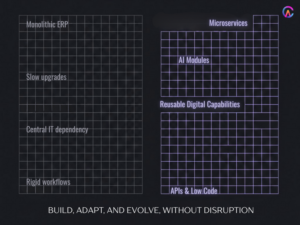
The era of massive ERP overhauls will give way to modular systems that continuously evolve.
Key points
- The composable enterprise model allows business units to create workflows using microservices, APIs, low code components, and pre built AI modules without bottlenecks from central IT.
- These platforms will facilitate the packaging, reuse, and monetization of digital capabilities, leading to the creation of internal marketplaces for workflows, data products, and AI agents.
- Deloitte predicts that 80% of enterprises will run production GenAI applications, enabling rapid iteration and experimentation.
Agility becomes the default operating model.
3 Hybrid multi cloud and edge intelligence ecosystems
Infrastructure strategies combine on premises private clouds, public clouds, and edge computing to ensure optimal workload placement.
Key points
- Hybrid cloud solutions keep sensitive data workloads secure while taking advantage of the public cloud’s flexibility and edge computing for IoT, 5G, and real time analytics.
- Industry cloud platforms offer specialized data models, compliance frameworks, and AI tools tailored for sectors like healthcare, finance, manufacturing, and retail.
- Edge AI facilitates factory automation, predictive maintenance, autonomous vehicles, and personalized in store experiences with incredibly low latency.
Workloads run where they perform best.
4 Generative AI powers phygital customer experiences
GenAI revolutionizes marketing operations and customer interactions, creating hyper personalized and seamless experiences.
Key points
- GenAI crafts personalized campaigns, product recommendations, and dynamic pricing in real time by utilizing unified customer data.
- Phygital convergence integrates AR, VR, IoT, and spatial computing to deliver immersive experiences in retail, healthcare, training, and services.
- Conversational commerce is evolving, with multimodal AI managing voice, video, text, and spatial inputs all at once.
Customers engage with brands across various channels in an intuitive manner.
5 Unified data ecosystems fuel intelligence
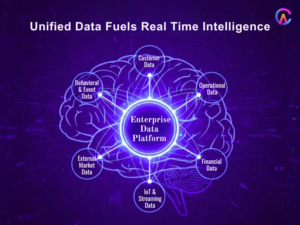
Data platforms act as the nervous system that connects all transformation initiatives.
Key points
- Lakehouse architectures bring together structured, unstructured, and streaming data, powering real time AI and analytics.
- Customer data platforms create golden records that enable predictive customer experiences and personalized journeys.
- Data mesh and fabric patterns decentralize ownership while ensuring governance and discoverability.
Data is the driving force behind every proactive decision.
6 Sustainability cyber resilience and future proofing
The shift towards green digital transformation and security is now essential.
Key points
- Integrating energy efficient infrastructure, carbon tracking, and circular economy models into core operations is crucial.
- Protecting digital assets requires zero trust architectures, quantum safe cryptography, and AI driven threat detection.
- Digital twins can simulate sustainability scenarios, ensuring cyber resilience and business continuity.
Transformation must be responsible and resilient.
How Codearies helps customers achieve 2026 digital transformation
Codearies is your go to technical partner for enterprises, startups, and scale ups looking to navigate the complex world of digital transformation. We don’t just stop at strategy like some consultancies or rely on offshore teams that lack the necessary expertise. Instead, Codearies brings together AI, Web3, product strategy, enterprise architecture, and hands on development to create production systems that continuously evolve and deliver real business results.
Specific ways Codearies delivers 2026 digital transformation
-
Agentic AI workflow transformation
We’ve developed custom AI agent fleets for our clients, like SalvaCoin, where these agents take care of KYC verification, wallet funding, compliance checks, and customer onboarding. This innovation has slashed manual work by a whopping seventy five percent. Our teams design modular agents that seamlessly integrate with CRMs, ERPs, payment gateways, and support tools, allowing for fully autonomous processes from lead generation to revenue collection or incident resolution, while human supervisors focus on exceptions and strategy.
-
Hybrid multi cloud and edge architectures
For a fintech client, we rolled out a hybrid architecture that combines on premises core banking with high volume AI inference on AWS, edge processing for mobile banking apps, and blockchain settlement on Polygon. This setup has cut latency by eighty percent, reduced cloud costs by forty percent, and ensured data sovereignty across three jurisdictions, all while automating workload orchestration.
-
Composable enterprise platforms
We’ve implemented a composable architecture for a Web3 gaming platform, enabling product teams to easily assemble tournaments, leaderboards, NFT minting, and payment flows from reusable microservices. This approach has dramatically sped up feature development from months to just weeks, while also creating internal capability marketplaces where teams can monetize their components.
-
GenAI and phygital experiences
Working alongside SissyGPT, Codearies has crafted a multimodal GenAI that personalizes NFT generation and offers AR “try before you buy” experiences across web, mobile, and VR headsets. This innovative system processes user preferences in real time, creating unique assets with embedded blockchain provenance, which has boosted conversion rates by threefold.
-
Data ecosystem unification
Codearies has brought together fragmented data sources for a DeFi protocol client by building a lakehouse architecture that features real time streaming predictive models and comprehensive customer 360 dashboards. This integration has slashed data latency from days down to mere seconds, paving the way for AI driven risk scoring, tailored yield strategies, and automated regulatory reporting.
-
Sustainability and resilience frameworks
Codearies has integrated carbon tracking into supply chain platforms for manufacturing clients, utilizing IoT sensors, blockchain provenance, and AI optimization to cut emissions by 22% while ensuring compliance with regulations across the EU, US, and India. To top it off, zero trust security layers safeguard all deployments, with quantum-safe cryptography already in place.
Codearies’ approach prioritizes production readiness from day one, employing battle tested patterns that cater to crypto, Web3, AI, and traditional enterprise clients all at once. Each project incorporates governance, monitoring, change management, and continuous optimization, ensuring that transformation builds momentum rather than gathering dust.
FAQs
Q1: What does success in digital transformation look like in 2026?
Success will be about consistently delivering value through agentic AI, composable architectures, and measurable outcomes in areas like revenue efficiency, customer satisfaction, and resilience, not just rolling out new technology. Codearies gauges success using KPIs such as process automation rates, cost savings, improvements in customer NPS, and faster time to market, with clients often seeing gains of 20% to 50% within the first six months.
Q2: How does Codearies’ approach stand out from traditional consultancies?
Unlike strategy firms that simply provide slide decks or offshore teams without real expertise, Codearies takes a hands on approach, managing everything from architecture design and development to deployment and production optimization.
Q3: What’s a realistic timeline for digital transformation with Codearies?
For focused pilots, like automating AI agents for support or sales, you can expect to see value in just four to eight weeks. Full workflow transformations typically take three to six months, while enterprise wide platform migrations are rolled out in phased roadmaps spanning six to eighteen months. Codearies’ structured approach includes rapid MVPs to validate ROI before scaling, as shown with a fintech client that achieved an impressive 80% reduction in latency in the first phase.
Q4 Can Codearies tackle both AI Web3 and traditional enterprise transformation?
Absolutely! Codearies is all about blending the best of both worlds. They focus on convergence projects that merge AI agents with blockchain technology, especially for DeFi platforms, tokenized assets, and hybrid Web3 Web2 experiences. For example, their team has developed AI driven risk engines that work seamlessly with Polygon smart contracts for a lending protocol, all while updating legacy CRM systems for traditional finance clients and ensuring compliance across both realms.
Q5 How does Codearies guarantee sustainability and security in transformations?
Every project at Codearies is built with a strong foundation in zero trust architecture, quantum safe cryptography, carbon tracking, and AI governance right from the start. For instance, manufacturing clients have managed to cut emissions by 22% through IoT blockchain provenance. Meanwhile, their financial services projects have successfully achieved SOC2 compliance with automated threat detection, resulting in zero critical vulnerabilities in production, as confirmed by independent penetration tests.
For business inquiries or further information, please contact us at