
Choosing the right tech stack is crucial for your website’s performance, scalability, maintainability, user experience, ROI, and overall digital presence as we head into 2026. Making the wrong choices can lead to high maintenance costs, sluggish load times, poor SEO, and scalability issues. On the flip side, the right decisions can provide lightning fast experiences, SEO superiority, optimized conversions, and a future proof architecture. Dive into proven tech stacks that cater to the needs of startups, enterprises, e-commerce, and content marketing comprehensively.
Frontend Frameworks Powering Modern Interfaces
React is the king of frontend development, thanks to its virtual DOM, component reusability, and a massive ecosystem that supports giants like Facebook, Netflix, and Airbnb. Next.js, a React framework, offers server side rendering, static generation, API routes, built in SEO optimization, and image optimization, making it the go to choice for high traffic marketing sites and e-commerce platforms in 2026.
Popular frontend options include
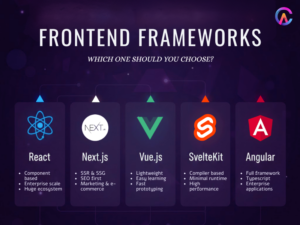
- React: Known for its component reusability and large ecosystem, perfect for enterprise level projects.
- Next.js: Offers SSR, ISR, and SEO performance, optimized for marketing and e-commerce.
- Vue.js: Lightweight and progressive, ideal for simplicity and rapid prototyping.
- SvelteKit: A compiler based framework with minimal runtime, delivering high performance for startups.
- Angular: A complete framework for enterprise applications, utilizing TypeScript and two way data binding.
Tailwind CSS is the go to for utility first styling, enabling rapid prototyping and responsive design while significantly reducing CSS bloat in 2026.
Backend Technologies Scalability Security
Node.js is a JavaScript runtime that excels in non blocking I/O, making it perfect for real time applications and scalability, especially within the MERN and MEAN stacks. Express.js is a minimalist framework for Node that simplifies routing, middleware, and API development, allowing for lightweight and fast MVP startups.
Here are the backend leaders for 2026:
- Node.js with Express: Offers non blocking scalability and real time features.
- Django: A Python framework that supports rapid development, complete with an admin panel and built in security.
- Laravel: Known for its elegant syntax, Eloquent ORM, and Blade templating in PHP.
- Spring Boot: A robust Java framework for enterprise microservices, focusing on security and scalability.
- Ruby on Rails: Emphasizes convention over configuration, making it great
Python Django FastAPI gaining traction AI integrations data heavy applications machine learning model serving APIs.
Database Selection Performance Reliability
PostgreSQL is a relational database known for its ACID compliance, JSON support, and ability to handle geospatial queries, making it a top choice for enterprises due to its unmatched scalability and reliability. On the other hand, MongoDB, a NoSQL document store, offers schema flexibility and horizontal scaling, which is ideal for content management and e-commerce, especially when dealing with rapidly changing schemas.
Database recommendations:
- PostgreSQL: a proven relational database with ACID compliance, JSON support, and geospatial capabilities for enterprises.
- MongoDB: a NoSQL option with a flexible schema and horizontal scaling, perfect for e-commerce.
- MySQL: a battle tested relational database, great for WordPress and PHP applications.
- Redis: excellent for caching sessions and real time data with high speed operations.
- Supabase: a PostgreSQL alternative that offers real time subscriptions, authentication, and storage, similar to Firebase.
For headless CMS options, consider Contentful, Strapi, and Sanity, which allow you to decouple content from the frontend for omnichannel delivery while being optimized for performance and SEO.
Hosting Deployment Scalability Infrastructure
Vercel, with Next.js, provides an optimized edge network and global CDN, along with serverless functions that make deployments as easy as a Git push, offering an unmatched experience for developers, especially in startups and scale ups. Netlify focuses on JAMstack for static sites, serverless functions, and form handling, prioritizing speed and simplicity in Git based deployments.
Hosting platforms to watch in 2026:
- Vercel with Next.js: developer friendly edge network and serverless functions.
- Netlify: JAMstack for static sites and efficient form handling with Git deployments.
- AWS Lambda: offers serverless scalability for enterprise applications.
- DigitalOcean: droplets and Kubernetes for managed simplicity and performance.
- Render: full stack deployments with integrated databases like Redis and PostgreSQL.
Cloudflare Workers provide edge computing capabilities with support for JavaScript, Python, and Rust, ensuring global distribution and low latency that’s hard to beat.
DevOps CI/CD Automation Pipelines
GitHub Actions, GitLab CI, and Jenkins are all about automating testing, building, and deployment workflows. They help maintain code quality and consistency while maximizing developer velocity. With Docker for containerization and Kubernetes for orchestration, we ensure that our environments are consistent, portable in the cloud, and scalable, all expertly managed.
DevOps essential tools
- GitHub Actions for CI/CD workflows, offering the simplicity of being GitHub native
- Docker for containerization, ensuring environment consistency and portability
- Kubernetes for orchestration, providing auto scaling and container management
- Terraform for infrastructure as code, ensuring multi cloud consistency
- Sentry for error monitoring and performance observability
For monitoring, tools like New Relic, Datadog, and Grafana help track performance, errors, and user experience in production environments.
Performance Optimization Core Web Vitals
When it comes to Performance Optimization and Core Web Vitals, Google’s metrics like Largest Contentful Paint (2.5 seconds), Cumulative Layout Shift (0.1), and Interaction to Next Paint (200ms) are crucial. They directly influence SEO rankings, user experience, and conversion rates. Image optimization, lazy loading, critical CSS, inline fonts, and CDN global distribution are all essential for achieving sub 2 second load times by 2026 in this competitive landscape.
Progressive Web Apps (PWAs) leverage service workers for offline functionality and push notifications, creating app like experiences that can be installed on home screens, leading to a dramatic increase in user retention.
Security Compliance Production Ready
When it comes to security, HTTPS and SSL encryption are non negotiable. We tackle the OWASP Top 10 vulnerabilities head on with robust web application firewalls (WAF) like Cloudflare and AWS Shield, ensuring DDoS protection, rate limiting, and effective bot management are all rigorously implemented. Plus, we prioritize GDPR and CCPA compliance with cookie consent, data minimization, and a privacy by design approach, establishing permanent audit trails.
For authentication, we rely on OAuth2, JWT, and OpenID Connect, utilizing platforms like Auth0 and Firebase Auth to ensure a secure and scalable experience that enterprises prefer. Role based access control (RBAC) allows for granular permissions, while API rate limiting, CORS, and CSRF protection create a multilayered security approach that’s flawlessly executed in production.
SEO Technical Foundations Rankings Dominance
Think of semantic HTML, structured data, schema markup, and rich snippets as your best friends in capturing a whopping 30% of search traffic, yes, that coveted position zero. Don’t forget about sitemaps, XML, robots.txt, canonical tags, and hreflang for international SEO. These tools are essential for multilingual sites and global expansion.
When it comes to performance, server side rendering (SSR) and static site generation (SSG) are game changers. Hybrid rendering ensures your SEO is on point, making your site crawlable and optimized. With canonical tags, you can dodge those pesky duplicate content penalties while effectively targeting multilingual audiences.
Accessibility WCAG Compliance Inclusive Design
Achieving WCAG 2.2 AA compliance isn’t just a legal requirement, it’s a chance to enhance your design. Think color contrast, keyboard navigation, screen reader support, ARIA labels, and alt text, all of these elements are crucial for creating an inclusive experience. By embracing inclusive design, you can expand your audience by 15% and significantly boost your SEO through improved dwell time and engagement signals.
Choosing Stack Project Requirements Perfect Match
When it comes to choosing the right tech stack for your project, it’s all about finding that perfect match.
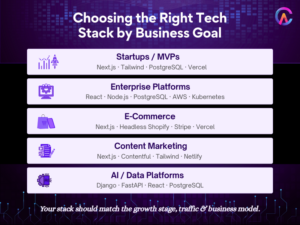
- For startups and MVPs focused on rapid iteration, consider Next.js, Tailwind, PostgreSQL, and Vercel with GitHub Actions. This combo prioritizes speed, simplicity, and scalability, maximizing developer velocity.
- For enterprise level projects with high traffic, React, Next.js, Node.js, PostgreSQL, AWS, and Kubernetes are your go to solutions. They offer proven scalability, security, and compliance to meet institutional demands.
- If e-commerce is your game, optimize for conversion with Next.js, Stripe, Shopify, and headless PostgreSQL on Vercel. This setup ensures top notch performance, security, and payment processing.
- For content marketing and authority sites, leverage Next.js, Contentful, Tailwind, and Netlify to maximize SEO performance and content velocity, strengthening your authority signals.
- And for those diving into AI and machine learning integrations, consider Django, FastAPI, React, PostgreSQL, and Vercel. This combination ensures your data platforms are scalable and ready for action.
How CodeAries Crafts Perfect Tech Stack Solutions
CodeAries crafts the perfect tech stacks that align seamlessly with your business goals, ensuring scalability and performance requirements are met. We deliver production ready websites that are tried and tested in the enterprise world.
- Using Next.js and React for our front end frameworks, along with Tailwind CSS for utility styling, we create SEO optimized marketing and e-commerce content platforms that are built for lightning fast conversions.
- On the back end, we utilize Node.js, Django, and Laravel for our APIs, paired with PostgreSQL and MongoDB databases. This setup guarantees scalability and security, effortlessly handling enterprise level traffic while enabling headless CMS solutions like Contentful and Strapi for decoupled, omnichannel delivery.
- For hosting and deployment, we rely on Vercel, Netlify, and AWS, implementing CI/CD with GitHub Actions, Docker, and Kubernetes. Our DevOps workflows are automated to ensure code quality and consistency, maximizing developer velocity and guaranteeing production reliability with 99.99% uptime.
- We focus on performance optimization, adhering to Core Web Vitals, optimizing images, and implementing lazy loading and PWA service workers to achieve sub 2 second load times. Our SEO strategies include rich snippets and schema markup to help you dominate the rankings right away.
- When it comes to security, we ensure compliance with HTTPS and OWASP standards, utilizing OAuth2, JWT, Auth0, WAF, and DDoS protection. We also manage GDPR and CCPA consent with rigorous audit trails for multilayered production security.
- Accessibility is a priority for us, following WCAG 2.2 AA guidelines with semantic HTML, ARIA labels, and keyboard navigation to create an inclusive design that expands your audience by 15% and dramatically improves SEO engagement.
We offer complete lifecycle consulting, from stack selection and architecture to implementation, deployment, optimization, training, and handover. Our goal is to transform your website into a revenue generating machine that’s future proofed for success.
Frequently Asked Questions
Q1: Which frontend framework is best for websites in 2026?
Next.js and React are leading the charge with their SEO performance, server-side rendering, incremental static regeneration (ISR), and optimized API routes, making them perfect for marketing and e-commerce. CodeAries specializes in building lightning-fast production websites using Next.js and Tailwind, focusing on conversion.
Q2: What’s the best backend database combination for enterprise scale?
Node.js and Django paired with PostgreSQL offer unmatched scalability and security, ensuring ACID compliance and handling JSON and geospatial data effortlessly. CodeAries deploys Node.js and PostgreSQL APIs with headless CMS solutions that are enterprise-ready and can be launched instantly.
Q3: What are the best hosting and deployment options for startups and scale-ups?
Vercel, Netlify, and GitHub Actions provide serverless functions and an edge network for Git deployments, all while being developer-friendly and prioritizing scalability. CodeAries guarantees 99.99% uptime for production deployments using Vercel and AWS Kubernetes.
Q4: How can I ensure SEO performance optimization?
To dominate rankings and boost conversions, focus on Core Web Vitals, schema markup, server-side rendering (SSR), static site generation (SSG), progressive web apps (PWA), rich snippets, and knowledge panels, all while achieving sub-2-second load times. CodeAries flawlessly implements these technical foundations for performance and SEO in production websites.
For business inquiries or further information, please contact us at