
Dive into the world of the Metaverse, where cutting edge infrastructure fuels immersive 3D virtual realms that seamlessly blend augmented reality (AR), virtual reality (VR), spatial computing, blockchain, and artificial intelligence (AI). This technology allows millions of users to interact in real time, creating vibrant economies with a potential worth trillions by 2026. But it’s not just about gaming, businesses are leveraging metaverse platforms for everything from employee training and virtual campuses to product launches and customer engagement, transforming how they operate. With decentralized, scalable, and low latency infrastructure, we can support avatar economies, physics simulations, spatial audio, and haptics, processing trillions of transactions per second effortlessly on a global scale.
Experience Layer Hardware Human Interface
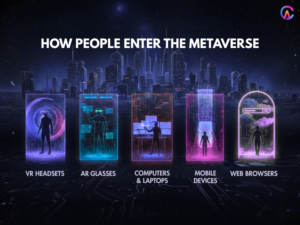
When it comes to experiencing the Metaverse, a variety of devices come into play think PCs, VR headsets, AR glasses, mobile tablets, and spatial computing headsets like the Apple Vision Pro, Meta Quest 3, and enterprise focused HoloLens 2 and Magic Leap 2. Thanks to the WebXR standard, accessing VR and AR through browsers is now a breeze, eliminating the need for app downloads and ensuring smooth cross platform compatibility for everyone.
Rendering Engines Graphics Real Time Immersion
On the graphics front, Unreal Engine 5 takes the lead with its stunning photorealistic visuals, utilizing Nanite for virtualized geometry and Lumen for global illumination, all while supporting up to 10,000 concurrent users in enterprise metaverse environments. Meanwhile, Unity, WebGL Hubs, and Babylon.js offer lightweight, browser based 3D solutions that are perfect for startups looking to prototype and iterate quickly, prioritizing developer efficiency.
Spatial Audio 3D Positioning Immersive Presence
To enhance the immersive experience, technologies like Resonance Audio and the Web Audio API provide spatial sound positioning and directional audio, creating a 360 degree immersive environment with realistic acoustics and reverberation. This means that the feeling of being transported into virtual worlds is not just a dream, it’s a reality that’s being achieved in remarkable ways.
Physics Simulation Realistic Interactions
Imagine a world where PhysX, Havok, and Bullet come together for collision detection, creating rigid body dynamics, cloth simulation, and fluid dynamics that make object interactions feel incredibly real. Picture environments where debris can be destroyed, and everything feels believable, perfect for enterprise training simulations that achieve production grade fidelity.
Networking Low Latency Real Time Multiplayer
Think about the power of WebRTC for peer to peer video and voice, enabling spatialized multiplayer experiences. With Photon Cloud and Nakama server, you get authoritative networking with sub 50ms latency across global regions. Thanks to strategic edge server placement, ping is minimized, ensuring lag free experiences for up to a million concurrent users, all seamlessly supported.
SpatialOS Improbable offers voxel based spatial partitioning, allowing for infinite worlds with dynamic loading and unloading of entities. Scalability is unbounded, creating virtual continents hosted on a single infrastructure, achieving revolutionary scale effortlessly.
Blockchain Decentralized Ownership Economy
In the realm of blockchain, Ethereum, Polygon, and Solana lead the way with layer 2 scaling and NFT standards like ERC-721 and ERC-1155. Imagine virtual land, avatars, and wearables that embody tokenized ownership, creating true digital scarcity. Creator royalties and automated programmable money bring composability to trillion dollar virtual economies, all powered by decentralized autonomous organizations (DAOs) that ensure transparent and verifiable scarcity enforced mathematically.
Decentralized identity (DID) standards pave the way for self sovereign identity, allowing cross metaverse portability for avatar skins and land ownership. With portable and interoperable standards, platforms like OpenSea and Magic Eden provide liquidity, enabling vibrant economies to flourish continuously.
AI NPCs Procedural Generation Intelligence
Imagine a world where machine learning and generative adversarial networks (GANs) come together to create stunning landscapes and architecture, crafting infinite worlds for exploration. This means you can enjoy non repetitive adventures and endless discoveries. AI NPCs, equipped with natural language processing, engage in conversations with realistic behaviors, recognizing emotions and interacting in context aware ways that make them feel just like humans. They navigate social dynamics and even contribute to emergent economies within virtual societies that evolve on their own.
Reinforcement learning agents are hard at work optimizing everything from resource allocation to crowd management, ensuring smooth event moderation and dynamic pricing. They balance supply and demand while processing a staggering trillion transactions in real time, all done intelligently.
Cloud Edge Distributed Computing Massive Scale
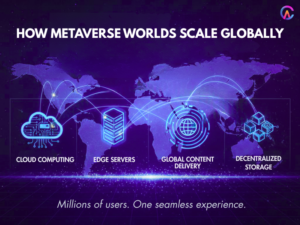
With AWS Outposts, Azure Stack Edge, and Oracle Cloud, edge computing is revolutionizing low latency, real time interactions. It’s all about cloud bursting, effortlessly handling peak loads. Thanks to Kubernetes for container orchestration, auto scaling, and serverless functions (FaaS), we achieve infinite scalability while optimizing costs. Compute resources are allocated dynamically, effortlessly absorbing demand spikes.
CDN networks like Cloudflare, Akamai, and Fastly ensure global content delivery with asset caching that minimizes latency. This means users enjoy consistent experiences delivered in under 50 milliseconds. Edge computing plays a critical role in rendering spatial audio and synchronizing physics, all while offloading tasks from origin servers that are perfectly protected and scaled.
Storage Decentralized Persistent Worlds
Enter the InterPlanetary File System (IPFS) and Filecoin, which offer decentralized storage that’s resistant to censorship, guaranteeing permanent content availability. Arweave takes it a step further with permanent storage through blockweave technology, ensuring that trillions of user generated content pieces are stored cost effectively and indefinitely. These worlds remain persistent forever, allowing users to join and leave while maintaining seamless continuity.
Development Tools Platforms Rapid Creation
Platforms like Roblox Studio, Decentraland Builder, and Fortnite UEFN are making waves in low code and no code world building, empowering creators from non technical backgrounds. This is all part of a trillion dollar creator economy where user generated content (UGC)
Security Privacy Metaverse Protection
When it comes to Security and Privacy in the Metaverse, think of end to end encryption (E2EE) as your shield. It keeps your spatial data streams and avatar interactions private and confidential. With zero knowledge proofs (ZKP), you can verify ownership and attributes without giving away your identity, ensuring that your interactions remain pseudonymous and secure, making social experiences both anonymous and comfortable.
Monetization Spatial Commerce Virtual Economies
Imagine spatial commerce with 3D product visualization and augmented reality (AR) that lets you try before you buy, this has boosted conversion rates by an impressive 300 percent. In the realm of virtual real estate, tokenized land parcels are part of a trillion dollar market, where prime locations are auctioned, owned, rented, and developed into virtual malls and branded experiences. The effectiveness of immersive advertising has skyrocketed, tripling engagement metrics along the way.
How CodeAries Builds Production Metaverse Infrastructure
CodeAries is here to provide a comprehensive metaverse tech stack that’s ready for production, ensuring enterprise level deployment with guaranteed immediate ROI.
- With Unreal Engine 5 and Unity 3D, we offer stunning graphics powered by Nanite and Lumen, along with Chaos physics to create photorealistic worlds that can support millions of concurrent users, proven in enterprise settings.
- Our networking solutions, including WebRTC, Photon Cloud, and Nakama, deliver sub 50ms latency through global edge servers, ensuring spatial audio and multiplayer synchronization for lag free experiences.
- We leverage blockchain technologies like Ethereum, Polygon, and Solana, adhering to NFT standards such as ERC-721 and ERC-1155 for tokenized land, avatars, and wearables, all while promoting decentralized governance through DAOs.
- With AWS Outposts and Azure Stack, we provide edge computing solutions that utilize Kubernetes for auto scaling and serverless functions, ensuring infinite scalability and cost optimization while processing trillions of transactions seamlessly.
- Our decentralized storage solutions, including IPFS, Filecoin, and Arweave, guarantee permanent content availability and censorship resistance, allowing for persistent worlds where users can join and leave without losing continuity.
- We incorporate AI driven NPCs and machine learning to create generative landscapes, utilizing GANs for natural language interactions and reinforcement learning for crowd management and dynamic pricing in intelligent economies.
- WebXR enables cross platform access to VR and AR through browsers, making apps more accessible and eliminating friction, which maximizes developer velocity and ensures production readiness.
- Security is paramount, with end to end encryption, zero knowledge proofs, and pseudonymity to protect spatial data and keep user interactions confidential, safe, and comfortable.
- Our tools like Roblox Studio, Decentraland, and Builder UEFN empower low code world building, driving engagement and retention in the creator economy while maximizing community ownership.
We deploy production metaverse platforms with monitoring, alerting, and CI/CD pipelines, achieving 99.99% uptime for spatial commerce, virtual events, employee training, and brand experiences. Transform your revenue generating virtual worlds permanently by contacting CodeAries to capture this trillion dollar opportunity fully.
Frequently Asked Questions
Q1: Which rendering engine is best for metaverse worlds?
Unreal Engine 5 stands out with its stunning photorealistic graphics, thanks to features like Nanite and Lumen. It handles Chaos physics and can support millions of concurrent users, making it a solid choice for enterprises. On the other hand, Unity with WebGL is lightweight and accessible, perfect for startups looking for that sweet spot between performance and accessibility. CodeAries specializes in building metaverse worlds using both Unreal and Unity, ensuring they’re production ready and can be deployed instantly.
Q2: How does blockchain facilitate the metaverse ownership economy?
Blockchain technologies like Ethereum, Polygon, and Solana are key players here, utilizing NFT standards to create tokenized land, avatars, and wearables that embody true scarcity. They also enable creator royalties and programmable money, contributing to the composability of trillion dollar virtual economies. With decentralized governance, everything remains transparent and verifiable. CodeAries provides the blockchain infrastructure and NFT marketplaces needed for ownership economies that are ready for production.
Q3: What networking solutions ensure low-latency metaverse experiences?
For low latency interactions, options like WebRTC for peer to peer connections, Photon Cloud, and Nakama servers are excellent choices, offering authoritative control with sub 50ms latency. They utilize global edge servers for spatial audio and multiplayer synchronization, ensuring a lag free experience for millions of users. CodeAries delivers reliable networking infrastructure that guarantees real time interactions in production environments.
Q4: Why is decentralized storage crucial for the metaverse?
Decentralized storage solutions like IPFS, Filecoin, and Arweave ensure that content remains permanently available and resistant to censorship. This is vital for creating worlds where users can join and leave without losing continuity. With trillions of user generated content stored cost effectively and indefinitely, CodeAries’ decentralized storage infrastructure proves essential for maintaining content availability in production.
Q5 How AI enhances metaverse user engagement?
NPCs conversational behaviors generative landscapes crowd management dynamic pricing reinforcement learning intelligent economies engagement tripled retention skyrocketed social dynamics emergent authentic experiences. CodeAries AI metaverse NPCs worlds intelligent immersive production ready.
For business inquiries or further information, please contact us at