

Artificial intelligence has really taken off in recent years, powering everything from chatbots to predictive analytics. However, centralized AI models come with significant concerns, think data privacy issues, single points of failure, and control resting in the hands of a few tech giants. That’s where decentralized AI steps in, merging AI with blockchain technology in a way that could change the game. This approach offers the promise of trustless AI models, where no single entity has all the control. But can AI really be trustless? Let’s explore what that means, how it operates, and the exciting possibilities it brings to the real world.
What Is Decentralized AI and Why Does Trust Matter?
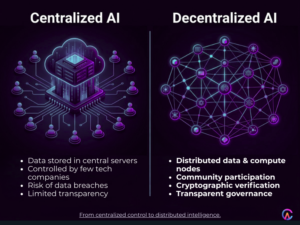
Traditional AI depends on huge datasets stored in the cloud, managed by companies like OpenAI or Google. This setup comes with risks, hacks, biased training data, and a lack of transparency in decision making.
Trustless AI models turn this idea on its head. “Trustless” doesn’t mean there’s no trust at all, it means these systems can function without relying on a central authority. With blockchain’s smart contracts and consensus mechanisms, rules are enforced in a transparent manner. Picture AI models that learn from data sourced from thousands of nodes around the globe, all verified cryptographically, so no single party can manipulate the information.
The key advantages include improved privacy (data remains local through methods like federated learning), resistance to censorship, and broader access for everyone. By 2026, as Web3 AI continues to gain momentum, projects like Bittensor and SingularityNET are proving that this isn’t just a theoretical concept, it’s actually happening.
Blockchain as the Backbone
Blockchain offers both immutability and decentralization. AI models can be tokenized, think of them as NFTs for neural networks, allowing for ownership and trading on decentralized marketplaces. Platforms like Ethereum or Solana host these models, ensuring that transactions are verifiable.
Consensus algorithms such as Proof of Stake help secure the network, stopping malicious nodes from corrupting the data. This results in a tamper proof ledger for updates and inferences related to the models.
Federated Learning for Privacy Preserving Training
Federated learning allows devices to train AI models right on their own without needing to share any raw data. Instead, only the model updates, or gradients, are sent over the network, all while being securely aggregated through multi party computation (SMPC). Google was the trailblazer in this area, but now we see decentralized versions that leverage blockchain technology to manage and reward participants.
The outcome? A trustless training environment where your phone can help build a global AI without compromising your personal information. A hot topic in 2026 is the use of zero knowledge proofs (ZKPs), which can conceal even those updates, ensuring complete privacy.
Decentralized Storage and Compute
While centralized clouds still dominate the computing landscape, initiatives like Filecoin and Akash Network are shaking things up by decentralizing it. AI models can now operate on rented GPU power sourced from a worldwide pool, with payments made in cryptocurrency. Meanwhile, IPFS takes care of storing datasets off chain, ensuring they’re pinned across various nodes for added redundancy.
This approach can drastically cut costs, up to 90% less than AWS, and enhances resilience. If one provider goes down, there’s no interruption in service.
Challenges in Achieving Truly Trustless AI
Decentralized AI sounds ideal, but hurdles remain. Can it ever be fully trustless?
Scalability and Speed Bottlenecks
Blockchain transactions tend to be slower than those on centralized servers. Training large language models (LLMs), like the various GPT versions, requires immense parallel processing. Layer 2 solutions such as Optimism can help, but some latency issues remain, this is especially critical for real time applications like self driving cars.
Data Quality and Sybil Attacks
The saying goes, “garbage in, garbage out.” In trustless environments, malicious actors can inundate the network with tainted data. While reputation systems and stake slashing can help mitigate this risk, they aren’t foolproof. How can we verify the quality of data without a central authority?
Incentive Alignment
It’s crucial for nodes to feel motivated to contribute honestly. While tokenomics do reward positive behavior, there are still threats like economic attacks that can undermine those rewards. To tackle this, game theory models, drawing inspiration from Bitcoin’s security, are continuously evolving.
Despite these challenges, things are moving quickly. By 2026, decentralized machine learning platforms were processing billions of inferences each month, showcasing their viability.

Real World Use Cases and Success Stories
Decentralized AI shines in high stakes areas.
Healthcare and Personalized Medicine
Hospitals are sharing model updates while keeping patient data secure on site. Trustless AI is stepping up to predict outbreaks and customize treatments, all while staying compliant with GDPR through blockchain audits.
Finance and DeFi Predictions
Web3 AI is making waves by forecasting crypto prices and spotting fraud on chain. With Ocean Protocol, users can safely monetize their data, paving the way for trustless trading bots.
Content Creation and Generative AI
Platforms like Render Network are shaking things up by decentralizing GPU rendering for AI art. These models learn from community datasets, producing creativity that can’t be censored.
Take Bittensor’s TAO token, for example, it reached all time highs in 2026, thanks to its subnet model that fosters collaborative intelligence. Meanwhile, SingularityNET’s marketplace boasts over 100 AI services, all designed to be trustless and interoperable.
The Road to Full Trustlessness
Achieving fully trustless AI may call for hybrid solutions, using blockchain for verification and off chain computing for speed. Innovations in homomorphic encryption (which allows computing on encrypted data) and verifiable computation (like zk SNARKs) are bridging the gaps.
By 2030, experts anticipate that 30% of AI workloads will be decentralized, driven by regulations such as the EU AI Act that promote transparency. The real question isn’t if this will happen, but rather how soon we’ll see it unfold.
How CodeAries Helps Customers Achieve Decentralized AI
CodeAries is all about connecting the dots between AI and blockchain to create smooth, decentralized solutions. Here’s how we can supercharge your projects:
- We design tailored federated learning pipelines that keep your data safe while training powerful models across distributed networks.
- We build AI platforms that integrate with blockchain, using smart contracts to ensure model deployment and monetization are completely trustless.
- We enhance decentralized storage and computing setups with tools like IPFS and Akash, ensuring they’re scalable and cost effective.
- We implement reputation and incentive systems to guarantee high quality data and encourage honest participation from nodes.
- And we offer comprehensive audits and integration for Web3 AI applications, covering everything from DeFi predictors to healthcare analytics.
Frequently Asked Questions
Q1: What makes decentralized AI more secure than traditional AI?
Decentralized AI enhances security by distributing data and computing power across various networks. This approach removes single points of failure and leverages blockchain technology for secure, tamper proof verification.
Q2: How does federated learning work in trustless systems?
In trustless systems, devices train their models locally and only share the updates. These updates are securely aggregated on the blockchain, ensuring that raw data remains private.
Q3: Can decentralized AI handle large models like LLMs?
Absolutely, With distributed computing networks that rent global GPUs, working with large models becomes both feasible and cost effective.
Q4: What are the biggest barriers to trustless AI today?
Currently, the main challenges are scalability and data quality. However, advancements like Layer 2 scaling and reputation protocols are quickly addressing these issues.
Q5: Is decentralized AI ready for enterprise use?
Definitely, Platforms such as Bittensor demonstrate that decentralized AI can effectively scale for real world applications in sectors like finance, healthcare, and beyond.
For business inquiries or further information, please contact us at