
AI and blockchain hold incredible potential to change the game, but they also bring up serious ethical dilemmas regarding fairness, privacy, and their impact on society. As we look ahead, these technologies are set to infiltrate finance, healthcare, governance, and our everyday lives, sparking heated discussions about issues like bias, surveillance, and the balance between decentralization and concentration of power, not to mention the long term implications for human agency. Key terms such as AI ethics, blockchain ethics, ethical AI development, responsible Web3, and the societal impact of AI and blockchain are shaping the conversation. This thorough examination delves into the challenges we face, potential frameworks for solutions, and what the future might hold.
Ethical Challenges in Artificial Intelligence
AI ethics is all about how machines can imitate human judgment.
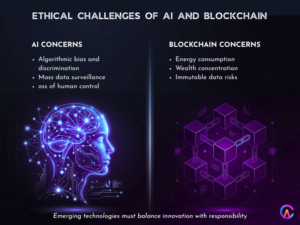
Bias and Algorithmic Discrimination
The data used to train these systems often mirrors societal biases, which can worsen inequality. For instance, studies by NIST show that facial recognition technology struggles with darker skin tones, failing 34% more often. Similarly, hiring algorithms tend to favor male resumes due to historical data biases. To create ethical AI, we need diverse datasets and regular bias audits, yet reports from 2026 indicate that a staggering 70% of deployed models haven’t been tested for fairness.
Privacy Erosion and Surveillance Capitalism
AI thrives on collecting data, often hoovering up personal information for targeted ads, predictions, or control. The Cambridge Analytica scandal has now become a common example of how routine profiling can go awry. Deepfakes are another concern, as they undermine trust and can facilitate misinformation or blackmail. Regulations like the EU AI Act aim to classify high risk uses and require transparency, but the enforcement of these rules is still lagging behind.
Existential Risks and Autonomy Loss
The rise of superintelligent AI brings alignment challenges, where its goals may not align with human values. According to Goldman Sachs, job displacement could affect up to 300 million roles, with creative positions being next in line. Ethical frameworks emphasize the need for human oversight, yet we continue to see the proliferation of autonomous weapons, even in the face of UN bans.
Blockchain Ethics Decentralization Dilemmas
Blockchain is all about transparency, but it also has its darker sides.
Environmental Footprint and Energy Waste
Proof of Work systems, like the original Bitcoin, use up energy levels that can rival entire countries. On the other hand, Ethereum made a huge leap post Merge, cutting its energy use by 99% thanks to Proof of Stake. Still, critics point out that there are rebound effects to consider. While ethical mining advocates for renewable energy, the Scope 3 emissions from the hardware still linger.
Inequality in Tokenomics and Access
Wealth tends to pile up among the early adopters, with whales holding a staggering 50% of the Bitcoin supply. Decentralized Finance (DeFi) often leaves the unbanked behind due to technological barriers. The NFT craze has sparked a lot of speculation, leading to a dramatic crash in floor prices for 95% of them. Ethical blockchain supporters are pushing for fairer distribution and tools that promote inclusion.
Immutability vs Right to be Forgotten
Public ledgers keep data forever, which can clash with GDPR rights to erasure. Pseudonymity doesn’t really fool anyone, especially with chain analysis tools. Ethical solutions are looking to blend privacy features like zk SNARKs with selective disclosure.
Intersectional Ethics AI Meets Blockchain
The merging of these technologies brings its own set of challenges.
Decentralized AI Bias Amplification
Federated learning spreads models across different nodes, but the threat of poisoned data attacks is still a concern. Networks like Bittensor reward validators, yet sybil attacks can undermine fairness. For decentralized AI to be ethical, we need to implement stake slashing and create diverse incentives for nodes.
Surveillance Resistant Systems
Blockchain can timestamp AI decisions, providing an auditable trail that helps combat the opacity of black box systems. Marketplaces like SingularityNET allow users to own their models, reducing corporate control. However, failures in oracles can lead to cascading risks.
Programmable Morality via Smart Contracts
Decentralized Autonomous Organizations (DAOs) can embed ethics directly into their code, such as using quadratic funding for fair resource allocation. However, there are risks involved, including hard forks that can split communities over moral disagreements.
Regulatory and Governance Frameworks
Global standards are starting to take shape.
Existing Guidelines and Laws
The UNESCO AI Ethics Recommendation, embraced by over 190 countries, emphasizes the importance of human rights. Meanwhile, the EU AI Act categorizes risks and even bans the use of real time biometrics. On the blockchain front, we have the MiCA regulations for stablecoins and the US FIT21, which aims to clarify custody issues.
Self Regulation Initiatives
Organizations like the Partnership on AI are stepping up with responsible AI councils to audit models. The Blockchain Crypto Council for Innovation is also working on drafting sustainability pledges, although their effectiveness is sometimes questioned due to profit driven motives.
Global Harmonization Challenges
There’s a stark contrast between the US’s hands off approach and China’s state driven AI ethics. Plus, cross border data flows make enforcement a tricky business.
Ethical Design Principles and Solutions
Taking proactive steps to mitigate risks is essential.
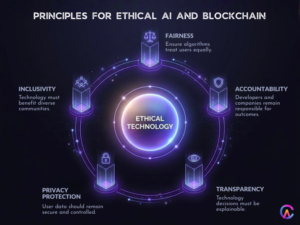
Fairness Accountability Transparency Explainability (FATE)
It’s crucial to integrate bias detection into our processes. Tools like SHAP in Explainable AI (XAI) help clarify decision making, while blockchain technology offers immutable audit trails.
Inclusive Development Practices
Having diverse teams can help minimize blind spots. It’s vital to co design solutions with end users, particularly those from marginalized communities.
Impact Assessments and Moratoriums
Before deploying high stakes AI, mandatory audits are a must. The pause letters from 2023 have evolved into specific moratoriums on untested AGI technologies.
For instance, IBM’s AI Fairness 360 toolkit has successfully reduced bias by 40% in pilot projects. Additionally, Polkadot’s on chain governance allows holders to vote on ethical upgrades, ensuring a more democratic approach.
Societal Implications and Future Trajectories
The stakes are high for the long term.
Economic Inequality and Power Concentration
The AI blockchain duo of Nvidia and ConsenSys could create new gatekeepers. Experiments with universal basic income through crypto are stepping in to tackle displacement.
Cultural and Democratic Erosion
Deepfake elections pose a threat to our sovereignty. Blockchain voting initiatives like Voatz are taking a careful approach to scaling.
Positive Potentials
Ethical technology has the potential to enhance precision medicine through secure data markets, provide equitable aid via transparent DAOs, and amplify creativity while preserving our human essence.
By 2030, ethical AI blockchain frameworks are expected to govern around 60% of deployments, according to Deloitte. Achieving this requires a proactive collaboration among technologists, policymakers, and citizens.
How CodeAries Helps Customers Build Ethical AI Blockchain Solutions
At CodeAries, we focus on responsible technology, steering our clients toward positive societal impact. Here’s how we weave ethics into your projects:
- We design tools for bias detection and curate diverse datasets to ensure fair AI outcomes for all user groups.
- We implement privacy layers, like zk proofs, to safeguard data while maintaining blockchain transparency.
- We create systems that can be audited with on chain governance for responsible decision making.
- We develop inclusive platforms that help bridge digital divides, ensuring broader access for society.
- We conduct ethics impact assessments to align innovations with global standards and values.
Frequently Asked Questions
Q1 What is the biggest ethical risk in AI today?
Bias amplification from skewed data can lead to unfair outcomes in hiring, lending, and the justice system.
Q2 How does blockchain solve AI black box problems?
It offers unchangeable logs of decisions, which allows for complete transparency and thorough audits.
Q3 Why does PoW mining raise ethical concerns?
The enormous energy consumption is comparable to that of entire countries, significantly contributing to climate change.
Q4 Can smart contracts enforce ethical behavior?
Absolutely, They embed rules like fair distribution, which helps prevent any human manipulation or abuse.
Q5 How do regulations balance innovation and ethics?
They categorize risks, giving low risk technologies the freedom to innovate while ensuring that high stakes applications have necessary safeguards in place.
For business inquiries or further information, please contact us at