
Real world asset (RWA) tokenization is all about turning physical and financial assets into digital tokens on blockchain networks, which is shaking up how we think about ownership, trading, and liquidity. By 2026, the RWA market is projected to surpass $50 billion, covering everything from real estate and art to commodities, private equity, and carbon credits. This groundbreaking approach connects traditional finance (TradFi) with decentralized finance (DeFi), allowing for fractional ownership, around the clock trading, and access from anywhere in the world. Keywords like RWA tokenization, real world asset tokenization, RWA 2026 trends, tokenized real estate, tokenized treasuries, DeFi RWA integration, and blockchain asset tokenization are set to drive significant SEO potential. This comprehensive analysis will explore the mechanics, industry shifts, benefits, challenges, case studies, and what the future holds.
What Is RWA Tokenization and How Does It Work
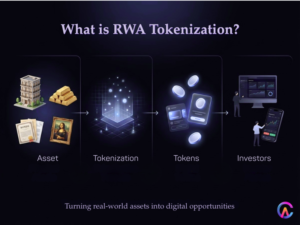
RWA tokenization creates blockchain based digital representations of tangible or intangible assets, each token granting proportional ownership rights.
Core Process Step by Step
The journey starts with selecting high value, illiquid assets like properties or bonds. Next up is legal structuring, which involves using special purpose vehicles (SPVs), trusts, or funds to ensure that the tokens are legally tied to the underlying assets. Auditors then step in to confirm that the valuation reflects fair market pricing.
When it comes to token issuance, we mint ERC-20, ERC-721, or ERC-1400 compliant tokens on networks like Ethereum, Polygon, or Solana. Smart contracts are used to define rights such as dividends, voting, or redemption. Off chain custodians take care of the physical assets, while on chain oracles provide real time valuations through Chainlink.
Custody arrangements separate physical vaults for gold from the wallet infrastructure for tokens. Secondary markets pop up on decentralized exchanges (DEXs) like Uniswap or regulated platforms like IX Swap, allowing for instant trades.
Compliance is built in, incorporating KYC, AML, whitelists, and transfer restrictions through token standards like ERC-3643. Lifecycle management takes care of redemptions, splits, or maturities automatically.
Key Technical Components
Oracles play a crucial role by feeding in external data to prevent any manipulation. Compliance layers help automate checks for investor accreditation. Fractionalization allows a $10 million property to be divided into 10,000 tokens at $1000 each democratizing access.
Industry Transformations Through RWA Tokenization
Tokenization is shaking things up by breaking down silos and creating programmable assets.
Real Estate Revolution
Commercial properties that were once only accessible to accredited investors are now being fractionalized on a global scale. Investors can now buy $500 stakes in iconic Manhattan skyscrapers and earn rental yields. Platforms like RealT have tokenized over $500 million by 2026, slashing entry barriers by an impressive 99%. Secondary markets are ramping up liquidity by 100 times compared to traditional closings.
Settlement times have plummeted from 60 days to mere seconds, with programmable rents being distributed through smart contracts. Plus, geographic diversification allows Europeans to effortlessly own farmland in the US.
Private Credit and Fixed Income
Tokenized treasuries, invoices, and bonds are yielding between 4-6% in DeFi pools. Ondo Finance’s BlackRock BUIDL fund has tokenized $500 million in US Treasuries, providing institutional yields to retail investors. Credit funds like Maple are syndicating SME loans globally, pooling over $2 billion.
Borrowers can access capital at 50% lower costs without the need for banks, as intermediaries are minimized. Lenders benefit from compounded APYs through auto reinvesting.
Commodities and Carbon Markets
Gold, silver, and oil are being tokenized through platforms like Pax Gold or Tether Gold, which are redeemable at a 1:1 ratio. Fractional gold bars can be traded 24/7, reflecting spot prices minus a 0.5% fee. Carbon credits are being tokenized for verifiable offsets, with the Toucan Protocol having retired over 10 million tons.
Supply chain provenance is tracing commodities transparently, helping to combat fraud.
Art Collectibles and Intellectual Property
Blue chip art is being fractionalized through platforms like Masterworks. A $50 million Basquiat can be split into 50,000 tokens, yielding an annualized return of 10-15% through rentals. Music royalties are being tokenized via Royal 2.0, allowing artists to earn perpetual streams from their catalogs.
Intellectual property licenses, movies, or patents are transforming into revenue sharing tokens.
Economic Benefits Driving Adoption
Tokenization is opening the door to trillions of dollars in previously trapped value.
Liquidity Explosion
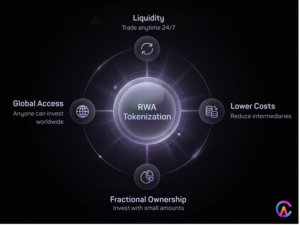
Illiquid assets are now tradable around the clock. According to McKinsey, we could see $2-4 trillion tokenized by 2030, which is about 10% of the global GDP. Secondary markets are slashing holding periods from years down to just days.
Cost Reductions
With the disappearance of intermediaries, fees are being cut by an impressive 70-90%. Automated compliance is saving a whopping $20 billion each year in paperwork, as reported by BCG. Investors can now access a variety of portfolios without needing wealth managers.
Fractional Ownership and Inclusion
Investment minimums are dropping from $1 million to just $100, making it possible for retail investors to join in. Emerging markets are skipping over outdated systems, bringing over a billion unbanked individuals into the fold.
Capital Efficiency
Tokens are being used as collateral in DeFi loops, which boosts yields. For instance, a $10,000 tokenized bond can generate $15,000 in borrowing power at a 75% loan to value ratio.
Challenges and Risk Mitigations
This transformation does come with its challenges.
Regulatory Uncertainty
Different jurisdictions have varying views, with the SEC considering most real world assets as securities, while MiCA aims to standardize regulations in the EU. Solutions are being developed to embed compliance at the protocol level, which can pause any non compliant transfers.
Oracle and Custody Risks
Price feeds can be manipulated through flash loans, but this can be countered by using time weighted average prices (TWAPs) and decentralized oracles. Regulated custodians like Fireblocks are insuring holdings of over $100 million.
Market and Liquidity Risks
Early platforms often struggle with thin order books. Reserves are being used to bootstrap liquidity, while protocol owned markets help stabilize the situation.
Scalability is improving thanks to Layer 2 solutions like Arbitrum and Base, which are handling over $10 billion in total value locked.
Real World Success Stories and Metrics
BlackRock has successfully tokenized $500 million in treasuries through its BUIDL fund, offering a 5.25% yield that’s caught the attention of pension funds. Meanwhile, Centrifuge has tokenized over $1 billion in invoices for small and medium sized enterprises, providing instant funding.
RealT has attracted more than 20,000 investors with $100 million in tokenized properties, boasting an average yield of 12%. Additionally, Mantra OM is backing a $2 billion pipeline of real world assets.
By 2026, volumes are projected to reach $500 billion at RWA.xyz, surpassing the assets native to DeFi.
Future Outlook RWA Convergence
The floodgates are opening for institutional investment, with JPMorgan’s Onyx tokenizing deposits and Goldman Sachs piloting equity tokens. Cross chain interoperability through LayerZero CCIP is set to unify liquidity across platforms.
AI is dynamically valuing illiquid assets, while real world assets are feeding into DeFi oracles. The expansion of perpetual futures derivatives is enhancing composability.
By 2030, Citi predicts that $16 trillion will be tokenized, representing 5% of global assets. Hybrid TradFi DeFi rails are poised to redefine capital markets.
How CodeAries Helps Customers Achieve RWA Tokenization Success
CodeAries is at the forefront of blockchain solutions, enabling seamless RWA platforms. Here’s how we can transform your assets:
- We create legally compliant token structures, including SPVs and ERC standards for any asset class.
- Our platforms integrate oracles to sync real world valuations with on chain execution.
- We develop marketplaces for fractional ownership, complete with automated dividends and secondary trading.
- Our custody compliance layers ensure adherence to KYC, AML, and jurisdictional controls.
- We design DeFi composability features, such as lending collateralization and yield optimization.
Frequently Asked Questions
Q1: What is RWA tokenization all about?
It’s the process of turning real assets, like real estate or bonds, into blockchain tokens that represent fractional ownership rights.
Q2: How does tokenization boost liquidity in real estate?
Tokens can be traded around the clock on global markets, reducing settlement times from months to mere seconds.
Q3: Are tokenized treasuries a safe bet for retail investors?
Absolutely, Regulated platforms provide institutional yields while ensuring full reserves and transparency.
Q4: What’s the role of oracles in RWA platforms?
Oracles provide accurate off chain pricing, which helps trigger payouts, liquidations, and valuations.
Q5: Will RWAs completely take over traditional finance?
Not really, they create a hybrid system that combines efficient, programmable rails with existing legacy systems.
For business inquiries or further information, please contact us at