
Real time recommendation engines are the driving force behind personalized experiences, accounting for a whopping 35% of Netflix views and 75% of Amazon purchases. These sophisticated systems handle billions of events every day, seamlessly blending collaborative filtering, content based models, deep learning, and reinforcement learning to provide instant suggestions as users navigate through their options. By 2026, businesses are in a race to replicate this kind of magic, all while managing exploding data volumes and the need for sub second response times. Keywords like real time recommendation engines, Netflix recommendation algorithm, Amazon recommendation system, real time personalization, streaming recommendations, e-commerce recays, and recommendation engine architecture are dominating SEO searches. This comprehensive technical guide dives into the architectures, data pipelines, model ensembles, real world implementations, scaling strategies, challenges, and future trends.
Core Components of Real Time Recommendation Systems
Modern engines are designed to work in harmony across multiple layers to ensure speed and accuracy.
Event Collection and Streaming Pipelines
Kafka streams are busy ingesting clicks, views, purchases, and ratings at millions of events per second. Netflix processes over 100 billion events daily, while Amazon handles around 2.5 billion line items every hour. Tools like Apache Flink and Spark Streaming aggregate real time features, such as session recency and cart abandonment signals.
Feature stores like Pinecone and Tecton provide low latency embeddings that are precomputed hourly and blended with live user behavior. Two tower models encode users and items separately, allowing for quick nearest neighbor lookups using approximate nearest neighbors (ANN) methods like HNSW.
Candidate Generation Sourcing Billions Fast
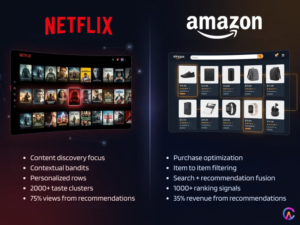
In the first stage, the system filters through trillions of possible items to narrow it down to thousands of candidates in under 50 milliseconds. Matrix factorization helps surface collaborative signals, such as “You watched X, similar users watched Y.” Netflix’s personalization algorithms can rank over 100,000 titles to just 75 thumbnails in an instant.
Approximate methods, like logistic matrix factorization rollups, allow for top K approximations without needing full computation. Amazon’s item to item collaborative filtering (CF) precomputes neighbor graphs, enabling the service of over 1 billion candidates every second.
Ranking Models Precision Scoring
The second stage scores candidates blending signals deeply.
Wide and Deep Learning Netflix Bandits
Netflix uses contextual bandits to strike a balance between exploring new content and exploiting what’s already popular, employing an epsilon greedy approach with multi armed bandits. Wide linear models focus on explicit features like genre and watch history, while deep networks uncover implicit patterns through residual blocks.
Amazon’s deep cross networks (DCN) explicitly handle low and high order feature interactions. Their two tower retrieval models utilize L2 loss to train user and item embeddings, aiming to maximize the likelihood of clicks.
Sequential and Session Based Ranking
Transformer models such as BERT4Rec and SASRec are adept at capturing sequence dependencies. What you watched just an hour ago can predict what you’ll want to watch in the next 30 minutes far better than your entire viewing history. GRU4Rec RNNs are designed to model sessions, predicting the next item based on what you’ve already watched.
Real time updates through online learning adjust weights with each interaction, eliminating the need for lengthy retraining cycles. Netflix’s adaptive row personalized rankings A/B test layouts to double engagement.
Netflix Architecture Deep Dive
Netflix showcases its production scale.
Member Personalization Algorithm Pipeline
Every day, batch jobs compute global rankings for the Top 100 by genre and demographics. A real time layer personalizes recommendations using over 2000 affinity models that track niche genres like quirky rom-coms.
Experience continuous learning (ECL) optimizes row weights in real time by measuring actual consumption against predictions. Top N optimization ensures a balance of diversity, steering clear of echo chambers.
Real Time Personalization at Scale
Cassandra manages user embeddings while Kafka streams trigger updates. Lewis’ highly available key value store enables sub millisecond lookups across different regions.
Bandit feedback loops assess the effectiveness of A/B tests, with over 100 deployed weekly. According to the Netflix Tech Blog, 80% of viewing hours can be attributed to recommendations.
Amazon Recommendation Engine Blueprint
Amazon has truly mastered the art of item collaborative filtering.
Item to Item Collaborative Filtering Core
By analyzing user history, we can determine how similar items are through an inverted index. For instance, if users bought X, they also likely bought Y. We use methods like Pearson correlation and cosine similarity to weigh co occurrences.
In real time, we process cart views and clicks, updating neighbor graphs every hour. This boosts search relevance and integrates recommendations into organic rankings.
Personalization Ranking PRF Deep Learning
Using LambdaMART and gradient boosted trees, we rank and blend over 1,000 features, incorporating both implicit feedback and explicit ratings along with business rules. DeepText NLP helps us extract purchase intent from reviews, enhancing our content signals.
Session intelligence monitors mouse movements, add to cart actions, and drop offs to predict user intent in less than a second. Sponsored products seamlessly combine paid and organic listings through a unified auction system.
Advanced Techniques Multi Armed Bandits Reinforcement Learning
We go beyond traditional supervised learning with dynamic adaptation rules.
Contextual Bandits Exploration vs Exploitation
Using LinUCB, we model linear bandits with contextual features like time of day and device type to predict click probabilities for each option. Thompson sampling helps us balance optimism and pessimism, allowing us to converge on optimal recommendations more quickly.
Netflix employs bandits for thumbnail optimization, testing 20 different variants for each title at the same time.
Reinforcement Learning Long Term Value
With Deep Q-Networks (DQN), we model future revenue streams, rewarding user retention over immediate clicks. Counterfactual evaluation helps us estimate policy value without needing a full rollout.
Amazon’s reinforcement learning optimizes checkout processes by predicting lifetime value (LTV) based on partial user journeys.
Data Processing Pipelines Battle Tested Scale
In production, we need to ensure fault tolerant data ingestion.
Streaming Feature Engineering
Flink jobs handle windowed aggregates to compute session features in 5 minute intervals. Deduplication measures prevent inflation from rapid clicks, while Bloom filters assist with approximate membership testing.
Feature validation schemas maintain data quality and alert us to any drifts. Iceberg tables are used to manage petabyte scale historical data for retraining purposes.
Cold Start Problem Solving
Content based fallback takes a deep dive into metadata, genres, and directors for new items. Popularity priors help bootstrap unknown users. Knowledge graphs work to uncover relationships between co actors and franchises.
Amazon’s solution: Your recent views help kickstart new accounts right away.
Personalization Feedback Loops Continuous Learning
Engines adapt and grow based on user behavior.
Online Learning Model Updates
We’re talking about online gradient descent that adjusts weights with each interaction, converging ten times faster than traditional batch retraining. Adaptive learning rates help keep things steady even when feedback gets a bit noisy.
A/B testing infrastructure like LangSmith and Weights & Biases measure causal lift, helping to isolate the impact of recommendations from outside influences.
Diversity Serendipity Counterfactuals
Maximum Marginal Relevance (MMR) strikes a balance between relevance and diversity, keeping filter bubbles at bay. Deterministic exploration systematically introduces variety.
Counterfactual logging helps us estimate those “what if” scenarios, giving more weight to long tail recommendations.
Scaling to Billions Challenges Solutions
Hyperscale reveals its limits.
Latency Optimization Sub 50ms Critical Path
Quantized embeddings using 32 bit floats, along with cache warming and pre fetching, significantly reduce lookup times. Model sharding across GPU clusters allows for parallel ranking.
CDN edge computing delivers recommendations regionally, cutting down on hops. The gRPC protocol enhances serialization, boosting throughput by three times.
Cold Content Warm Users Matrix
We can kickstart new items using synthetic profiles and popularity signals. This warms up new users with a mix of content based metadata.
Infrastructure Cost Intelligence
Mixture experts (MoE) dynamically route queries to specialized models. Serverless inference scales costs linearly, and using spot instances can train models at 70% less expense.
With Netflix boasting 200 million subscribers and Amazon having 300 million active buyers, it’s clear that the trillion parameter scale is not just a dream, it’s a reality.
Industry Benchmarks Business Impact Metrics
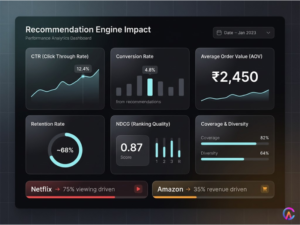
Netflix sees 75% of views coming from recommendations, and there’s a whopping 93% member satisfaction thanks to personalization. Over at Amazon, 35% of sales are driven by recommendations, translating to billions in annual impact.
YouTube boasts that 70% of watch time is fueled by recommendations, while Spotify follows closely with 60% of its streams coming from similar suggestions. Key metrics like NDCG (normalized discounted cumulative gain), diversity, coverage, business lift, average order value, and retention are all crucial in this landscape.
Future Trends 2026 Beyond
Innovation accelerates.
Multimodal Recommendations
CLIP style models blend text, images, and video embeddings to enhance visual search, and this trailer suggests similar content. Generative recommendations create engaging images that can boost click through rates by 20%.
Federated Learning Privacy Preserving
Learn across devices without needing to centralize data, all while staying compliant with GDPR. Differential privacy with epsilon helps control data leakage.
Autonomous Agents Proactive Personalization
LLM agents keep an eye on your context and proactively suggest new episodes based on what’s in your queue.
Graph Neural Networks Relational Learning
PinSage from Amazon uses social graphs to amplify signals, resulting in a 15% lift. Temporal graphs help capture changing tastes over time.
How CodeAries Helps Customers Build Real Time Recommendation Engines
CodeAries provides comprehensive recommendation systems that power personalization at the scale of Netflix and Amazon. Here’s how we turn your data into engines that drive revenue:
- We design streaming pipelines that can process millions of events per second with sub 50ms inference times.
- Our hybrid model ensembles blend collaborative, content based, and sequential learning for optimal results.
- We implement bandit feedback loops that continuously optimize the balance between exploration and exploitation.
- Our scalable feature stores serve trillions of embeddings globally with low latency.
- We deploy A/B testing infrastructure to measure causal lift in production traffic.
Frequently Asked Questions
Q1: How does Netflix personalize 75 thumbnails instantly?
Two tower models precompute embeddings, and real time ranking selects the top slate in under a second.
Q2: What makes Amazon’s item-item collaborative filtering so effective?
Inverted indexes quickly compute similarities, allowing for fast scaling across billions of products without relying on user ratings.
Q3: How do engines tackle cold start problems?
They use content metadata and popularity priors from knowledge graphs to immediately bootstrap new users and items.
Q4: Why choose bandits over standard machine learning ranking?
Bandits strike a balance between exploration and exploitation, helping to discover better long-term recommendations.
Q5: Can smaller businesses create real time recommendation engines?
Absolutely, With cloud feature stores and open source tools like RecBole and openbandit, they can slash compute needs by 90%.
For business inquiries or further information, please contact us at