

Designing applications that cater to millions of users requires a careful balance of performance, reliability, cost, and maintainability right from the start. By 2026, major players like Netflix, Uber, and Airbnb will be handling billions of requests every day through distributed systems, microservices, cloud native stacks, and AI orchestration. When scaling goes wrong, it can lead to significant outages, like the $440 million loss suffered by Knight Capital in just 45 minutes or the crashes experienced by Robinhood during the Super Bowl. Key phrases such as “designing for scale,” “scalable application architecture,” and “horizontal scaling strategies” are crucial for SEO in 2026. This guide aims to provide you with essential principles, architectural evolution, scaling patterns, real world examples, monitoring challenges, solutions, and trends for the coming years.
Foundational Principles of Scalable Design
Scaling starts with the right mindset, not just bigger servers.
Statelessness and Horizontal Scaling Fundamentals
Focus on designing stateless services that can scale out by adding more instances instead of relying on larger virtual machines. Use session tokens stored in Redis or Memcached rather than server memory to ensure they survive restarts and load balancer rotations.
API idempotency is key for safe retries, especially for POST payments, where idempotency keys help prevent duplicate transactions. Implementing graceful degradation with circuit breakers can stop cascading failures, while timeouts, retries, and backoff patterns help isolate faults.
Loose coupling through event queues allows services to operate independently. Adopting domain driven design with bounded contexts helps avoid the pitfalls of monolithic architectures.
Capacity Planning Predictive Modeling
Forecast peak daily active users (DAU) with a hockey stick growth model, aiming for a 20% month over month increase. Calculate requests per second (RPS) and concurrency using the formula: Concurrency = RPS × Avg Response Time. Set P99 latency targets to under 200ms and aim for 99.99% uptime with your service level objectives (SLOs).
Before launching, conduct load testing with tools like Locust or Artillery to simulate 10x peak loads. Embrace chaos engineering, like Netflix’s Chaos Monkey, which randomly terminates instances to reveal weaknesses in your system.
Architectural Evolution Zero to Millions
Let’s explore how progressive patterns align with different growth stages.
10-1K Users Monolith Serverless Foundation
In the early stages, a monolith can really simplify development. You deploy once, and it scales vertically with just 16 vCPUs doing the trick. For those sudden bursts of activity, Serverless options like Lambda and Vercel take over, requiring zero operational effort. To manage reads, we use leader follower database replication with PostgreSQL, Aurora, or MySQL.
Static assets are served through CDNs like CloudFront and BunnyCDN, which help reduce the load on the origin server. Plus, autoscaling groups in EC2 and GKE kick in to add instances when CPU usage hits that 70% mark.
10K-100K Users Microservices CDN Caching Layer
As we grow, microservices break down the monolith, allowing for independent scaling of authentication, payments, and search services. Kubernetes takes the reins for orchestrating deployments, ensuring rolling updates happen without any downtime.
To enhance performance, we implement read replicas and sharding, partitioning the database by user ID or tenant. A Redis cluster helps cache frequently accessed data, boasting an impressive 80% hit ratio with sub millisecond latency. For dynamic content, we rely on global CDNs like Akamai and Cloudflare, using Varnish rules for edge caching.
An API gateway, such as Kong or AWS API Gateway, manages traffic, centralizes authentication, and enforces rate limits.
100K-1M Users Sharding Edge Global Distribution
At this stage, we employ database sharding with consistent hashing, distributing user data across 1024 buckets. Multi region active active deployments ensure low latency, with Cloudflare Workers executing logic close to users.
We also adopt event sourcing and CQRS to separate read and write operations, utilizing Kafka streams for durable messaging and Apache Pulsar for event handling. GraphQL federated schemas help us efficiently aggregate microservices.
A service mesh like Istio or Linkerd provides traffic management and observability, focusing on key metrics like latency, traffic saturation, and error rates.
1M+ Users AI Orchestration Federated Sharding
With over a million users, AI orchestration and federated sharding are making waves.
AI autoscaling in Kubernetes (K8s) uses HPA to predict demand through Prophet LSTM models, allowing for proactive scaling of pods. Mixture experts (MoE) intelligently direct requests to specialized services on the fly.
Federated sharding divides data into geo partitions, with shards located in Singapore, the EU, and the US. Serverless containers powered by Knative can scale down to zero, optimizing for cold starts. Beyond Kubernetes, eBPF and Cilium enhance kernel level networking, boosting throughput by ten times.
Core Scaling Patterns Battle Tested
These tried and true techniques are the backbone of hyperscalers.
Caching Strategies Multi Layer Defense
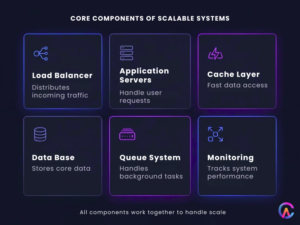
At the first layer, we have an L1 app memory LRU cache that holds up to 10,000 items. The second layer features a 100GB Redis cluster with pub sub invalidation and write through capabilities. Finally, the third layer employs a CDN to geo cache HTML, CSS, and images.
With a cache aside strategy, we lazy load and populate on a miss. To prevent cache stampedes, we use a mutex to manage thundering herds. Our TTL strategies vary, with 5 minute settings for volatile data and 24 hour settings for reference data.
Database Scaling Read Replicas Sharding Replication
For vertical scaling, we rely on SSDs, indexes, and connection pooling via PgBouncer. On the horizontal front, we implement read replicas with a 10:1 read write ratio and cross AZ failover.
Sharding is done using range, hash, and composite keys. Vitess and ProxySQL help manage shared maps, enabling online resharding without downtime. NewSQL solutions like CockroachDB and Spanner support geo distributed ACID transactions.
Asynchronous Processing Queues Backpressure
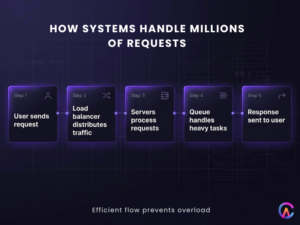
Using SQS and RabbitMQ, we create durable queues that decouple producers from consumers. Fanout patterns help broadcast events, while dead letter queues manage retries for problematic messages with exponential backoff.
Backpressure queues handle overload gracefully, employing rate limiting and token bucket algorithms.
Load Balancing Global Traffic Management
Layer 7 NGINX and Envoy manage HTTP and gRPC traffic using techniques like weighted round robin and least connections. Global server load balancing (GSLB) employs DNS anycast for latency based routing.
We also have health checks that actively and passively probe endpoints, along with circuit breakers to ensure stability.
Real World Architectures Case Studies
Hyperscalers share the real stories behind their production environments.
Netflix 250M Subscribers Chaos Engineering
Their microservices architecture includes over 1,000 Spring Boot applications, utilizing a Zuul gateway and Hystrix circuit breakers that have evolved into Istio. They manage a staggering 3 petabytes of data in Cassandra, sharded by title and user. Keystone handles dynamic configurations with up to 100,000 changes per minute.
Cassandra also aggregates real time views from a Kafka and Flink personalization pipeline, processing an impressive 100 billion events daily.
Uber 100M Trips Weekly Geospatial Scaling
They use ring pop for consistent hashing across more than 1,000 services. Their schemaless MySQL setup features 500 shards, while the Xaiver dispatch engine leverages geospatial indexes in an H3 grid to connect millions of drivers and riders.
M3 time series metrics capture 1 trillion samples a day, with Prometheus and Grafana for monitoring.
WhatsApp 2B Users Erlang Telemetry
Their architecture employs the Erlang actor model to handle 2 million connections at its core, with millions of lines of fault tolerant code. Mnesia serves as their distributed database, supported by Ejabberd for the XMPP backbone. They utilize FreeBSD with ZFS storage and onion routing for enhanced privacy.
Monitoring Observability SRE Practices
Visibility is crucial to avoid surprises.
Golden Signals RED Method
Let’s break down the key metrics: error rates, duration, and resource saturation. Prometheus gathers metrics, while Grafana dashboards, alertmanager, and PagerDuty handle escalations.
For distributed tracing, we have tools like Jaeger and OpenTelemetry that help spans propagate context and visualize latency waterfalls.
When it comes to logging, the ELK stack shines with structured JSON and Loki for compression. We also need to keep an eye on SLOs, with a monthly failure allowance of just 0.1%.
Synthetic monitoring and canary deployments are crucial, allowing us to test changes with 5% of traffic and roll back if we hit any SLO breaches.
Common Pitfalls Antifragile Mitigations
Failures are great teachers when it comes to building resilience.
Database as Bottleneck Single Point Failure
To tackle this, consider solutions like sharding, read replicas, and managed services such as Aurora and CosmosDB. Connection storms can be managed with pooling, capping at 100 connections per pool.
Caching Invalidation Hell
We need to think about eventual consistency, TTLs, and pub sub invalidation. Cache warming can help by pre populating those hot keys.
Microservices Distributed Monolith Trap
It’s essential to align service boundaries with business domains rather than just technology. Using GraphQL and OpenAPI can help prevent unwanted coupling.
Vendor lock in can be avoided with escape hatches, polyglot persistence, and ensuring Kubernetes portability.
2026 Trends Future Proofing Scale
Innovation is constantly pushing the boundaries..
AI Driven Autoscaling Predictive Capacity
Machine learning models like LSTM and Prophet can forecast requests per second, allowing us to scale preemptively within a 30 minute window. Reinforcement learning can optimize resource allocation, leading to 20% cost savings.
Edge Computing Serverless Global
With tools like Cloudflare Workers and Deno Deploy, we can execute user side tasks with just 100ms cold starts. WASM modules enable polyglot runtimes in a single binary format, whether it’s Rust, Go, or JavaScript.
eBPF Zero Trust Networking
magine a world where kernel observability meets networking, boasting a whopping 10Gbps throughput with Cilium and Hubble for visualization. We’re talking about zero trust service meshes with mTLS working seamlessly in the background.
Sustainable Scale Green Computing
With Arm Graviton3, you can enjoy 40% efficiency gains and save up to 70% with spot instances. Plus, carbon aware scheduling helps you operate in low emission regions.
How CodeAries Helps Customers Design Scalable Applications
At CodeAries, we specialize in building hyperscale architectures that support millions of users without a hitch. Here’s how we fuel your growth:
- We architect microservices with sharding and caching pipelines that can handle over 1 million concurrent users.
- Our team implements Kubernetes with Istio for service mesh, ensuring global load balancing and multi region failover.
- We design streaming data platforms using Kafka and Flink for real time personalization, processing millions of events per second.
- Our observability stacks, including Prometheus, Grafana, and OpenTelemetry, help you track golden signals and set up alerting.
- We optimize cost efficiency with AI driven autoscaling and serverless edge computing, guaranteeing 50% savings.
Frequently Asked Questions
Q1: What single change scales apps fastest?
Stateless horizontal scaling by adding instances is key, as opposed to relying on larger servers, load balancing is essential.
Q2: How can we prevent databases from becoming bottlenecks for millions of users?
Utilizing sharding and read replicas with managed services like Aurora, which offers a 10:1 read write ratio, allows for linear scaling.
Q3: Why choose microservices over monoliths when scaling?
Microservices allow for independent scaling, enhance team velocity, provide fault isolation, and enable different tech stacks for each service.
Q4: What monitoring essentials are needed for production scale?
You’ll want to focus on golden signals like RED, tracing, SLOs, and error budgets, along with chaos testing to proactively expose weaknesses.
Q5: How will edge computing change scaling by 2026?
By running logic closer to users, we can achieve 100ms latency and global distribution, which could cut cloud costs by 40%.
For business inquiries or further information, please contact us at