
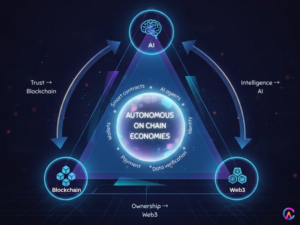
AI blockchain and Web3 are no longer just separate entities, they’re merging into systems where smart agents utilize decentralized infrastructure for identity, payments, data, and trust. By 2026, this fusion will give rise to verifiable autonomous economies, with AI agents negotiating, executing contracts, and managing assets on chain, while blockchain serves as the backbone for transparency and security.
Let’s take a closer look at how these technologies will come together in 2026, and how Codearies is paving the way for innovative products at this cutting edge.
1) AI agents on blockchain autonomous execution
AI agents are transforming into on chain participants that manage wallets, sign transactions, and interact with smart contracts all on their own. Blockchains create a trustworthy environment where these agents can function without needing central intermediaries.
Key points
- Web3 AI agents are moving past mere experimentation and into real world enterprise applications, where they negotiate, execute contracts, and transfer assets, with every action recorded immutably.
- Smart contracts outline the boundaries for agents, while AI provides the decision making power, and decentralized verification ensures protection against manipulation.
- Initiatives like Ritual Fetch.AI and Grass are developing protocols for agent to agent commerce, while wallets from Coinbase, Solana, and Polygon are integrating AI capabilities.
These agents are turning blockchains into the essential infrastructure for AI driven finance, logistics, and management.
2) Verifiable AI blockchain for trust and provenance
Blockchain addresses the trust issues in AI by documenting model versions, tracking training data lineage, and recording outputs with cryptographic proofs.
Key points
- As fleets of AI agents access sensitive data and take actions, verifying their behavior becomes critical, with blockchain dashboards monitoring their activities.
- Zero knowledge proofs (ZK proofs) can demonstrate model accuracy, fairness, or content authenticity without disclosing intellectual property or raw data.
- Protocols like Worldcoin, Provenance Labs, and Adobe’s Content Authenticity Initiative leverage blockchain to fight deepfakes and verify synthetic content.
This paves the way for auditable AI, which is vital for enterprises and regulatory compliance.
3) Decentralized AI infrastructure DePIN for compute and data
DePIN networks are all about providing decentralized computing power and storage specifically designed for AI tasks, steering clear of those big centralized cloud providers.
Key points
- Platforms like Akash, io.net, Render, and Bittensor are shaking things up by distributing GPU resources for AI training, inference, and rendering, all while offering token rewards.
- Decentralized data markets allow AI to tap into tokenized datasets, models, and computing power through smart contracts.
- DeAI protocols are booming, growing by fifty percent or more, thanks to institutional interest and the scalability of AI on the blockchain.
AI gets a free pass to infrastructure, while blockchain benefits from real revenue driven by computing demand.
4) Tokenized AI marketplaces and economies
AI resources are turning into tokenized assets that can be traded in decentralized marketplaces for models, data, computing, and inference.
Key points
- Decentralized AI marketplaces facilitate the exchange of datasets, models, and computing power through smart contracts, connecting closed AI systems with the open Web3.
- AgentFi is on the rise, where autonomous agents take charge of yield farming, trading, and DeFi strategies across various chains.
- Initiatives like Ocean Protocol, iExec, and Render are tokenizing AI services, paving the way for new economic models.
This opens up permissionless markets for AI capabilities.
5) AI powered smart contracts and automation
AI is taking smart contracts to the next level with dynamic decision making, while blockchains ensure that AI actions are both verifiable and composable.
Key points
- AI driven smart contracts can adapt to real world data conditions and forecasts, making them useful for finance, insurance, and supply chains.
- Autonomous economies are emerging, where AI agents oversee ongoing, transparent global operations.
- Verifiable AI records track model origins and performance metrics on the blockchain.
Contracts are becoming smarter and more proactive.
6) Privacy preserving AI with ZK and on chain identity
ZK proofs and decentralized identity allow AI to handle data privately while still proving results on the blockchain.
Key points
- ZK technology enables privacy preserving AI inference, where computations occur off chain, but proofs validate their accuracy.
- On chain identities and attestations provide AI agents with trusted identities for KYC compliance and access control.
- This framework supports regulated DeFi, real world assets, and enterprise AI.
Privacy and verifiability coexist.
7) Enterprise blockchain with AI governance
Enterprises are increasingly turning to hybrid stacks, where AI enhances blockchain operations and blockchain audits inform AI decisions.
Key points
- AI driven blockchain agents take on essential enterprise tasks such as compliance monitoring, asset management, and workflow automation.
- A multi layered validation process merges smart contracts, AI inference, and decentralized verification.
- This approach is particularly beneficial for sectors like finance, logistics, and wealth management.
Enterprise gets the best of both worlds.

How Codearies helps customers build AI blockchain Web3 convergence
Codearies is at the forefront of designing and implementing products that sit at the intersection of AI, blockchain, and Web3, providing verifiable autonomous systems for both enterprises and startups.
How Codearies supports convergence projects
-
AI agent and AgentFi development
Codearies creates on chain AI agents that facilitate trading, automate DeFi processes, and coordinate multiple agents, all while integrating wallets and executing smart contracts.
-
DeAI and DePIN infrastructure
We develop decentralized computing data marketplaces and tokenized AI services on networks such as Bittensor, Render, and iExec.
-
Verifiable AI and provenance
We implement zero knowledge proofs, blockchain provenance, and audit trails to ensure transparency for AI model outputs and agent actions.
-
Enterprise hybrid stacks
We integrate AI optimization with blockchain technology to enhance governance, compliance, and operations in finance, supply chains, and Web3 applications.
-
Full product lifecycle
From architecture and tokenomics to deployment, scaling, and governance, Codearies transforms innovative convergence ideas into fully operational systems.
FAQs
Q1 What is the biggest convergence trend in 2026?
AI agents will be working independently on the blockchain for tasks like executing identities and handling payments, while the blockchain itself ensures the trustworthiness and origin of these AI systems.
Q2 How does blockchain solve AI trust issues?
By using provenance tracking, zero knowledge proofs create unchangeable audit logs and allow for decentralized verification of model data and the actions of agents.
Q3 Can Codearies build AI agents that execute on chain?
Absolutely, Codearies is all about developing agents equipped with wallets, capable of interacting with smart contracts, coordinating multiple agents, and implementing security layers for DeFi trading and automation.
Q4 What are leading projects in this space?
Some of the top projects include Render, Bittensor, Fetch.AI, Ocean Protocol, iExec, Ritual, Grass, and various protocols focused on decentralized AI compute and data.
Q5 Timeline for a convergence project with Codearies?
You can expect agent prototypes and DeFi pilots to roll out in a matter of weeks to months, with full enterprise systems being developed in phases over quarters, complete with audits, compliance checks, and scaling efforts.
For business inquiries or further information, please contact us at