
AI trading agents are emerging as a new breed of autonomous systems that can monitor markets around the clock, analyze thousands of signals every second, and execute strategies across both centralized and decentralized exchanges without the emotional biases or fatigue that humans experience. In the world of crypto, this trend is increasingly referred to as DeFAI, which blends decentralized finance with AI driven trading logic. These agents operate on blockchain networks or around smart contracts, directly interacting with DeFi protocols. They pose a significant challenge to traditional discretionary traders and even many systematic human traders by drastically reducing reaction times, capitalizing on tiny inefficiencies, and scaling strategies to levels that no manual trading desk can match, all while introducing new types of systemic risk.
From bots to AI trading agents
Basic trading bots have been around for years, executing simple rules for market making, arbitrage, or trend following. They depend on hard coded conditions and often fail when market conditions change or data becomes erratic. AI trading agents take it a step further. They leverage machine learning models to identify patterns in price movements, order books, on chain flows, and even off chain news sentiment. These agents can adapt their strategies over time, learning which signals are significant in various volatility environments and adjusting their allocations accordingly.
In the DeFi space, AI agents can connect directly to smart contracts, providing liquidity to automated market makers (AMMs), adjusting positions in lending markets, hunting for on chain arbitrage opportunities, and rebalancing portfolios in near real time. Instead of a human monitoring dashboards, an agent keeps an eye on the mempool, liquidity pools, and oracle feeds, executing complex multi step transactions seamlessly. This blend of autonomy, speed, and composability is what sets DeFAI apart from traditional bot based trading setups.
Why AI is so powerful in trading
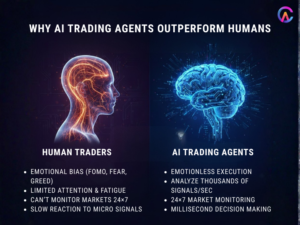
Markets are constantly churning out massive streams of data, think tick data, order books, liquidations, funding rates, social media chatter, and macroeconomic news. It’s a lot for human traders to keep up with on a continuous basis. That’s where AI models come in, especially those using deep learning and reinforcement learning. They can handle vast, multi dimensional datasets and spot complex, non linear relationships between various inputs and future returns or risk profiles. By analyzing factors like volatility clusters, order book imbalances, whale wallet movements, and correlated asset shifts, they can predict short term price movements.
AI also helps eliminate emotional biases that often plague human traders. Emotions like fear of missing out, loss aversion, and the tendency to overtrade after a loss can cloud judgment. Well designed AI agents, on the other hand, adhere to data driven strategies and risk management rules. They know when to pull back on exposure if the signals start to weaken, rather than doubling down on losing trades. Over time, this disciplined approach can lead to significant performance advantages, especially in high frequency or intraday trading, where human emotions and reaction times can be major drawbacks.
How DeFAI agents operate in on chain markets
In the world of decentralized finance, AI trading agents engage with protocols in a variety of ways.
One common approach is autonomous market making. These agents keep an eye on volume, volatility, and order flow on automated market makers (AMMs), adjusting liquidity ranges, fees, or pool allocations in real time. For instance, an AI agent might decide to concentrate liquidity closely around the current price or spread it out to minimize impermanent loss. They can also shift liquidity between different pools or chains based on yields and risk assessments.
Another strategy involves cross protocol arbitrage and rebalancing. An AI agent continuously scans for price differences between decentralized exchanges (DEXs), centralized exchanges (CEXs), and derivatives markets. When it identifies mispricings, it can execute complex multi leg trades, including flash loans, to secure profits. Additionally, it can rebalance collateral and borrowing across lending protocols, optimizing funding costs for a treasury or investment fund based on current rates and utilization.
Portfolio style DeFAI agents are designed to handle longer term investments. They typically spread their allocations across blue chip tokens, DeFi governance tokens, stablecoins, and yield strategies, all based on risk models that take into account on chain analytics like protocol total value locked (TVL), governance activity, emission schedules, and whale movements. These agents regularly rebalance their portfolios and may use options or perpetual contracts to hedge when necessary.
Will AI agents replace human traders
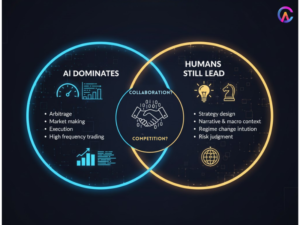
AI trading agents are set to take over many roles in trading, but they won’t replace everything. Routine tasks like basic arbitrage, passive market making, and straightforward trend strategies are already being handled by algorithms in traditional finance, and this trend is only speeding up in the crypto space. As DeFAI continues to evolve, the proportion of trading volume managed by autonomous agents is expected to increase, putting pressure on discretionary traders who don’t have a distinct informational or structural advantage.
That said, markets are intricate and adaptive systems. Human creativity is still vital for crafting innovative strategies, shaping new narratives, and grasping regime shifts that disrupt previous correlations. People are particularly good at interpreting complex geopolitical events, regulatory changes, or technological advancements that models may not have encountered before. The most successful trading organizations will likely blend human strategic insight with AI agents for execution, scanning, and optimization, creating a hybrid model where humans and machines work together rather than one completely replacing the other.
Another significant limitation is that models rely on historical data for training. When markets venture into truly uncharted territory, AI can falter dramatically if not properly managed. Human oversight is essential for tracking performance, stepping in when assumptions fail, and determining when to retire or retrain models. Therefore, DeFAI is more likely to shift human traders into roles as supervisors and designers of agent ecosystems rather than eliminate them altogether.
New risks introduced by DeFAI
As AI agents continue to gain traction, several systemic risks start to surface.
Herding and correlation: When numerous agents are trained on similar data and share the same objectives, they tend to adopt comparable strategies. In stable markets, this can boost efficiency, but during stressful events, it can lead to crowded exits, sudden liquidity gaps, and feedback loops where AI driven selling prompts even more selling.
Adversarial behavior: Unscrupulous individuals might try to manipulate AI systems by injecting misleading patterns into data streams, spoofing order books, or taking advantage of known model behaviors. If agents aren’t resilient against such adversarial inputs, they risk becoming exploitable instead of generating alpha.
Overfitting and regime shifts: Models that perform well in backtests might just be overfitted to random noise. When actual conditions change, they can quickly lose capital. Without solid risk controls, position limits, and kill switches, DeFAI can collapse faster than human run desks because the reaction loops are automated.
Smart contract and integration risk: DeFAI agents that depend on complex multi leg DeFi transactions carry all the risks associated with smart contract bugs, MEV attacks, oracle failures, and bridge exploits. Poorly designed transaction flows can be sandwiched or front run by MEV bots, turning what could be profitable strategies into consistent losses.
Regulatory uncertainty: As AI driven trading grows, regulators may introduce new rules regarding algorithmic trading, transparency, and risk management. Projects operating DeFAI systems without clear legal frameworks could find themselves facing unexpected enforcement actions.
Best practices for designing robust AI trading agents
Teams building AI trading agents should adopt several principles.
First off, prioritize risk. Your strategies should focus on risk limits, drawdown thresholds, and rules for preserving capital, rather than just aiming for the highest backtested returns. Implementing stop conditions and capital throttles can safeguard against potential model failures.
Next, aim for explainability whenever you can. While some deep learning models can feel like black boxes, adding layers of explainability and diagnostic metrics can help operators grasp which signals are influencing behavior and identify when the model is deviating from expected performance.
Also, consider using diverse models and ensembles. Instead of depending on a single, large model, leverage ensembles and diversify across different timeframes and signal types. This approach minimizes the risk of one modeling error derailing your overall performance.
Don’t forget about human oversight. It’s crucial to keep humans in charge of approving strategies, making parameter changes, and allocating capital. While agents can suggest trades and make adjustments within set limits, they shouldn’t have unchecked authority.
Lastly, ensure your infrastructure is robust. Strengthen it against latency spikes, network issues, and specific risks associated with DeFi. Test transaction flows in simulated environments, including chaotic scenarios like oracle failures and situations with heavy MEV activity.
How Codearies helps you build DeFAI and AI trading agent systems
Codearies collaborates with trading desks, DeFi protocols, and crypto startups that are eager to create, launch, and scale AI driven trading agents in a responsible way. Rather than just throwing a black box model into the mix and crossing fingers for positive results, Codearies views DeFAI as both an engineering and governance challenge, as well as a data science issue.
During the discovery phase, Codearies helps you clarify your trading goals, timeframes, risk tolerance, and operational limits. The team partners with you to determine which aspects of your system should be automated like signal generation, execution routing, portfolio rebalancing, or DeFi strategy management, and which should stay under human oversight. This approach ensures that the agents enhance your core expertise instead of replacing it.
On the technical front, Codearies can create and implement data pipelines for both on chain and off chain signals, develop feature engineering frameworks, and set up modular model training environments. The agents are connected to your execution venues, whether centralized exchanges, DeFi protocols, or both, through secure API layers and smart contract integrations. The architecture focuses on latency aware routing, order book safety checks, and strong error handling, ensuring that agents don’t make reckless decisions in thin or manipulated markets.
Risk management and governance are woven into every aspect. Codearies helps establish position limits, VaR style checks, maximum daily losses, and circuit breakers that automatically reduce or halt trading when certain metrics are exceeded. Monitoring dashboards offer real time insights into PnL, signal health, slippage, and model drift, allowing portfolio managers to step in when necessary. For DeFi focused agents, Codearies can create simulation environments that replay historical on chain scenarios to stress test strategies against past crashes, liquidations, and MEV events before they go live.
At Codearies, we understand that every market and team has its own unique needs, which is why we don’t believe in a one size fits all approach. Instead, we work closely with you to develop tailored strategies, whether you’re into market making, DeFi yield rotation, or cross market arbitrage. We package these strategies into adaptable agent frameworks that can grow and change with new data and market conditions. Over time, Codearies also facilitates versioning, retraining, and controlled rollouts of updated agents, ensuring that any improvements are safely integrated into production.
FAQs
Q1: What sets an AI trading agent apart from a regular trading bot?
A regular bot sticks to a set of rules and tends to fail when market conditions change. In contrast, an AI trading agent learns from data, adapts to new trends, utilizes various signals, and can handle everything from generating signals to executing trades and rebalancing—all while staying within defined risk limits.
Q2: Will DeFAI render human traders obsolete?
While DeFAI is likely to take over many routine and high frequency tasks, human traders and portfolio managers will still play a vital role in designing strategies, overseeing operations, and navigating complex market shifts or macroeconomic events. The future leans towards a collaboration between humans and AI, rather than humans working in isolation.
Q3: How does Codearies help manage risk with AI trading agents?
Codearies creates agents with strict position limits, stop loss conditions, and constant monitoring. Circuit breakers are in place to limit daily losses or losses per strategy, and humans maintain control over capital allocation and significant parameter adjustments, ensuring that agents operate within well defined boundaries.
Q4: Can Codearies link AI agents directly to DeFi protocols?
Absolutely, Codearies can seamlessly integrate agents with decentralized exchanges (DEXs), lending markets, derivatives protocols, and cross chain infrastructure, allowing them to execute DeFi strategies from start to finish while considering gas fees, slippage, and smart contract risks through careful transaction design.
Q5: What’s a realistic timeline for launching an AI trading agent with Codearies?
A focused pilot for a single strategy with a limited capital base can often go live in just a few months, covering everything from data pipelines to modeling and execution integration. Expanding to multi strategy portfolios, cross venue routing, and full DeFAI integrations usually occurs in phased rollouts over a longer timeline, depending on the complexity and compliance needs.
For business inquiries or further information, please contact us at