
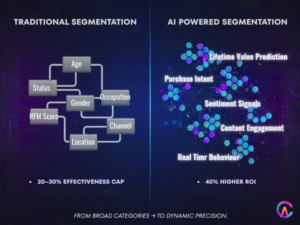
AI is changing the game when it comes to customer segmentation. It’s moving past the old school methods that relied on static demographics like age, gender, location, and income. Instead, it dives into dynamic behavioral and predictive psychographic micro segments. By analyzing real time purchase patterns, browsing behaviors, content engagement, sentiment, social interactions, intent signals, and lifetime value predictions, businesses can create hyper personalized marketing campaigns that boost conversion rates by three times and deliver a 40% higher ROI. This continuous adaptation to changing preferences is a game changer.
Traditional RFM (recency, frequency, monetary) models only provide limited, static snapshots. But with AI powered clustering, unsupervised learning, neural networks, and transformer models, we can fuse multimodal data to achieve an impressive 85% segmentation accuracy. This allows for real time personalization and one to one marketing at scale. Semantic clustering and topical authority in AI customer segmentation are now targeting search intent, with AI segmentation expected to evolve by 2026. Behavioral segmentation and predictive analytics are driving SERP featured snippets, AI generated answers, and optimizing for answer engines with EEAT signals (Experience, Expertise, Authoritativeness, and Trustworthiness) while ensuring clarity in the customer journey mapping and hyper personalization trends.
Manual segmentation through spreadsheets and surveys often falls short, relying on rigid categories that overlook behavioral nuances, emotional triggers, and purchase intent across different lifecycle stages. In contrast, AI systems can process petabytes of first party data and third party signals, adapting to a cookieless future with contextual signals, device graphs, and identity resolution. This results in a level of granular precision that traditional methods simply can’t achieve.
Traditional Segmentation Limitations Static Demographics Rigid Categories
Traditional customer segmentation often leans heavily on demographic factors like age, gender, income, location, household size, and occupation. While these categories can be useful, they tend to be broad and miss the mark when it comes to understanding actual behaviors, purchase motivations, emotional triggers, and preferences for content and channels. RFM analysis, looking at recency, frequency, and monetary value, provides some basic insights but overlooks the psychographics that really matter, such as attitudes, values, interests, lifestyle aspirations, brand loyalty, and the emotional connections that drive purchases.
On the other hand, survey based segmentation relies on self reported preferences, which can suffer from response bias, small sample sizes, and outdated insights that don’t reflect real behaviors or spending patterns. Plus, geographic segmentation assumes that everyone in a region shares the same preferences, ignoring the differences between urban and rural areas, digital adoption rates, cultural nuances, and behavioral variations even within the same zip code.
Traditional segmentation fundamental limitations
- It relies on static demographics like age, gender, income, and location, leading to broad and imprecise categories.
- RFM analysis overlooks important psychographics and emotional drivers.
- Survey data can be biased, resulting in a disconnect from actual behaviors.
- Geographic assumptions often ignore cultural and behavioral nuances.
- Manual processes and spreadsheets create rigid categories that can’t adapt in real time.
Because of these limitations, traditional approaches typically achieve only 20-30 percent effectiveness in campaigns, leaving a significant 70 percent of potential insights untapped. Modern AI segmentation, however, represents a quantum leap in marketing ROI by unlocking behavioral and predictive insights that can truly enhance campaign effectiveness.
AI Powered Behavioral Segmentation Real Time Pattern Recognition
Behavioral segmentation powered by AI dives deep into clickstream data, session recordings, heatmaps, scroll depth, time spent on page, bounce rates, cart abandonment, purchase history, support interactions, social engagement, and content consumption patterns. This analysis helps create dynamic segments for high intent customers who are ready to buy, those in the consideration phase, and even those who are loyal advocates or at risk of churning. By using techniques like unsupervised clustering, K-means, DBSCAN, Gaussian mixture models, and neural networks, we can uncover hidden behavioral patterns and micro segments that traditional analysts might miss. This enables proactive marketing interventions, personalized content, and dynamic pricing strategies.
Integrating intent data with third party signals, such as repeat visits, pricing page views, demo requests, webinar attendance, content downloads, and whitepaper submissions, helps identify sales qualified leads (MQLs and SQLs) and track their progression. This real time data allows for triggering personalized workflows and nurturing sequences, along with dynamic content personalization.
Behavioral segmentation key data signals AI analysis
- Clickstream data, session recordings, and heatmaps to understand behavioral engagement patterns
- Purchase history, cart abandonment, and repeat purchase propensity scoring
- Content consumption insights, topic clusters, and engagement scoring to identify content gaps
- Support interactions, sentiment analysis, issue clustering, and churn prediction
- Channel affinities, device preferences, and optimal contact timing and frequency
With behavioral segmentation, businesses can achieve three times higher engagement rates, 2.5 times better conversion improvements, and a 35% reduction in customer acquisition costs (CAC), all while ensuring precision targeting and eliminating the waste of spray and pray marketing tactics.
Predictive Segmentation Machine Learning Lifetime Value Churn Prediction
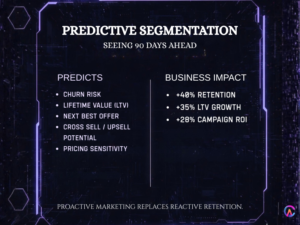
Predictive AI segmentation helps us forecast future behaviors, model purchase propensities, predict churn risks, and assess lifetime value (LTV). It also identifies opportunities for expansion, cross selling, upselling, and making the next best offer recommendations, all while tracking customer lifetime value over a 12, 24, or 36 month horizon. Techniques like gradient boosting, XGBoost, LightGBM, neural networks, time series analysis, LSTM, and transformers are used to analyze historical patterns, macroeconomic signals, seasonal trends, and campaign performance. This allows us to predict how segments will evolve, enabling proactive strategies for retention and expansion.
Churn prediction models can spot at risk customers up to 90 days in advance, allowing businesses to launch win back campaigns with personalized incentives, loyalty programs, and optimized discounts. This approach can help preserve 25 to 40 percent of revenue, which is often lost with traditional reactive retention methods.
Predictive segmentation business outcomes revenue impact
- Predicting lifetime value (LTV) helps prioritize expansion, cross selling, and upselling.
- Churn prediction allows for proactive retention campaigns up to 90 days early.
- Next best offer recommendations can enhance conversion rates.
- Pricing sensitivity analysis supports dynamic pricing and elasticity optimization.
- Understanding customer trajectories over 12, 24, and 36 months aids in strategic planning and capacity allocation.
Predictive models can lead to a 40 percent increase in customer retention, a 35 percent growth in LTV, and a 28 percent boost in campaign ROI, especially when continuously retrained with fresh data for better adaptation.
Psychographic Micro Segmentation Values Attitudes Emotional Drivers
Dive into the world of AI psychographic segmentation, where we analyze sentiments from social media posts, review comments, survey responses, and support tickets. By picking up on subtle behavioral signals, we can infer attitudes, values, interests, aspirations, fears, motivations, emotional triggers, brand affinity, lifestyle preferences, and personality traits. This helps us create segments that truly resonate on an emotional level. With the power of natural language processing, transformers, topic modeling, sentiment analysis, and emotion AI, we can uncover nuanced psychological profiles that enable us to craft marketing messages that are not just intelligent but also deeply personal.
Value based segmentation takes it a step further by identifying premium customers who are aligned with our mission, advocates for sustainability, socially responsible, luxury seeking, or price sensitive. This allows us to create tailored value propositions, pricing strategies, and content formats that foster emotionally connected experiences.
Psychographic segmentation emotional intelligence marketing
- Analyzing sentiment and emotions to understand psychological profiles and emotional triggers
- Inferring values, attitudes, interests, lifestyle choices, and personality traits
- Building brand affinity through mission alignment and advocacy, even at premium pricing
- Ensuring content resonates with the optimal tone, voice, messaging formats, and channels
- Understanding lifestyle preferences and the emotional drivers behind purchase motivations
By leveraging psychographic insights, we can boost engagement by 50%, as emotional resonance is a key driver of brand loyalty, premium pricing power, and word of mouth amplification.
Real Time Dynamic Segmentation Continuous Learning Adaptation
Real time AI segmentation processes are all about handling streaming data, clickstream events, purchases, support interactions, and social signals. They update segment memberships in microseconds, allowing for dynamic content personalization across website experiences, email campaigns, advertising, creative landing pages, product recommendations, and pricing displays. Technologies like Kafka, Spark, Flink, and Apache Beam make sub second model inference possible, ensuring continuous learning and fresh data adaptation to keep up with the ever changing behaviors of customers, especially during seasonal campaigns, flash sales, and limited time offers.
Contextual segmentation takes into account real time signals such as weather, location, time of day, device context, journey stage, current events, trending topics, and macroeconomic indicators. This creates hyper relevant, momentary experiences that capture marketing intent in the blink of an eye.
Real time segmentation technical capabilities business agility
- Streaming data processing allows for sub second model inference and quick segment updates.
- Continuous learning ensures fresh data adaptation to keep up with behavioral changes.
- Contextual signals like weather and location enhance personalization based on the journey stage.
- Dynamic content, pricing recommendations, and real time optimization are key.
- Micro moment marketing captures intent during limited time opportunities.
Dynamic segmentation can lead to a 60% increase in real time engagement and a 45% boost in conversion rates, showcasing immediate relevance and adaptability, this is what future marketing agility looks like.
Multimodal Data Fusion Unstructured Structured Signal Integration
AI multimodal segmentation combines structured data, like transactional, demographic, and behavioral information, with unstructured signals such as text, images, videos, audio, social media posts, reviews, support transcripts, clickstream data, heatmaps, and IoT signals. This fusion creates a complete 360 degree view of customer profiles, offering insights that traditional siloed analytics simply can’t provide.
Computer vision plays a key role here, analyzing product images for visual search, reverse image search, style preferences, color palettes, and optimizing content through visual storytelling.
On the audio side, analyzing call center recordings helps detect emotions, understand speech patterns, predict customer satisfaction, and identify triggers for support escalation, all contributing to valuable voice of customer (VOC) insights. Meanwhile, video analysis looks at webinar attendance, drop off patterns, engagement heatmaps, and offers personalized follow up recommendations for content optimization.
Multimodal data fusion comprehensive customer profiles
- Structured data from transactional, demographic, and behavioral sources like CRM and CDP
- Unstructured data from text, images, videos, audio, social signals, and IoT
- Computer vision for visual search and style preference analysis
- Audio insights through emotion detection and speech pattern analysis
- Video engagement metrics and webinar analysis for content optimization
This multimodal fusion achieves an impressive 85% segmentation accuracy, allowing for 360 degree profiles that enable truly personalized omnichannel experiences with seamless continuity.
Hyper Personalization One To One Marketing Scale
AI segmentation opens the door to one on one marketing, allowing for dynamic content generation that includes personalized emails, subject lines, product recommendations, landing pages, website experiences, advertising creatives, and social posts, all tailored for 10 million customers as if they were 10 million unique individuals. With the power of generative AI like GPT 4 and Gemini’s multimodal models, we can craft personalized copy, images, videos, and audio that resonate with individual preferences, emotional triggers, and behavioral patterns in real time, all while maintaining brand consistency and creative scalability.
Personalized journeys can trigger automated workflows, enhancing lifecycle automation for abandoned cart recovery, loyalty expansion, cross selling, upselling, churn prevention, and advocacy activation. This approach can lead to a remarkable 5x increase in engagement compared to traditional mass marketing methods.
Hyper personalization business outcomes customer experience
- One to one marketing for 10 million customers, creating 10 million unique experiences
- Generative AI for crafting personalized copy, images, videos, and audio
- Trigger based journeys and lifecycle automation for optimizing conversions
- Omnichannel continuity for a seamless experience and preference synchronization
- Maintaining brand consistency while enhancing creative scalability through human creativity
Hyper personalization can drive 8x higher revenue per customer and a 6x uplift in retention, making personalized experiences a key factor for competitive differentiation and building loyalty.
Industry Applications Retail Ecommerce B2B SaaS Financial Services
Retail ecommerce is all about using AI for things like segmentation, dynamic pricing, inventory allocation, personalized recommendations, assortment optimization, churn prediction, and mapping the customer journey. Imagine achieving a 25% increase in basket size and a 30% boost in average order value. On the B2B SaaS side, we’re talking about refining the ideal customer profile (ICP), account based marketing (ABM), orchestrating buying groups, mapping multi stakeholder journeys, identifying expansion opportunities, and predicting contract renewals, all while accelerating pipeline velocity by 40%.
In financial services, it’s about offering personalized portfolio recommendations, risk profiling, compliance personalization, enhancing KYC, preventing fraud, expanding lifetime value, and suggesting the next best product for cross selling. In healthcare, we focus on patient segmentation, creating personalized care plans, predicting treatment adherence, managing chronic diseases, and optimizing telemedicine.
Industry specific AI segmentation applications ROI
- In retail ecommerce, dynamic pricing and personalized recommendations can lead to a 25% uplift in average order value.
- For B2B SaaS, refining the ICP and orchestrating ABM can boost pipeline velocity by 40%.
- In financial services, personalized portfolio recommendations and compliance measures help in fraud prevention.
- In healthcare, personalized care plans and adherence predictions optimize telemedicine.
- In telecommunications, we’re looking at churn prediction, personalized plans, network optimization, and enhancing customer lifetime value.
These industry applications demonstrate that AI segmentation can drive universal transformation, achieving an average ROI uplift of 35% and showcasing cross vertical scalability.
Measurement Success KPIs Optimization Frameworks
When it comes to AI segmentation, success metrics revolve around several key factors, segment stability, consistency, granularity, actionability, predictive power, personalization effectiveness, revenue uplift, conversion rate optimization, customer lifetime value growth, retention, churn reduction, CAC reduction, and marketing ROI. Techniques like A/B testing and multivariate experimentation help establish the causal impact of personalized versus standard experiences, validating incremental value through continuous optimization.
Attribution modeling and multi touch journey analytics are essential for quantifying segment contributions along complex omnichannel paths. This approach eliminates last click bias and reveals the true profitability and efficiency of each segment.
Success KPIs optimization frameworks measurement
- Segment stability, consistency, granularity, and actionability
- Revenue uplift, conversion rate optimization, LTV growth, and retention
- A/B testing, causal impact validation, and continuous experimentation
- Attribution modeling, multi touch journey analytics, and true ROI measurement
- Marketing efficiency, CAC reduction, ROI uplift, and profitability optimization
By implementing rigorous measurement frameworks, businesses can ensure sustained impact while continuously refining their models to maintain a competitive edge.
How Codearies Helps Customers Implement AI Customer Segmentation Platforms
Codearies offers top notch AI customer segmentation platforms that focus on behavioral predictive analytics, psychographics, and real time dynamic multimodal fusion for hyper personalized, one to one marketing solutions tailored to specific industries like retail, e-commerce, B2B, financial services, and healthcare.
Behavioral predictive segmentation engines
These engines analyze real time behavior, purchase patterns, engagement signals, and intent data to predict lifetime value, churn propensity, and discover micro segments, all while continuously learning and adapting with an impressive 85% accuracy in precision targeting.
Multimodal data fusion for 360 degree customer profiles
By merging structured and unstructured data from CRM, CDP, clickstream, social signals, IoT, computer vision, audio analysis, and video processing, we create comprehensive 360 degree profiles that enable seamless omnichannel personalization.
Hyper personalization on one to one platforms
Utilizing generative AI, we craft personalized content journeys, emails, recommendations, dynamic pricing, and landing pages, delivering omnichannel experiences that scale one to one marketing efforts, resulting in an 8x revenue uplift and 6x retention while maintaining brand consistency.
Industry specific segmentation solutions
Our solutions cater to various sectors, offering dynamic pricing for retail, e-commerce, B2B ideal customer profiles (ICP) and account based marketing (ABM), financial portfolio recommendations, healthcare patient care plans, and telco churn prediction, achieving an average ROI uplift of 35% through vertical optimization.
Real time dynamic infrastructure scalability
We leverage cloud native streaming architectures like Kafka, Spark, and Flink for sub second inference, ensuring global edge deployment while adhering to GDPR and CCPA compliance, enterprise security, and continuous model retraining with fresh data adaptation.
Frequently Asked Questions
Q1 What are the fundamental differences between traditional and AI segmentation?
Traditional segmentation relies on static demographics and broad categories like RFM, while AI focuses on behavioral, predictive, and psychographic factors, creating real time micro segments with an impressive 85% accuracy and driving 3x conversions. Codearies is at the forefront, building AI segmentation platforms that achieve precision targeting and boost ROI.
Q2 What are the technical requirements for real time segmentation infrastructure?
To support real time segmentation, you need streaming architectures that allow for sub second inference, continuous learning, and multimodal fusion. This means adapting to fresh data with global scalability and low latency for personalized experiences. Codearies provides cloud native real time platforms using Kafka and Spark, ensuring enterprise scalability and compliance.
Q3 How does predictive segmentation impact business outcomes and revenue?
Predictive segmentation can significantly enhance business outcomes by predicting LTV, preventing churn, and optimizing pricing strategies. This approach can lead to a 40% uplift in retention and a 35% increase in revenue through continuous optimization. Codearies implements predictive engines for LTV, churn, and propensity scoring, enabling proactive retention and expansion strategies.
Q4 What are the advantages of multimodal data fusion in segmentation?
By fusing structured and unstructured data, you can create 360 degree profiles that incorporate computer vision, audio, and video analysis for omnichannel personalization. This results in greater accuracy, precision, and even emotional intelligence. Codearies develops multimodal platforms that build comprehensive profiles, ensuring hyper personalization and competitive differentiation across channels.
Q5 What challenges arise when implementing hyper personalization at scale?
Scaling hyper personalization involves creating one to one experiences through generative AI content generation while maintaining brand consistency and creative scalability. It also requires effective omnichannel synchronization and measurement attribution. Codearies offers hyper personalization platforms that leverage generative AI for omnichannel journeys, achieving 8x revenue and 6x retention at scale.
For business inquiries or further information, please contact us at