
Decentralized exchanges, or DEXs, are revolutionizing the way we trade cryptocurrencies by allowing peer to peer transactions through smart contracts on the blockchain. This means no need for centralized intermediaries like banks or brokers, which helps users maintain their sovereignty, privacy, and resistance to censorship. DEXs provide global, permissionless access to rare tokens and long tail assets, all while benefiting from the composability of DeFi. Leading platforms like Uniswap v4, Curve, 1inch, Jupiter, Velodrome, Aerodrome, and Raydium on Solana and Base are processing an impressive $600 billion in monthly volumes, accounting for 25% of total crypto spot trading. They utilize automated market makers (AMMs) with constant product formulas, concentrated liquidity, and dynamic fees, along with order book hybrids and intent based solvers, all while offering MEV protection that outshines centralized exchanges (CEXs) in terms of security, incidents, downtime, and hacks.
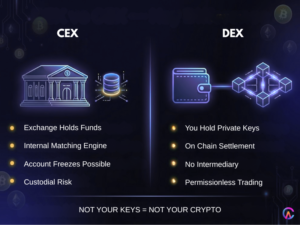
When it comes to centralized exchanges, they hold user funds in internal databases and rely on matching engines, which can create single points of failure. We’ve seen this with FTX, Mt. Gox, and Binance, where outages and hacks have led to billions being stolen. In contrast, DEXs offer on chain settlement through smart contracts, ensuring transactions are transparent and immutable. Users control their private keys, which significantly reduces counterparty risks and the vulnerabilities associated with systemic centralization.
DEX Fundamentals Non Custodial Peer to Peer Trading Smart Contracts
Decentralized exchanges (DEXs) make it easy for users to trade without needing to trust a third party. They do this by using smart contracts that handle everything from token swaps to providing liquidity, all while keeping your private keys safe throughout the entire transaction process. This means no more waiting for withdrawals, frozen accounts, or worrying about the exchange going bankrupt. Smart contracts are designed to follow specific trading rules, using automated market maker (AMM) formulas, pricing algorithms, and governance mechanisms. Plus, the code is transparent and publicly available, so you can be sure there are no hidden fees or unfair advantages.
With a non custodial setup, users can sign transactions directly from their wallets, like MetaMask, Phantom, or WalletConnect, ensuring they maintain control over their assets. This allows for instant access to funds anytime, anywhere, and supports trading in unique meme coins and experimental tokens that traditional exchanges often overlook.
DEX core principles user sovereignty advantages
- Non custodial self custody means you control your private keys, reducing counterparty risk.
- Smart contracts provide a clear, transparent, and unchangeable trading logic.
- Permissionless listings give everyone access to rare and niche tokens.
- On chain settlements ensure quick finality and resistance to censorship.
- They operate 24/7 without downtime, KYC delays, or withdrawal limits.
DEXs boast an impressive 99.9% uptime and work seamlessly with other DeFi protocols, enabling trading volumes in the trillions and promoting financial inclusion in emerging markets.
Automated Market Makers AMM Constant Product Concentrated Liquidity
AMMs power 90% of DEX volume liquidity pools, paired tokens, smart contracts, constant product formulas, x y k pricing algorithms, and automatic market making, which do away with the need for order book matching that centralized exchanges require. Uniswap v3 has a concentrated liquidity position, an active price range, and capital efficiency of 4000x. It also has a uniform distribution that lowers impermanent loss and optimizes fees for high volume pairs.
Dynamic fees Uniswap v4 time weighted fees volatility based adjustments liquidity provider LP incentives, the best prices, stable market conditions, and profitable arbitrage are all important. Algorithms for stable swaps Curve 3 CryptoSwap stablecoin pools have flat price curves and 0.01% slippage on billion dollar trades, which keeps the peg stable and makes capital more efficient.
AMM mechanisms pricing efficiency capital optimization
- Constant product formulas for automatic pricing and arbitrage pool balancing
- Concentrated liquidity that maximizes capital efficiency by 4000 times
- Dynamic fees that adapt to market volatility, providing optimal incentives for LPs
- Stable swap algorithms with flat curves for stablecoin pools
- Strategies to protect against impermanent loss through hedging and range orders
Ultimately, AMMs are revolutionizing market making, enabling retail LPs to earn between 10% and 50% APY as passive income. This permissionless liquidity provision is a key driver behind the explosive growth of decentralized finance (DeFi).
Order Book DEXs On Chain Matching Hybrid Models
Order book DEXs like Serum and dYdX v4 are designed to match limit market orders while keeping the depth of the order book on chain. This approach maintains the familiarity of centralized exchanges (CEXs) and offers slippage protection for large orders, along with MEV protection through private mempools and encrypted order flow. Hybrid DEXs, such as GMX and Hyperliquid, combine order books with AMM features, utilizing intent based solvers like CoW Protocol and 1inch Fusion. They also implement private auction mechanisms, Dutch auctions, and counterparty discovery to ensure optimal execution while minimizing issues like sandwich MEV and front running.
On chain order books and RFQs (request for quotes) allow for off chain matching with on chain settlement, which helps preserve privacy and execution efficiency while delivering the performance of traditional CEXs with decentralized trust guarantees. Layer 2 rollups like Base, Arbitrum, Optimism, and zkSync enable low cost order book execution with fees under a cent, facilitating 100k gas transactions that support high frequency trading (HFT) for institutional players.
Order book hybrid DEX advantages execution efficiency
- On chain matching depth with slippage protection for large orders
- Hybrid perpetuals that combine AMM and order book features with intent solvers and MEV protection
- Private mempools and encrypted order flow to eliminate sandwich front running
- Layer 2 rollups offering sub cent fees for efficient HFT execution
- RFQ systems that allow off chain matching with on chain settlement for privacy and efficiency
Order book hybrids are capturing 30 percent of DEX volume, effectively bridging traditional institutional trading with the composability and execution efficiency of DeFi.
DEX Aggregators Intelligent Routing Optimal Execution
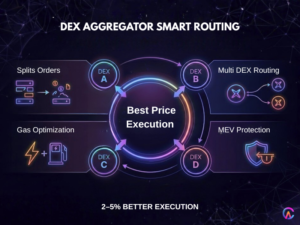
DEX aggregators like 1inch, Jupiter, Matcha, and Paraswap are all about smart routing. They split orders across multiple DEXs and AMM pools to get the best prices while minimizing slippage and gas costs. Plus, they offer MEV protection across platforms like Uniswap, SushiSwap, Curve, and Balancer. With multi hop swaps involving ETH, USDC, DAI, and USDT, they navigate complex routing paths to seize arbitrage opportunities while maintaining execution efficiency in a fragmented liquidity landscape.
When it comes to gas optimization, these aggregators utilize batch auctions and private mempools, ensuring MEV protection and preventing sandwich attacks. They also focus on gas abstraction, allowing users to pay minimal gas fees through optimized bundles, which helps maintain profitability for high frequency trading and arbitrage bots, as well as retail traders.
Aggregator advantages fragmented liquidity optimization
- Smart routing that splits orders across various DEXs and AMM pools for the best prices
- Multi hop swaps that navigate complex paths for efficient arbitrage execution
- Gas optimization through batch auctions and MEV protection to prevent sandwich attacks
- Cross chain bridging and liquidity aggregation on Layer 2 chains
- Private mempools that ensure encrypted order flow for execution privacy
Aggregators can achieve 2-5% better execution compared to traditional single DEX routing, helping to preserve alpha in the competitive DeFi landscape.
Liquidity Provision Impermanent Loss Fee Optimization
Liquidity providers, or LPs, put their paired tokens into pools to earn trading fees that range from 0.05% to 1%, depending on the trade volume. However, they also face the risk of impermanent loss, which can be managed through various hedging strategies, range orders, and optimizing liquidity positions for better capital efficiency. To tackle impermanent loss, LPs can turn to stablecoin pools, concentrated liquidity, and single sided staking, which can supercharge their APRs thanks to protocol emissions and incentives.
When it comes to LP strategies, stablecoin pools present a low risk of impermanent loss, especially when paired with correlated assets like ETH and BTC. These strategies can enhance yield farming, collateralization, and lending within the DeFi space, all while maximizing returns in a risk adjusted manner. Gauge voting also plays a crucial role in liquidity incentives and protocol governance, allowing LPs to participate in decision making that preserves optimal capital allocation.
LP strategies risk return optimization
- Stablecoin pools offer low impermanent loss with correlated assets for stability.
- Concentrated liquidity and range orders can boost capital efficiency by up to 4000x.
- Single sided staking and Superchargers can enhance APRs through emissions.
- Hedging against impermanent loss involves collateralization, lending, and composability.
- Gauge voting influences governance and LP incentives for optimal allocation.
Sophisticated LPs can achieve impressive APYs ranging from 20% to 100% with risk adjusted returns, driving the growth of DEX liquidity and fueling the flywheel effect.
Cross Chain DEXs Layer 2 Interoperability Multi Chain Liquidity
Cross-chain DEXs like LayerZero, Axelar, and Wormhole are all about bridging liquidity and making multi chain trading smooth, while also focusing on gas optimization and execution efficiency. Then we have intent centric DEXs such as Anoma and CoW Protocol, which tackle solver competitions for optimal execution and cross chain bridging, ensuring capital efficiency even with fragmented liquidity.
When it comes to Layer 2 DEXs, think Velodrome, Aerodrome, Base, and Optimism. They offer native liquidity, low fees, and high throughput, all while supporting specialized trading pairs and ecosystem tokens that maintain chain specific composability and liquidity depth.
Cross chain L2 DEX advantages multi chain liquidity
- Bridge aggregation through LayerZero, Axelar, and Wormhole for atomic bridging
- Intent centric solvers that ensure optimal execution for cross chain arbitrage
- Layer 2 native liquidity from Velodrome, Aerodrome, Base, and Optimism
- Multi chain liquidity aggregation that enhances execution efficiency
- Gas optimization through Layer 2 scaling solutions for better throughput and scalability
Cross chain DEXs are key to unlocking unified liquidity in a $10 trillion multi chain economy, all while preserving a seamless experience for traders.
Security Risks Smart Contract Audits Bug Bounties Insurance
DEXs are grappling with smart contract vulnerabilities like reentrancy, flash loan exploits, oracle manipulation, governance attacks, and flash loan liquidation cascades, all while trying to maintain protocol integrity and protect their multi million dollar total value locked (TVL). To tackle these challenges, professional audits from firms like Trail of Bits, OpenZeppelin, and Certik, along with quarterly reviews and continuous formal verification, are essential for keeping security measures up to date against evolving attack surfaces.
Bug bounty programs such as Immunefi and HackerOne offer million-dollar rewards for identifying critical vulnerabilities, encouraging responsible disclosure and fostering a proactive security community. Additionally, insurance protocols like Nexus Mutual and Cover provide underwritten coverage for smart contract failures, bridge exploits, and custody risks, which helps maintain confidence among liquidity providers and traders.
DEX security measures comprehensive protection
- Professional audits from Trail of Bits and OpenZeppelin, along with quarterly formal verification
- Bug bounty programs like Immunefi offering million dollar rewards for critical vulnerabilities
- Insurance protocols such as Nexus Mutual providing smart contract and bridge coverage
- Emergency pause features, timelock governance, and multisig recovery mechanisms
- Formal verification to ensure mathematical correctness and eliminate attack surfaces
This multi layered security strategy aims to preserve 99.99% of funds, instilling confidence in a billion dollar TVL.
Advanced Trading Perpetuals Options Structured Products
Perpetual DEXs GMX Hyperliquid dYdX v4 dynamic funding rates oracle price feeds leverage trading 100x isolated cross margin liquidation engines MEV protection preserving CEX performance decentralized guarantees. Options DEXs Lyra Hegic on chain options Black Scholes pricing automated market making volatility trading Greeks delta hedging structured products.
Structured products principal protected notes yield farming vaults options embedding leveraged yield perpetual exposure preserving sophisticated DeFi primitives traditional derivatives.
Advanced trading DEX capabilities institutional execution
- Perpetuals from GMX and Hyperliquid offering 100x leverage and oracle funding rates
- Options from Lyra and Hegic utilizing on chain Black Scholes for volatility trading
- Structured products like yield vaults that ensure principal protection and leveraged exposure
- MEV protection through private mempools, encrypted order flow, and high frequency trading execution
- Cross margin isolated liquidation engines for effective risk management
These advanced DEXs are designed to attract sophisticated traders from the institutional space, effectively bridging the gap between traditional finance and decentralized finance for enhanced execution efficiency.
How Codearies Helps Customers Build Production DEX Platforms
Codearies delivers enterprise grade DEX platforms AMM order book hybrids aggregators cross chain interoperability perpetuals options Layer 2 deployment audited smart contracts achieving billion dollar TVL 99.99 percent uptime MEV protection.
AMM DEX platforms Uniswap v4 concentrated liquidity
Constant product dynamic fees concentrated liquidity Uniswap v4 hooks custom logic stable swaps LP position management impermanent loss protection audited contracts.
Order book hybrid perpetual DEX infrastructure
On chain order books RFQs perpetuals GMX Hyperliquid oracle price feeds leverage trading MEV protection Layer 2 low latency execution institutional HFT capabilities.
DEX aggregators cross chain liquidity optimization
1inch Jupiter style intelligent routing multi hop swaps cross chain bridging Layer 2 aggregation gas optimization private mempools MEV protection optimal execution.
Smart contract security audit insurance protocols
Trail of Bits OpenZeppelin audits formal verification bug bounties Immunefi Nexus Mutual insurance emergency pause governance multisig billion dollar TVL protection.
Layer 2 cross chain DEX deployment scalability
Base Arbitrum Optimism Solana deployment atomic bridging intents centric solvers unified multi chain liquidity gas optimization global scalability.
Frequently Asked Questions
Q1: What are the fundamental differences in the security models between DEX and CEX?
In a DEX, you have non custodial smart contracts that allow for self custody and on chain settlement. On the other hand, CEX relies on custodial internal databases, which introduces counterparty risk. Codearies is focused on building production ready DEXs that prioritize non custodial security and self custody, boasting a billion dollar total value locked (TVL) for protection.
Q2: How does the AMM constant product pricing mechanism work in liquidity pools?
The x y k formula is at the heart of automatic market making, facilitating arbitrage, pool balancing, and concentrated liquidity for better capital efficiency while managing impermanent loss through hedging. Codearies is implementing Uniswap v4 AMM with dynamic fees, stable swaps, and optimized liquidity provider (LP) strategies, all backed by audited contracts.
Q3: What are some strategies for mitigating impermanent loss for LPs?
To tackle the price divergence penalty, strategies include using stable pools, concentrated liquidity, single sided staking, and yield optimization through hedging. Codearies offers impermanent loss protected LP strategies that enhance capital efficiency with audited smart contracts.
Q4: How do DEX aggregators optimize execution and protect against MEV?
With intelligent routing across multiple DEXs, cross chain gas optimization, and private mempools, we can safeguard against sandwich attacks and ensure optimal execution. Codearies is developing aggregators like 1inch and Jupiter that provide MEV protection and unify cross chain liquidity for seamless execution.
Q5: What are the security risks associated with DEX smart contracts, and how is insurance coverage handled?
To maintain protocol integrity and protect a billion dollar TVL, we rely on audits, bug bounties, insurance, pause mechanisms, and formal verification. Codearies employs Trail, OpenZeppelin audits, Immunefi bounties, and Nexus insurance for comprehensive protection.
For business inquiries or further information, please contact us at