
DeFi security is that crucial balance between the freedom of open programmable finance and the risk of devastating losses. Right now, billions of dollars are locked up in smart contracts that anyone can access, which makes these systems incredibly powerful but also attractive targets for savvy attackers.
Why DeFi security is such a hard problem
In decentralized finance, we swap out trusted intermediaries for code. This means:
- Smart contracts automatically manage and transfer funds once they’re set up.
- Anyone can interact with them without needing permission, including potential attackers.
- Protocols are highly composable, so a flaw in one area can trigger issues in others.
Research and industry reports indicate that DeFi and cross-chain protocols are responsible for most of the crypto losses, with individual exploits often racking up tens or even hundreds of millions of dollars in a single event. As the total value locked increases, attackers become more driven and inventive.
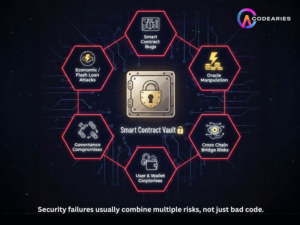
The main risks can be grouped into several categories: bugs in smart contracts, economic attacks, vulnerabilities in cross-chain systems, failures in oracles and price feeds, governance exploits, and compromises on the user side.
Smart contract bugs the core technical threat
Once smart contracts are deployed, they can’t be changed, so any coding error can turn into a permanent vulnerability. Studies of DeFi hacks consistently show that flaws at the contract level are a primary attack vector, especially in unaudited or forked code.
Common patterns
- Reentrancy, where an external call allows an attacker to re-enter a function before the state updates are complete.
- Access control mistakes, where functions that should be restricted end up being accessible to anyone or to overly broad roles.
- Arithmetic and logic errors, which can lead to miscalculated collateral limits, fees, or balances.
- Uninitialized variables or misconfigurations in upgradeable proxies that allow attackers to take over admin control.
Modern protocols address this through
- A series of independent audits on smart contracts conducted by specialized firms, both before and after the launch
- Relying on tried-and-true libraries and patterns instead of reinventing the wheel
- Formal verification for essential components, which mathematically proves certain properties
- Bug bounty programs that reward ethical hackers for identifying vulnerabilities before malicious actors do
Yet, despite these measures, reports from 2025 still indicate that flaws in smart contracts are leading to losses in the hundreds of millions, particularly among smaller projects that bypass thorough reviews.
Economic and market manipulation attacks
In the world of DeFi, it’s all about the interplay of code and economics. Even contracts that are flawlessly coded can be vulnerable if their incentives or assumptions are shaky.
Key vectors
- Flash loan attacks, where attackers borrow massive amounts of capital for a single block, manipulate prices or states, and then repay the loan
- Oracle manipulation, which involves exploiting thin liquidity pairs or taking advantage of delayed price feeds to alter protocol valuations
- Sandwich and MEV attacks, where attackers frontrun and backrun user trades in Automated Market Makers (AMMs) to siphon off value
- Liquidity drainage, which exploits incentive structures to withdraw liquidity and trigger a chain reaction of liquidations
Security guidance now emphasizes
- Utilizing time-weighted average price (TWAP) or robust multi-source oracles for critical pricing instead of relying on a single pool
- Reducing dependence on ultra-short-term prices for collateral and liquidation thresholds
- Conducting stress tests on protocol economics using simulation agents and adversarial modeling
- Incorporating MEV-aware designs, auctions, or protected transaction relays to minimize user-exploitable slippage
Economic exploits can be particularly elusive during code reviews, as they often arise from the interactions between contracts, markets, and the capital of attackers.
Cross chain bridges and interoperability risks
Cross-chain bridges and messaging layers are some of the most targeted elements in the DeFi space. They often manage large pools of assets that represent various networks, making them incredibly attractive targets.
Looking ahead to 2025, reports indicate that cross-chain exploits could lead to over a billion dollars in stolen funds, with multi-chain hacks affecting otherwise unrelated protocols through their shared bridges or custodial components.
Typical issues
- Centralized bridge guardians or multisigs that act as single points of failure
- Complex state synchronization logic that can harbor subtle bugs
- Vulnerabilities like message replay or spoofing between chains
Modern mitigations include
- Transitioning to light client or proof-based bridges whenever feasible
- Distributing control of bridge infrastructure among more independent validators
- Conducting thorough audits and maintaining ongoing monitoring of bridge contracts and off-chain relayers
- Implementing rate limits, circuit breakers, and pausable components to manage abnormal flows
Despite these advancements, many risk frameworks now categorize bridge exposure as a distinct risk, necessitating stricter limits.
Oracle and data feed vulnerabilities
When it comes to oracle and data feed vulnerabilities, oracles bring off-chain data, such as prices, into on-chain contracts. If this data is inaccurate or can be manipulated, it can lead to mispriced collateral or incorrect redemptions.
Common failures
- Dependence on a single DEX pair with low liquidity
- Delayed updates or outdated prices during volatile market conditions
- Centralized oracle operators who can be coerced or compromised
Best practice today
- Utilizing robust decentralized oracle networks that aggregate multiple data sources
- Implementing sanity checks and bounds between updates
- Steering clear of using spot prices directly for liquidations or large mints, and instead opting for TWAP or median feeds
Oracle manipulation continues to represent a significant portion of DeFi exploits, especially when projects skimp on their data infrastructure
Governance and admin key risks
Many DeFi protocols kick off with admin roles that allow a core team to upgrade or control parameters. This setup brings about two main types of risks:
- Malicious or compromised administrators who could potentially drain funds or disable important safeguards.
- Governance attacks, where an attacker gathers or borrows governance tokens to push through harmful proposals.
Research into DeFi governance incidents shows that token voting systems can be manipulated, especially when liquidity is high but participation is low.
Modern countermeasures
- Implementing timelocks for critical governance actions, giving users a chance to withdraw before any risky changes take effect.
- Using multisig or council-controlled upgrades with clearly defined scopes and emergency powers.
- Gradually decentralizing with well-defined plans for phasing out admin keys.
- Setting quorum and participation requirements to help reduce the risks of governance capture.
Additionally, protocols are increasingly separating treasury control from core contract control to limit the potential damage.
User side and infrastructure threats
Even if the protocol is secure users and supporting infrastructure can be attacked
- Phishing and fake dApp sites that trick users into signing harmful transactions.
- Wallet compromises through malware, clipboard hijacking, or compromised browser extensions.
- RPC provider and front-end compromises that can alter transaction payloads.
Security reports indicate that phishing and private key theft account for a significant portion of total crypto losses, even when on-chain contracts remain uncompromised.
Mitigations include
- Use clear signed messages and ensure wallets provide human-readable transaction previews.
- Opt for hardware wallets and multi-factor setups for high-value accounts.
- Implement front-end integrity checks and use open-source clients that users can host themselves.
- Educate users about official links, contract addresses, and transaction verification.
Ultimately, security in DeFi is a shared responsibility between the protocol and its participants.
How modern protocols design with security in depth
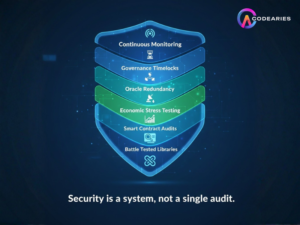
These days, leading DeFi teams are shifting towards a defense-in-depth approach instead of just depending on a single audit or safety measure. Here are some common strategies they’re using:
- Getting multiple audits from various firms along with solid internal security engineering
- Keeping an eye on on-chain anomalies through alert dashboards and machine learning detectors
- Launching in controlled phases, starting with limits and gradually increasing them as the system becomes more robust
- Exploring insurance or coverage options that work with both on-chain and off-chain insurers
- Having clear incident response plans that include emergency pauses and communication channels
Both academic and industry reviews highlight that while DeFi is still in its early and somewhat unstable stages, a mix of strong engineering, adversarial testing, and continuous monitoring can significantly boost resilience over time.
How Codearies helps DeFi teams reduce security risks
Codearies is here to support DeFi founders and teams who want to move quickly without compromising on security.
What Codearies typically does
Threat modeling and architecture review
- Mapping out protocol flows to identify trusted assumptions and potential single points of failure
- Highlighting risky design patterns related to upgrades, governance, bridges, and oracles
Secure smart contract development
- Developing contracts using proven patterns, rate limits, and access controls
- Integrating safe math to protect against reentrancy and other common vulnerabilities
Audit preparation and coordination
- Cleaning up and documenting codebases for external auditors
- Collaborating with independent security firms to address findings and retest swiftly
Security operations and monitoring
- Setting up dashboards, alerts, and anomaly detection for key on-chain metrics like TVL flows, liquidations, and governance actions
- Crafting incident response playbooks that include pause mechanics and communication templates
User and governance safety
- Assisting in structuring admin keys, multisigs, timelocks, and paths to decentralization
- Providing educational content on safe usage, links, signing, and role responsibilities
The goal isn’t just to pass an audit; it’s about building a protocol that can stand strong against evolving threats.
Frequently asked questions
Q1 What is the single biggest risk most new DeFi projects underestimate?
A lot of teams don’t realize that even the tiniest logic errors or lapses in access control can result in a complete loss of funds once their protocol goes live. It’s not just about those rare zero-day bugs; often, it’s simply about missing checks or having poor upgrade paths. Codearies tackles this issue by implementing early-stage threat modeling and conducting thorough reviews of privileged functions.
Q2 Are audits enough to keep a DeFi protocol safe?
While audits are essential, they alone aren’t enough. They help minimize risk, but they can’t guarantee safety, especially as protocols change and integrate with others. Continuous monitoring, controlled feature rollouts, and bug bounties are equally crucial. Codearies supports teams in establishing a comprehensive security lifecycle.
Q3 How can we reduce risk around cross chain features?
Whenever possible, it’s best to keep the core value and logic on the most secure base layer and treat bridges as tools with limited exposure, complete with caps and circuit breakers. Opt for proof-based or well-tested bridge systems instead of custom experiments. Codearies assists in designing those boundaries and selecting safer interoperability stacks.
Q4 What can we do to protect users even if our contracts are secure?
It’s important to invest in front-end and wallet safety, provide clear transaction previews, establish strong branding around official links, and promote security education. Think about integrating with wallet security tools and offering optional insurance. Codearies often helps teams create easy-to-understand safety guides and design user experiences that gently steer users away from risky actions.
Q5 When should a DeFi project involve Codearies in its security journey?
Ideally, you should bring Codearies on board during the architecture phase, not just right before launch. Getting us involved early allows us to shape designs that are simpler, safer, and easier to audit, rather than having to patch up complex systems later. That said, Codearies can also step in for existing protocols to strengthen contracts, processes, and monitoring
For business inquiries or further information, please contact us at