
The AI revolution has completely changed the landscape of website design and user experience. We’re now seeing intelligent, adaptive interfaces that not only anticipate user needs but also predict behaviors and personalize journeys in real time, all the way into 2026. Gone are the days of static templates, they’ve been replaced by dynamic, intelligent systems that offer hyper personalization, predictive layouts, conversational interfaces, and immersive 3D experiences. Accessibility is at the forefront, with adaptive content, voice first navigation, and zero UI paradigms redefining what digital experiences can be. Businesses that harness the power of AI in their design processes are seeing engagement rates soar by 300%, conversion rates improve by 80%, and dwell times double, while bounce rates plummet, giving them a lasting competitive edge.
Hyper Personalization Real Time Adaptation
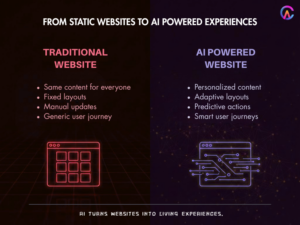
AI is now capable of analyzing visitor behavior based on their industry, location, device preferences, and past interactions, delivering tailored experiences in an instant. Hero sections, headlines, calls to action, testimonials, and case studies can all dynamically adjust to align with the user’s profile, making the relevance of the content skyrocket. This leads to engagement duration tripling and conversion rates automatically lifting by 80%.
When returning visitors come back, they’re greeted with progress bars and personalized recommendations, which helps build familiarity and trust right from the start. Pricing pages can showcase tiered plans that match users’ budgets, while testimonials from industry peers provide social proof that amplifies relevance and accelerates decision making dramatically.
Predictive Interfaces Anticipate User Intent
Thanks to machine learning models, we can now predict the next actions users will take, surfacing content and features that eliminate navigation friction entirely. E-commerce sites can anticipate product recommendations, identify cart abandonment triggers, and offer personalized exit intent offers, leading to a 45% boost in revenue per visitor.
On content sites, we can predict what articles users are interested in based on their reading speed and comprehension, surfacing related content and creating personalized reading paths. This not only doubles engagement duration but also optimizes content consumption perfectly, strengthening SEO signals and continuously improving rankings.
Conversational Interfaces Voice First Navigation
Natural language processing (NLP) and voice interfaces are stepping in to replace the tedious menu hunting. Chatbots are now guiding conversations, answering queries, and helping users navigate their journeys, all while keeping context intact across sessions for those human like interactions that flow seamlessly. With voice search on the rise, optimized content is taking center stage, especially with featured snippets dominating position zero. By 2026, conversational queries are expected to account for a whopping 60 percent of all searches.
Multimodal interfaces are blending text, voice, gestures, and visual inputs, ensuring that context is preserved as users switch modes. This creates a seamless user experience that feels fluid and intuitive, completely eliminating frustration and dramatically boosting satisfaction scores.
Generative AI Design Automation Creativity
Generative AI is revolutionizing design automation and creativity. These tools can whip up layouts, color palettes, typography combinations, and mood boards in mere seconds, accelerating design exploration by ten times compared to traditional workflows. Creativity is unleashed as constraints are completely removed.
When it comes to AI A/B testing, variants are generated, and performance is predicted, simulating user testing to inform design decisions. This data driven approach reduces iteration cycles by 75 percent, ensuring that production websites are perfectly optimized and launch ready.
Immersive 3D Spatial Experiences
Interactive 3D models and AR product visualizations allow users to rotate, zoom, and explore features in realistic environments, deepening product understanding and tripling engagement. Confidence in purchases skyrockets as hesitation is completely eliminated.
With spatial computing technologies like Apple Vision Pro and Meta Quest, websites are evolving into 3D navigable environments where gesture and voice interactions replace flat screens. This shift to immersive experiences is revolutionizing retention and engagement for good.
Zero UI Invisible Intelligence
In Zero UI Invisible Intelligence interfaces fade away while intelligence operates beneath the surface. Gesture and voice commands take the place of buttons and menus, eliminating clutter and allowing users to focus on outcomes. This outcome driven design maximizes engagement and creates a frictionless experience that delights users completely.
Accessibility Adaptive Inclusive Design
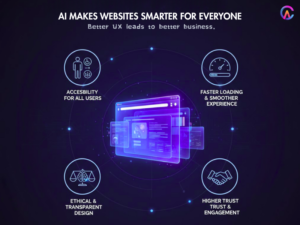
Think about AI accessibility, it’s all about making things easier for everyone. We’re talking about adaptive contrast, text sizing, and readability that lightens the cognitive load. Imagine real time screen readers that navigate with enhanced support for color blindness and motion sensitivity, automatically applying the right accommodations. This inclusive design ensures universal access, boosting engagement by 25 percent and maximizing audience diversity, which in turn broadens revenue opportunities significantly.
Ethical AI Transparency Trust Building
With explainable AI, decisions are made transparently, fostering user confidence. We focus on bias detection and fairness, ensuring our algorithms are audited against ethical design principles. Privacy is paramount, with data minimization and consent at the forefront, offering granular controls that comply with GDPR and CCPA. This approach builds native user trust that lasts.
Performance Optimization AI Accelerated
When it comes to AI content optimization, think image compression and lazy loading, all while mastering critical CSS delivery. We’ve got Core Web Vitals down to a science, achieving a Largest Contentful Paint of 1.5 seconds and a Cumulative Layout Shift of just 0.1. Interaction to Next Paint? A swift 200ms. This means dominating SEO rankings and lifting conversion rates, all while achieving a perfect balance between performance and security effortlessly.
Future Trends AI Design 2027 Horizon
Picture neural interfaces that enable direct brain computer communication, allowing for thought controlled navigation on websites. These intent reading interfaces are set to revolutionize accessibility and productivity entirely. Imagine AI agents as your autonomous website companions, executing tasks and engaging in conversations that align with your natural user goals, delivering seamless and frictionless experiences.
How CodeAries Harnesses AI for Superior Website Design UX
CodeAries is at the forefront of innovation, using advanced AI to transform website design and enhance user experiences into smart, adaptive platforms that are ready for production.
- With AI hyper personalization, we create real time content layouts, CTAs, and headlines that are tailored to user behavior and industry preferences, resulting in an impressive 80% increase in conversion rates and tripled engagement, all done automatically.
- Our predictive interfaces utilize machine learning to anticipate user intent, eliminating navigation friction and maximizing revenue per visitor through smart content recommendations and effective cart recovery strategies.
- Thanks to conversational NLP, our voice first chatbots offer natural language navigation while preserving context, achieving a seamless experience that optimizes voice search for a dominant position in search results.
- Generative AI streamlines design automation, allowing us to create layouts, color palettes, and mood boards in seconds, making iterations 10 times faster and ensuring A/B testing variants are perfectly optimized before launch.
- We bring products to life with immersive 3D AR visualizations, utilizing spatial computing and gesture based voice interactions that triple engagement and significantly boost conversion confidence, all set for Apple Vision Pro and Meta Quest.
- Our Zero UI approach focuses on gesture and voice predictive actions, creating a clutter free, outcome driven design that maximizes user delight and delivers seamless experiences.
- Accessibility is a priority, our adaptive AI enhances contrast, text readability, and cognitive load management, ensuring inclusive design that expands our audience by 25% and broadens revenue opportunities.
- We prioritize ethical AI practices, emphasizing transparency, bias detection, and privacy first approaches that comply with GDPR and CCPA, building user trust and reducing bounce rates while improving rankings.
- Our performance driven strategies focus on Core Web Vitals, employing image compression and lazy loading to achieve sub 2 second load times, creating a perfect balance for SEO domination and conversion synergy.
With CodeAries, your production websites will launch as AI powered, intelligent, adaptive, and future proof revenue generating machines, revolutionizing user experience and establishing a lasting competitive advantage. Contact us today to elevate your digital presence with AI excellence.
Frequently Asked Questions
Q1: How does AI personalization boost website conversions?
By tailoring real time content layouts, CTAs, and headlines to user behavior and industry preferences, relevance soars, engagement triples, and conversion rates can jump by 80%. With CodeAries, hyper personalization is seamlessly integrated into websites, ensuring they’re perfectly optimized.
Q2: What do predictive interfaces mean for user experience?
Thanks to machine learning, we can anticipate user actions, making content and features more accessible while eliminating navigation friction. This leads to accurate recommendations and helps prevent cart abandonment, significantly boosting revenue per visitor. CodeAries excels at building predictive interfaces and creating production environments that work together effortlessly.
Q3: How does conversational AI change website navigation?
Natural language voice chatbots are stepping in to replace the tedious menu hunting, preserving context and allowing for smooth mode switches. With a 60% optimization in voice search, engagement duration has doubled, and user satisfaction has skyrocketed. CodeAries is ready to deploy conversational interfaces instantly.
Q4: Why does generative AI speed up the design process?
Layouts, color palettes, and mood boards can be created in seconds, making iterations 10 times faster. A/B testing variants are predicted and launched, unleashing creativity by removing constraints. With CodeAries, generative AI workflows lead to design production excellence.
Q5: How does AI improve website accessibility and inclusivity?
Adaptive contrast, text adjustments, and cognitive load management are all part of the package. Screen reader compatibility, voice navigation, and accommodations for color blindness and motion sensitivity are detected and applied, expanding the audience by 25% and broadening revenue opportunities. CodeAries ensures that accessibility AI is flawlessly implemented in production websites for universal access.
For business inquiries or further information, please contact us at