

On chain lending protocols are the backbone of decentralized finance, allowing people to borrow and lend directly on blockchain networks. These smart contract systems step in for traditional banks, offering trustless and transparent ways for users to provide liquidity and borrow against collateral. By 2026, as DeFi’s total value locked (TVL) exceeds $300 billion, platforms like Aave and Compound are leading the charge, handling billions in loans every single day. This exploration breaks down how they work, the risks involved, the innovations they bring, and where they might be headed, all while using popular terms like “on chain lending protocols,” “DeFi lending explained,” “smart contract lending,” “overcollateralized loans blockchain,” and “RWA lending 2026.”
Core Mechanics of On Chain Lending Protocols
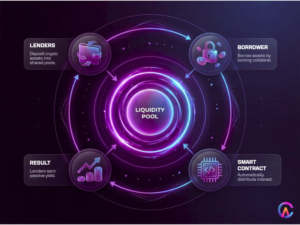
At their core, these protocols create marketplaces where peers can pool their resources. Lenders put in their assets, while borrowers offer collateral, and smart contracts take care of the rest.
Liquidity Pools and Supply Mechanism
Users contribute tokens like ETH, USDC, or stablecoins into communal pools. In exchange, they receive interest bearing tokens like Aave’s aTokens or Compound’s cTokens, that grow in value as interest accumulates block by block.
Interest rates are adjusted dynamically through algorithms that balance supply and demand. When utilization is high (the ratio of borrowed to supplied assets), rates go up to attract more lenders, when it’s low, rates drop. The formulas use the utilization ratio u=Total Borrows/Total Supply, with the sweet spot typically around 80-90%.
Borrowing and Collateralization
When borrowers want to take out a loan, they typically put up overcollateralized assets, usually around 150-200% of the loan to value (LTV) ratio. For instance, if you lock up $150 worth of ETH, you can borrow $100 in USDC. This extra cushion helps protect against market volatility.
Smart contracts play a crucial role here by enforcing health factors. The formula for the Health Factor is: Health Factor = (Collateral Value × Liquidation Threshold) / Borrow Value. If this value drops below 1, it triggers a liquidation event, meaning anyone can step in to repay the debt and snag the collateral at a discount.
And then there are flash loans, which add a bit of excitement to the mix. You can borrow millions instantly without any collateral, as long as you pay it back in the same transaction. These are often used for arbitrage opportunities or swaps.
Risk Management Behind the Scenes
Behind every protocol, there are carefully designed safeguards in place.
Liquidation Engines
Automated bots keep a close eye on health factors using oracles, like Chainlink, which provide real time price feeds. To encourage rescuers, there are liquidation bonuses ranging from 5-10%. Partial liquidations allow for 50% of the debt to be repaid in slices, helping to stabilize the situation.
We’re also seeing the rise of undercollateralized loans in private credit protocols like Maple. These loans are evaluated off chain by delegates and then tokenized on chain for funding.
Oracle Integration and Price Feeds
Oracles are essential for preventing price manipulation. Decentralized networks gather exchange prices and timestamp them for accuracy. Those who try to manipulate the system face countermeasures against “sandwich attacks.”
Interest Rate Models
Kink models are used to differentiate interest rates, they remain stable below optimal utilization but become steep above that point. Jump rates help cap the extremes. Looking ahead to 2026, we might see innovations like AI predicted rates based on historical data.
Types of On Chain Lending Protocols
A variety of models cater to specific needs.
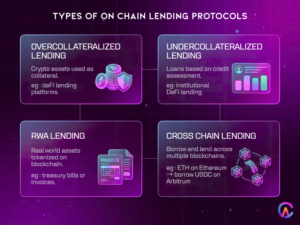
Overcollateralized Crypto Lending
Aave V4 and Compound V3 are all about pure crypto collateral and permissionless access. You can choose between fixed or variable rates, and there’s an e-mode for correlated assets like ETH and wstETH, allowing for a 97% loan to value ratio.
Undercollateralized and RWA Lending
Platforms like Goldfinch and TrueFi use credit scores or off chain collateral, such as invoices and treasuries. They tokenize real world assets (RWAs) through the Centrifuge bridge, bringing traditional finance debt onto the blockchain.
Cross Chain Protocols
Radiant and Venus operate across Ethereum, BSC, and Polygon. Bridges like LayerZero help verify collateral across different ledgers, which opens up access to larger liquidity pools.
Advanced Features and Composability
The magic of DeFi lies in its ability to stack features like building blocks.
Credit Delegation and Isolation Mode
You can delegate your borrowing power without having to transfer your assets. Isolation mode helps manage risk by limiting exposure to specific markets.
Yield Optimization
Auto compounders like Yearn intelligently route supplies across various protocols to maximize annual percentage yield (APY). Morpho Blue enhances this by adding peer to peer matching on top of liquidity pools for better spreads.
Permissioned Pools
Institutional lending on chain is facilitated through soulbound tokens or KYC proofs, merging the compliance of centralized finance with the efficiency of decentralized finance.
Risks and Mitigation Strategies
Every system has its flaws, and it’s crucial to address them.
Smart Contract Vulnerabilities
Historically, over $3 billion has been exploited due to vulnerabilities. To strengthen code, audits from firms like Trail of Bits, formal verification, and bug bounty programs (with payouts exceeding $10 million from Immunefi) are essential.
Oracle Attacks
Flash loan price manipulations are countered by using time weighted average prices (TWAP) and implementing delay thresholds.
Liquidity Crises
Unexpected market drops can trigger a cascade of liquidations. Circuit breakers can pause borrowing, and reserve funds (ranging from 0.1% to 2% of the supply) are set aside to cover losses.
According to 2026 stats from Dune Analytics, protocols processed over $500 billion in volume with a bad debt ratio of less than 0.5%.
Real World Impact and Case Studies
Protocols are the driving force behind ecosystems.
- Aave leads the pack with a whopping $15 billion in total value locked (TVL), with flash loans facilitating over $1 trillion in volume.
- Maker’s DAI collateralized debt position (CDP) model gave birth to stablecoins.
- There’s a notable shift in the institutional landscape, BlackRock is now tokenizing treasuries, lending them through Ondo, and achieving yields of over 5%.
Cross chain lending is slashing costs by 80% and enhancing capital efficiency, according to reports from 2026.
The Future of On-Chain Lending
Hybrid models are merging on chain and off chain solutions. Real world assets (RWAs) are set to explode into a $10 trillion opportunity. Zero knowledge proofs (ZK proofs) are paving the way for private credit, while intent based solvers are automating positions.
Regulations like the EU’s MiCA are bringing legitimacy to the space, attracting banks. By 2030, we can expect to see AI driven risk models and perpetual lending becoming the norm.
How CodeAries Helps Customers Build On Chain Lending Solutions
At CodeAries, we specialize in creating secure DeFi platforms designed specifically for lending protocols. Here’s how we can empower your projects:
- Craft liquidity pools with dynamic rates and overcollateralized borrowing mechanics.
- Integrate oracle feeds and liquidation engines to ensure robust risk management.
- Develop pipelines for RWA tokenization that connect real world assets to the blockchain.
- Create cross chain lending systems that tap into liquidity across multiple networks.
- Implement cutting edge features like flash loans and credit delegation to enhance composability.
Frequently Asked Questions
Q1: What sets on chain lending apart from traditional banks?
It leverages smart contracts to offer instant, trustless loans without the need for middlemen or credit checks.
Q2: How does the liquidation process function in these protocols?
Smart contracts automatically sell off collateral if its value falls too low, ensuring lenders are protected.
Q3: Are flash loans safe for everyday users?
They require repayment within the same transaction, making them perfect for arbitrage but potentially risky for those without experience.
Q4: What is the role of oracles in lending?
Oracles supply accurate asset prices that trigger liquidations and adjustments in rates.
Q5: Can institutions participate in on chain lending?
Absolutely, Permissioned pools with off-chain credit checks allow for compliant lending of real-world assets.
For business inquiries or further information, please contact us at