
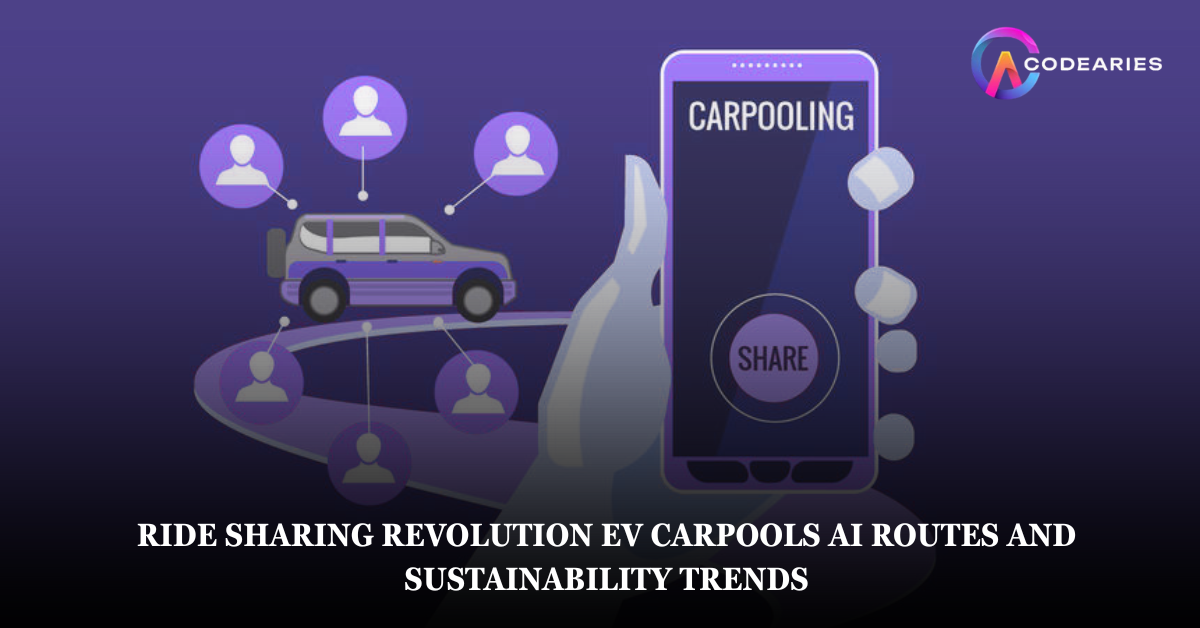
Ride sharing has completely transformed how we get around cities ever since Uber and Lyft made app based carpooling a thing. As we look ahead to 2026, the industry is on the brink of exciting new developments fueled by electric vehicles, smart AI route planning, and an unwavering push for sustainability. Electric vehicle carpools are a game changer, cutting down emissions, while AI driven routing helps ease traffic congestion. Plus, the latest green trends are weaving together micromobility, public transit, and carbon tracking into a smooth, integrated experience. This shift promises a cleaner, quicker, and fairer transportation system that benefits everyone, riders, drivers, cities, and our planet.
This in depth analysis takes a closer look at each of these transformative elements, exploring the technologies, real world applications, economic effects, challenges, and how innovative companies can spearhead this mobility revolution alongside partners like Codearies.
EV Carpools Electrifying Shared Mobility
Electric vehicle carpools are where ride sharing meets clean energy, offering shared EV fleets that produce zero tailpipe emissions, lower operating costs, and an exceptional user experience. With battery prices dropping and charging stations becoming more widespread, integrating EVs is becoming the norm for these platforms.
Key advancements include
- Dedicated EV Fleets: Companies like Uber and Lyft are rolling out thousands of specially designed EVs from brands like Tesla, Rivian, Lucid, and BYD, allowing riders to choose eco friendly rides that offer longer ranges and a quiet, smooth experience.
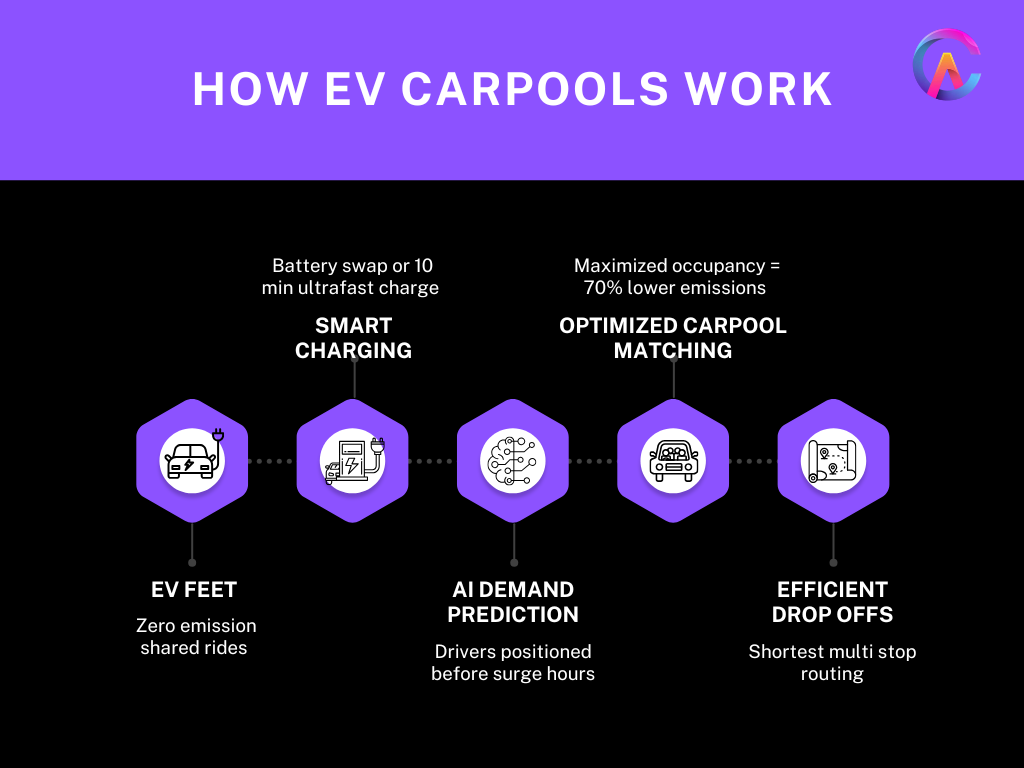
- Battery Swapping and Ultrafast Charging: Charging stations can swap out depleted batteries in just minutes or provide an 80% charge in under 10 minutes, keeping downtime to a minimum for high demand fleets.
- Smart Energy Management: AI technology forecasts demand and schedules charging during off peak hours when renewable energy is plentiful, while vehicle to grid (V2G) systems send power back to help stabilize the grid.
- Carpool Matching Optimization: Advanced algorithms connect riders with compatible EV routes, maximizing vehicle occupancy and cutting per passenger emissions by as much as 70%.
Real world leaders are making waves. Uber Comfort Electric is rolling out premium EV rides across 100 cities, while Lyft Purple is seamlessly integrating electric vehicles with carpooling. Over in Europe, companies like Bolt and Free Now are mandating EV fleets in select markets, and in China, Didi boasts the world’s largest EV ride hailing network with more than 10 million vehicles. The economic benefits are driving this shift; EVs can slash fuel costs by 50 to 70 percent, extend the life of drivetrains, and come with government incentives. Plus, riders get to enjoy quieter rides, instant torque, and access to HOV lanes, making them even more appealing.
AI Routes Revolutionizing Navigation and Efficiency
Artificial intelligence is taking ride sharing to the next level, moving from just matching riders to predictive, hyper efficient routing. Machine learning is now able to anticipate demand, optimize routes, and personalize journeys in real time. AI is making car pooling app smarter.
Here are some core AI capabilities:
- Demand Forecasting: Neural networks sift through historical data, weather patterns, local events, sports games, and social signals to predict surges and strategically position drivers ahead of time.
- Dynamic Path Optimization: Reinforcement learning constantly recalibrates routes, taking into account traffic, accidents, construction, road closures, and rider preferences for speed, scenery, or a quieter ride.
- Carpool Formation AI: Advanced matching algorithms consider pickup windows, rider compatibility, music tastes, conversation levels, and even pet friendliness to ensure a smooth group ride.
- Autonomous Fleet Integration: Self driving vehicles from Waymo, Cruise, and Tesla work alongside human drivers, creating hybrid fleets that operate around the clock without fatigue.
- Personalization Engines: AI learns individual rider habits, suggesting the best pickup times, favorite music, ambient settings, or even integrating food and coffee orders.
Platforms are excelling in this space. Uber Elevate is harnessing AI for flying taxis and ground optimization, while BlaBlaCar has mastered long distance carpools with AI driven route sharing. In India, Ola and Rapido are leveraging AI to enhance their dense networks of two wheelers and auto rickshaws.
AI routes are making a real difference by cutting wait times by 25%, reducing mileage by 20%, and boosting driver earnings through smarter dispatch, which is transforming the way we think about operational economics.
Sustainability Trends Reshaping Ride Sharing Ecosystems
Sustainability is becoming a key focus in ride sharing as platforms work to address Scope 1, 2, and 3 emissions, embrace circular economy principles, and align with net zero goals.
Pivotal trends include
- Carbon Tracking and Offsets: Apps now show real time CO2 savings for each ride and automatically invest a portion of fares into verified offsets like reforestation or methane capture.
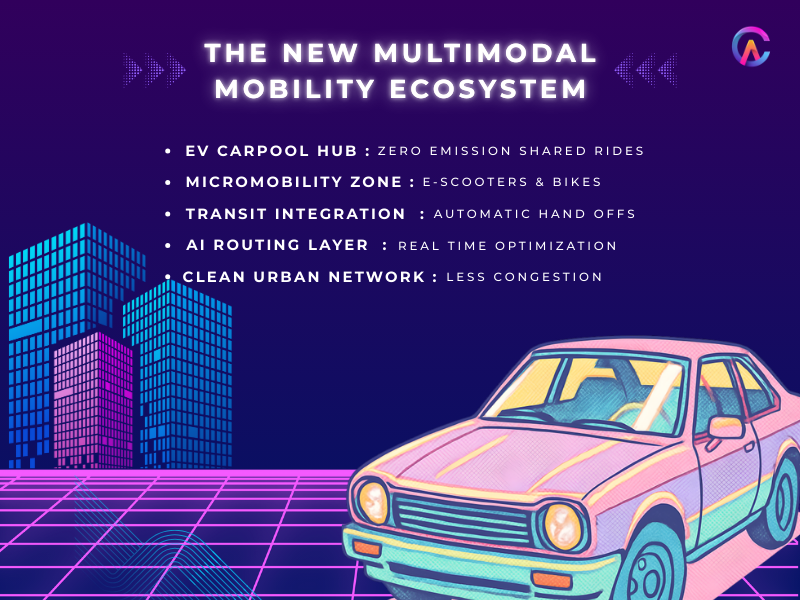
- Micromobility Integration: Users can easily switch from EV carpools to e-scooters, e-bikes, or public transit through unified apps and interoperable wallets.
- Shared Fleet Models: Subscription based vehicle pools allow users to access EVs, bikes, or pods as needed, reducing the need for private car ownership.
- Biodegradable and Circular Materials: Interior fabrics, packaging, and even tires are designed for recyclability and low lifecycle emissions.
- Regenerative Incentives: Users earn rewards for carpooling, traveling during off-peak hours, or choosing renewable charged EVs, making green behavior more engaging.
Bolt and Gett are leading the charge in European sustainability, while Uber Green and Lyft Light modes are gaining popularity worldwide. Cities like Paris, Singapore, and Los Angeles are even mandating green fleets for ride hailing services.
These trends are not only slashing urban emissions and improving air quality but also easing the strain on infrastructure, all while appealing to eco conscious millennials and Gen Z.
Convergence Ecosystem Impacts and Challenges
The real game changer comes from how we integrate different systems. Imagine AI coordinating electric vehicle carpools alongside drone deliveries, micromobility options, and public transit to create a seamless multimodal ecosystem. Meanwhile, blockchain technology ensures the authenticity of carbon credits and the history of rides, while IoT sensors keep tabs on vehicle health in real time.
The economic ripple effects are significant, leading to job transitions towards roles like charging tech specialists, AI dispatchers, and fleet managers, all supported by trillions in infrastructure investments. Cities stand to gain from less congested roads and developments focused on transit.
However, challenges remain. We face issues like EV charging deserts, regulatory hurdles for autonomous vehicles, and the need for innovation in battery mineral supply chains. Additionally, building public trust is essential for encouraging carpooling with strangers and ensuring data privacy in highly personalized routing.
Moving forward, we need to foster public private partnerships, reskill the workforce, and establish standards for interoperable green mobility
How Codearies Accelerates Your Ride Sharing Revolution
Codearies is here to supercharge mobility startups, platforms, and cities with cutting edge technology that leads the way in electric vehicle AI and sustainable ride sharing.
Comprehensive solutions include
- AI Route Engine Development: Tailored machine learning for predicting demand, dynamic matching, and optimizing multiple modes of transport.
- EV Fleet Management Platforms: All in one software for scheduling charging, monitoring battery health, and integrating vehicle to grid (V2G) systems.
- Sustainability Dashboards: Real time tracking of carbon emissions, offset marketplaces, and green key performance indicators (KPIs).
- Cross Platform Apps: User friendly interfaces for riders and drivers that support EV selection, AI driven personalization, and micropayments.
- Autonomous Vehicle Integration: APIs and orchestration for a blend of human driven and autonomous vehicle fleets.
- Regulatory Compliance Tools: Automated reporting to meet emissions, safety, and data privacy standards.
From initial MVP pilots to scaling up to a billion rides, Codearies provides the technological backbone for the next generation of mobility
Frequently Asked Questions
Q1: How does Codearies optimize EV carpool economics?
Our AI boosts occupancy, reduces idle time, and incorporates fast charging, leading to a 30% drop in costs per mile.
Q2: Can Codearies build AI routes for two wheelers or micromobility?
Absolutely, Our models are designed to adapt to bikes, scooters, cars, and pedestrians, creating a well rounded urban ecosystem.
Q3: What sustainability metrics does Codearies track?
We monitor CO2 savings per ride, the impact of modal shifts, waste reduction, and lifecycle emissions across various fleets.
Q4: How quickly can we launch an EV ride-sharing MVP?
We can roll out functional pilots in just 12 to 16 weeks, with full scale platforms ready in about 6 months.
Q5: Does Codearies support global regulatory compliance?
Definitely, We incorporate standards for the EU, US, India, China, and emerging markets into every solution we provide.
For business inquiries or further information, please contact us at