
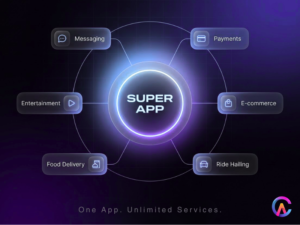
Super apps are revolutionizing the way we interact with technology by combining messaging, payments, e-commerce, entertainment, and more into one smooth experience, especially in Asia. Take WeChat, for instance, it boasts 1.3 billion users and handles everything from booking rides to scheduling doctor appointments. Meanwhile, Grab and Gojek are making waves in Southeast Asia with similar transformations. As users face app fatigue juggling over ten apps daily, Western companies are racing to mimic this model. Keywords like “super apps,” “super app development,” “all in one platforms,” “WeChat business model,” “super app trends 2026,” “Grab Gojek strategy,” and “super app monetization” are driving SEO success. This thorough analysis breaks down definitions, architectures, business drivers, regional differences, monetization challenges, implementation roadmaps, and predictions for 2026.
What Defines a True Super App
Super apps go beyond just serving a single purpose, they create interconnected ecosystems where various services work together seamlessly.
Core Characteristics and Ecosystem Design
They offer unified access through a single login and interface that spans multiple verticals. Mini programs, which are lightweight apps, can load within the host app, eliminating the need for native downloads. Tencent has over 8 million mini apps, allowing for instant commerce without the hassle of app store barriers.
Deep integrations utilize user data across different services. For example, chat histories can enhance personalized shopping experiences, while payment actions can trigger loyalty rewards. The network effects make these apps even stickier, with the average WeChat session lasting about 45 minutes each day.
Platform governance strikes a balance between openness and control. API marketplaces allow developers to integrate their services, while centralized moderation helps maintain user trust.
Evolution from Messaging to Ecosystems
WeChat started in 2011 as a messaging app, but by 2013, it pivoted to include payments, which took off thanks to features like red packets. In Japan, Line added comics and payments, then ventured into fintech. Meanwhile, Western counterparts like Snapchat have expanded their payment features and introduced Snap Map, while PayPal is exploring commerce hubs.
Business Drivers Fueling Super App Adoption
In a world where apps are scattered, businesses are coming together to enhance user retention and gain a competitive edge.
User Retention and Lifetime Value Explosion
Single apps capture over 80% of daily usage compared to their fragmented counterparts. Users of super apps engage in transactions five times more frequently, according to McKinsey, and experience 40% lower churn rates. By leveraging cross vertical data, these apps can offer predictive personalization, tripling lifetime value.
Distribution and Acquisition Efficiency
The cost of acquiring internal traffic has plummeted by 90%. WeChat’s mini programs have successfully onboarded over a million merchants without any customer acquisition costs. The combination of viral loops, chat, payments, and commerce creates a self sustaining ecosystem.
Data Moats and Personalization Power
With unified profiles, hyper personalization becomes a reality. For instance, Grab suggests food options based on your ride and dining history. AI agents seamlessly manage multi service workflows, allowing you to book a ride, order food, and pay your bill all in one go.
Regulatory Compliance Bundling
A single KYC verification process can cover all services, significantly reducing friction. Consolidated data reporting simplifies audits across payments, lending, and insurance.
Regional Super App Landscapes
The evolution of super apps is heavily influenced by geography.
Asia Dominance: WeChat Grab Gojek
China’s regulatory sandbox has nurtured industry giants. WeChat offers over 30 services that cater to various life stages. In India, Paytm and PhonePe combine UPI payments with commerce and insurtech. In Southeast Asia, Grab and Gojek have merged their ride hailing, fintech, and logistics services, dominating 70% of the GMV.
Latin America Expansion Rappi Mercado Pago
Rappi in Colombia provides hyperlocal logistics for anything you need. Mercado Pago in Argentina has transformed its payment gateway to include commerce, lending, and NFTs, with a projected penetration of 60% among smartphone users by 2026.
Western Experiments and Challenges
Meta’s vision for a super app has hit a wall due to antitrust issues. Uber’s attempts to expand into payments, Eats, and ads have struggled under siloed regulations. Amazon is exploring messaging and commerce integration, while Apple and Google are facing the challenges posed by the Digital Markets Act, which demands greater openness.
Technical Architecture Powering Super Apps
Scalable backends manage complexity with ease.
Mini App Frameworks and Cloud Native Design
Lightweight containers create a safe space for mini apps, keeping them from crashing. ByteDance’s BytePlus caters to 2 billion users through serverless functions. Micro frontends allow for dynamic UI composition.
Unified Data Layer and AI Orchestration
Customer data platforms (CDPs) bring together profiles in real time. Large language models (LLMs) enable cross service agents to handle everything from dinner reservations to transportation and payments, all with a single prompt.
Payment Rails and Instant Settlement
Embedded wallets can hold both fiat and crypto. Stablecoin rails facilitate cross border transactions with zero fees. Programmable payments can automatically split bills and tip drivers.

Monetization Models Beyond Ads
Super apps are diversifying their revenue streams in exciting ways.
Transaction Fees and Value Based Pricing
With payment cuts ranging from 2-5% and service commissions between 10-20%, the potential for massive scaling is clear. WeChat, for instance, takes a 6% cut from WeChat Pay, which has an annualized GMV of $3 trillion.
Financial Services Revenue Pools
Lending, insurance, and investments are all leveraging balance sheet data. Grab Financial boasts 40% of its revenue from a $1 billion+ annual recurring revenue (ARR). Wealth management robo advisors typically charge fees based on assets under management (AUM).
Enterprise SaaS and API Monetization
Merchant tools, CRM analytics, and licensing for B2B are all part of the mix. Developer platforms often charge for premium APIs and data feeds.
Premium Features and Memberships
VIP tiers offer perks like priority support and exclusive deals. WeChat Channels ads are designed to target 100 million creators.
Implementation Roadmap for Businesses
A strategic migration plan helps avoid major failures.
Phase 1: Core App Strengthening
Focus on optimizing existing app features like messaging and payments. Create a mini app developer portal to kickstart 50+ services.
Phase 2: Ecosystem Expansion
Collaborate with adjacent sectors like logistics, delivery, and fintech. Introduce a unified rewards currency that can be redeemed everywhere.
Phase 3: AI Agent Layer
Deploy cross service agents to automate 80% of routine tasks. Launch a developer platform with over 10,000 mini apps by Year 3.
Challenges and Mitigation Strategies
The complexity of super apps requires a disciplined approach.
User Experience Overload
A well structured information architecture helps avoid confusion. Personalized home screens can highlight five relevant services, and we should phase out underperformers every quarter.
Data Privacy and Regulatory Risk
Building trust through granular consent for zero party data is essential. Federated learning allows models to be trained locally, ensuring we’re GDPR compliant from the ground up.
Technical Debt and Scalability
Transitioning from modular monoliths to microservices is key. Chaos engineering helps us test for 99.99% uptime, while edge caching ensures low latency for 1 billion users.
Competition from Incumbents
To stand out, we need to master niche markets with vertical depth. Daily hunting app bundles can provide gear booking guides tailored for the community.
Real World Metrics and Success Benchmarks
WeChat boasts 1.3 billion monthly active users, sending 20 billion messages daily and generating over $100 billion in gross payment volume. Grab has 35 million monthly active users across nine countries, holding a 70% market share. Gojek has achieved 200 million downloads, with 60% penetration in Indonesia’s fintech sector.
In the West, Uber One has 20 million members with a 25% retention boost, while DoorDash’s DashPass has 18 million subscribers.
By 2026, forecasts suggest super apps will capture 40% of digital commerce, amounting to $1.5 trillion globally, according to Bain.
Future Trends Super Apps 2030
The convergence of technologies is speeding up.
Agentic Super Apps
AI agents are set to autonomously plan and execute entire days. We’ll see advancements in multi modal voice, gesture, and spatial computing.
Web3 Integration
Expect embedded wallets, social tokens, and DAO governance to become commonplace. Creator economies will thrive within super apps.
Global Interoperability
Imagine a world where you can use a single sign on for all your apps, making cross app credentials a breeze. Plus, think about universal rewards currencies that make earning and spending seamless.
Experts predict that, 70% of our smartphone time will be spent on super apps, leading to a more unified digital life.
How CodeAries Helps Customers Build Super App Success
At CodeAries, our engineers are dedicated to building scalable super app platforms that turn fragmented services into cohesive ecosystems. Here’s how we can fast track your all in one platform journey:
- We design unified data layers that personalize user experiences across payments, commerce, and messaging.
- Our mini app frameworks empower developers to launch services instantly within your app.
- We create AI agent orchestrators that automate workflows across services, enhancing user retention.
- Our embedded payment solutions come with instant settlement and built in compliance.
- We implement scalable architectures that can handle millions of users while guaranteeing 99.99% uptime.
Frequently Asked Questions
Q1: What sets a super app apart from regular apps?
Super apps combine multiple services, like payments, shopping, and rides, into one smooth experience.
Q2: Why are businesses pursuing super app models now?
Users dislike switching between apps, and super apps can significantly boost retention, revenue, and data driven personalization.
Q3: Can Western companies successfully create super apps?
Absolutely, A focused approach to vertical bundling and gradual expansion is more effective than simply trying to replicate Asian giants.
Q4: How do super apps generate revenue beyond advertising?
They earn through transaction fees, financial services, premium features, and licensing their developer platforms.
Q5: What technical hurdles do super apps encounter?
They face challenges in scalability, data privacy, and user experience design, all of which require top notch architectural expertise.
For business inquiries or further information, please contact us at