data sharing

How AI and Data Sharing Are Making Car Pooling Apps Smarter
AI, Car Pooling App

How AI and Data Sharing Are Making Car Pooling Apps Smarter

The transportation sector is changing significantly due to artificial intelligence (AI) and data sharing. One of the most notable examples of this change is car pooling apps. These have transformed from simple ride-sharing platforms into smart systems that optimize routes, match riders, and reduce environmental impact, all thanks to real-time data and innovative algorithms.  As cities become more crowded and people focus more on cost, time, and sustainability, car pooling apps that use AI and data sharing have emerged as effective solutions that are reshaping how we move in urban areas.  In this blog, we’ll look at how AI and data sharing come together to create smarter car pooling apps. We will discuss the benefits and challenges and show how Codearies helps businesses create modern, data-driven mobility platforms for the future. The Rise of Smarter Car Pooling Car pooling originally started as informal arrangements that were slow, inconvenient, and limited in scale. Then ride-sharing apps like Uber Pool and BlaBlaCar entered the scene, making the process digital and providing convenience and scalability. Now, the “smart” part comes from technologies that analyze large datasets and continuously improve the experience. How AI Enhances Car Pooling Apps 1. Intelligent Rider-Driver Matching AI algorithms analyze individual locations, destinations, preferences, historical ride patterns, and traffic conditions to effectively match riders for seamless ridesharing. This goes beyond simply checking who is nearby; matching also considers: The outcome is a smooth car pool that maximizes vehicle occupancy and minimizes travel time, cost, and emissions. 2. Real-Time Route Optimization AI engines use dynamic traffic data, road closures, weather, and rider schedules to adjust routes during trips. This flexibility: With millions of data points processed every second, AI keeps journeys smooth and predictable. 3. Demand Forecasting and Resource Allocation AI predicts peak hours, popular routes, and regional demand surges by analyzing historical booking data, events, and weather. This allows: Forecasting boosts operational efficiency and profitability. 4. Dynamic Pricing and Incentives AI calculates optimal pricing that balances what customers can afford, driver earnings, and platform margins. Real-time data on demand, driver availability, and trip length feed into pricing models, enabling: Dynamic pricing motivates participation and maximizes marketplace health. 5. Enhanced Safety and Trust AI-driven identity verification, behavioral analysis, and anomaly detection help reduce fraud, fake accounts, and misconduct. Features include: Safety drives user trust crucial for mass adoption. The Role of Data Sharing Collaborating Across Platforms and Cities Data sharing between ride-sharing apps, public transit, GPS services, and local governments can create smarter car pools by: Open APIs and data trusts enhance efficiency and user convenience. Privacy and Security Considerations Balancing data sharing with user privacy is essential. Techniques like anonymization, differential privacy, and secure multi-party computation allow for valuable insights without exposing personal information, in line with GDPR, CCPA, and other regulations. Benefits of AI and Data Sharing Powered Car Pooling Apps Benefit Description Reduced Commute Times Efficient matching and routing speed journeys. Lower Costs Optimal pooling divides fare, cutting rider expenses. Environmental Impact Fewer cars on road reduce emissions and congestion. Enhanced Safety Continuous monitoring and fraud detection protect everyone. Better Resource Utilization Demand prediction optimizes vehicle distribution and driver hours. Stronger User Engagement Personalized experiences and incentives boost platform loyalty. Challenges and Considerations How Codearies Empowers Next-Gen Car Pooling Apps At Codearies, we work with mobility innovators to build smart, scalable ride-sharing platforms driven by AI and data. Our experienced team combines AI knowledge, software engineering, and regulatory expertise to create user-focused, secure, and future-ready solutions. Our Offering Includes: With Codearies as your tech partner, you can unlock the full potential of AI and data-sharing advancements, creating car pooling apps that satisfy users, optimize resource use, and contribute to smarter, greener cities. FAQs Can Codearies integrate AI-powered matchmaking into existing carpool apps? Yes, we focus on modular AI integrations that improve your platform’s matching, routing, and pricing abilities. How does data sharing improve app accuracy and user experience? Pooling data from various sources allows for more accurate demand forecasts, route optimizations, and tailored recommendations. How do you ensure user data privacy while sharing data? We use advanced anonymization, encryption, and fully comply with global data protection laws. What’s the typical development timeline for AI-driven carpooling app features? Core AI features can be implemented within 3 to 6 months, with ongoing improvements as data and user feedback increase. Can Codearies help scale my carpooling app globally? Absolutely. We design systems and processes for various markets, languages, and regulations to ensure smooth expansion.

Can Blockchain Help Solve the Global Data Privacy Crisis?
Blockchain

Can Blockchain Help Solve the Global Data Privacy Crisis?

In the digital age, data is the new oil. It fuels products, shapes opinions, and drives the global economy. But just like oil, data brings risks: leaks, exploitation, and power controlled by a select few.   From the Cambridge Analytica scandal to multimillion-record breaches at Equifax and Marriott, we see a clear trend: the current data model is failing. Consumers have no control. Big tech is profiting. And privacy is suffering.   Now, a powerful technology is gaining attention for its potential to address this imbalance: Blockchain.   In this blog, we’ll explore if blockchain can really tackle the global data privacy crisis, how it operates, where it’s already in use, and how companies like Codearies are helping organizations prepare for a privacy-first world.  The Global Data Privacy Crisis: A Snapshot  Breaches, abuse, and surveillance are now common:   Beyond the financial impact, trust is disappearing. Consent is often hidden in terms nobody reads. Ownership is assumed, not granted. A Broken System: Centralized Models of Data   The traditional data model looks like this:   Key Flaws:   Enter Blockchain: Redesigning the Foundation of Digital Privacy   Blockchain rethinks how we store, share, and control data. It is decentralized, tamper-resistant, and user-controlled. This enables a privacy-first structure. How Blockchain Can Help: Decentralized Storage Self-Sovereign Identity (SSI) Consent-Based Access via Smart Contracts Transparency and Auditability Privacy-Preserving Techniques: ZKPs Real-World Applications: Where It’s Already Happening 1. Healthcare 2. Digital Identity   3. Web Browsing & Advertising   4. Social Networks 5. Data Marketplaces Challenges Blockchain Must Overcome Every promising technology has limits. Here are the key challenges: Issue Solution Public nature of blockchains Use privacy chains, ZKPs, or hybrid/on-chain models Scalability Use Layer 2s, sharding, and off-chain storage User interface complexity Simplified apps, wallets, and onboarding tools Regulatory friction (e.g., GDPR) Mix off-chain storage + verifiable on-chain proofs How Codearies Can Help Build a Privacy-First Future  At Codearies, we build blockchain apps and design frameworks that protect user data, establish trust, and support human-centered business models.   We assist businesses, governments, and tech platforms in moving from vulnerable data practices to decentralized, privacy-preserving innovation.   Our Privacy-Focused Solutions Include: Self-Sovereign Identity (SSI) Systems Let users own and manage their identity across platforms while staying fully compliant. Decentralized Storage and Access Control Create apps where personal data is not stored on centralized servers, and access is always based on consent.  Smart Contract-Based Privacy Automations  Set rules for who can access what data, and when, without manual processing.  Zero-Knowledge Integration  Use ZKPs for privacy-focused financial, identity, or compliance apps.  Regulatory-Ready Design Ensure compliance with GDPR and HIPAA by incorporating privacy as a fundamental design principle.   Data Monetization Platforms for Users  Help create ethical data marketplaces where users earn fairly when they share anonymized data. Want to create the next breakthrough in digital identity, healthcare, ads, or social networking? Codearies is your strategic partner in blockchain privacy.   Frequently Asked Questions Can blockchain guarantee 100% privacy?   Not on its own. Public blockchains are transparent by nature. But by employing ZKPs, private chains, and off-chain encrypted data, we can build systems that are both private and verifiable. Is blockchain compliant with GDPR and other privacy laws?   Yes and no. Immutability can conflict with GDPR’s “right to be forgotten.” However, we design hybrid models where identifiable data is stored off-chain, and blockchain is used solely for access control or audit trails. Will users find managing digital identities difficult?  This is improving. With Codearies’ help, you can deploy user-friendly wallet-based apps and biometric login options that make self-sovereign identity easy for everyone, even non-technical users. Where should companies start with blockchain privacy solutions?   Start with a data protection use case, such as digital ID, consent management, or access logs. Codearies can assess your current data flows and help you implement a secure, future-proof plan. Is this just a theory, or can we build it now?   It’s already happening. From Estonian e-citizenship to Brave Browser and tokenized health records, the infrastructure is real, and Codearies is actively building on it today.

Blockchain_Powered_data_sharing
Blockchain

Blockchain-Powered Data Sharing Platforms for Medical Research

Imagine a world where medical researchers could access global datasets securely, patients controlled their own data, and discoveries were accelerated by seamless collaboration. Sounds like science fiction, right? Well, thanks to blockchain technology, this is rapidly becoming our reality.From solving data security issues to bridging the trust gap, blockchain-powered data sharing platforms are revolutionizing the healthcare landscape. This innovation doesn’t just address the inefficiencies of traditional systems; it opens doors to possibilities we never thought imaginable. Introduction: The Need for Change in Medical Research Medical research has always been a cornerstone of healthcare innovation. From discovering life-saving treatments to understanding the nuances of human biology, research drives progress. However, significant roadblocks have hindered this field for years: Blockchain-powered platforms address these issues, offering solutions rooted in transparency, security, and efficiency. What Are Blockchain-Powered Data Sharing Platforms? Blockchain-powered data sharing platforms leverage decentralized ledger technology to store, manage, and share data securely. Unlike traditional systems, these platforms operate without a central authority, ensuring all participants have equal access to verified, immutable data. Each data transaction on these platforms is time-stamped, encrypted, and permanently recorded. This ensures complete traceability, enabling researchers to rely on data accuracy and authenticity. Key features include: The Role of Blockchain in Medical Research Blockchain technology has the potential to address many of the systemic challenges facing medical research today. Enhancing Data Security Healthcare data breaches have become alarmingly common, undermining trust in existing systems. Blockchain’s encryption ensures that sensitive data remains secure and can only be accessed by authorized parties. Boosting Transparency By recording every data-sharing transaction on an immutable ledger, blockchain eliminates ambiguities. Researchers, patients, and institutions can track how data is being used, fostering trust. Empowering Global Collaboration Medical research thrives on collaboration, but legal, logistical, and technological barriers often prevent seamless partnerships. Blockchain creates a unified platform where researchers worldwide can access and contribute to shared datasets. Addressing Ethical Concerns Patients are increasingly vocal about wanting control over their data. Blockchain platforms allow individuals to grant or revoke access permissions, ensuring ethical data usage. How Blockchain Technology Is Reshaping Data Sharing Decentralization: The New Norm Traditional centralized databases are prone to cyberattacks and technical failures. Blockchain distributes data across multiple nodes, making the system resilient and robust. Smart Contracts: Automating Trust Smart contracts are pre-programmed agreements that execute automatically when conditions are met. In medical research, they ensure compliance with data-sharing protocols without manual oversight. Immutable Data: Ensuring Integrity Once data enters the blockchain, it’s there forever. This immutability ensures that research data is accurate and can be audited at any time, bolstering confidence in findings. Interoperability: Bridging Systems Healthcare systems often operate in silos, making data sharing cumbersome. Blockchain acts as a bridge, enabling seamless integration across different systems and platforms. Applications of Blockchain-Powered Platforms in Medical Research Blockchain technology is transforming the medical research field by enhancing security, transparency, and collaboration. Here are key applications: 1. Secure and Transparent Data Sharing 2. Supply Chain Management 3. Intellectual Property Protection 4. Decentralized Clinical Trials 5. Interoperability and Data Exchange 6. Smart Contracts for Research Funding By integrating blockchain, medical research can achieve faster, more secure collaborations, paving the way for innovative treatments and improved patient outcomes. Real-World Examples of Blockchain in Action Estonia’s eHealth System Estonia has implemented blockchain in its national healthcare system, allowing citizens to control their medical data securely while enabling researchers to access anonymized data. Shivom: Genomics and Blockchain Shivom uses blockchain to enable individuals to share their genomic data securely. This has advanced precision medicine by providing researchers access to diverse genetic datasets. BurstIQ’s Healthcare Ecosystem BurstIQ combines blockchain with artificial intelligence to create a secure platform for managing healthcare data. Researchers can access high-quality, verified data for their studies. Future Trends in Blockchain-Powered Medical Research AI and Blockchain Integration The combination of AI and blockchain could revolutionize data analysis, enabling faster and more accurate insights from large datasets. Tokenized Data Sharing Patients and researchers may receive token-based incentives for contributing their data to research projects. Real-Time Disease Monitoring Blockchain could support real-time data sharing during pandemics, allowing governments and researchers to track disease outbreaks and coordinate responses efficiently. Global Health Initiatives Blockchain can unite international efforts to combat global health crises by creating a unified platform for data sharing and collaboration. Conclusion Blockchain-powered data sharing platforms are not just a technological advancement—they are a revolution in medical research. By solving issues of trust, security, and inefficiency, blockchain is enabling researchers to unlock the full potential of global collaboration. As adoption grows, these platforms will pave the way for faster discoveries, better treatments, and a healthier future for all. FAQs How is blockchain used in the medical field? Blockchain is used in healthcare for secure patient data management, tracking clinical trials, ensuring data integrity, enabling decentralized clinical trials, streamlining supply chain management, and facilitating seamless data exchange across institutions. It also protects intellectual property and automates processes like funding disbursements through smart contracts. Which country uses blockchain in healthcare? Countries like Estonia, the United States, China, and the United Arab Emirates are actively implementing blockchain in healthcare. Estonia is a pioneer, using blockchain to secure medical records, while the UAE has ambitious projects for integrating blockchain into healthcare systems. Which pharma companies use blockchain? Pharma giants like Pfizer, Novartis, Merck, and GlaxoSmithKline (GSK) are adopting blockchain. These companies use it for clinical trial transparency, drug supply chain management, and preventing counterfeit medicines. How can blockchain be used in the pharmaceutical industry? Blockchain can ensure drug authenticity by tracking supply chains, improve clinical trial management by enhancing data transparency, secure intellectual property, and facilitate real-time data sharing. Additionally, it can automate regulatory compliance and streamline payment processes through smart contracts.

AI, Blockchain

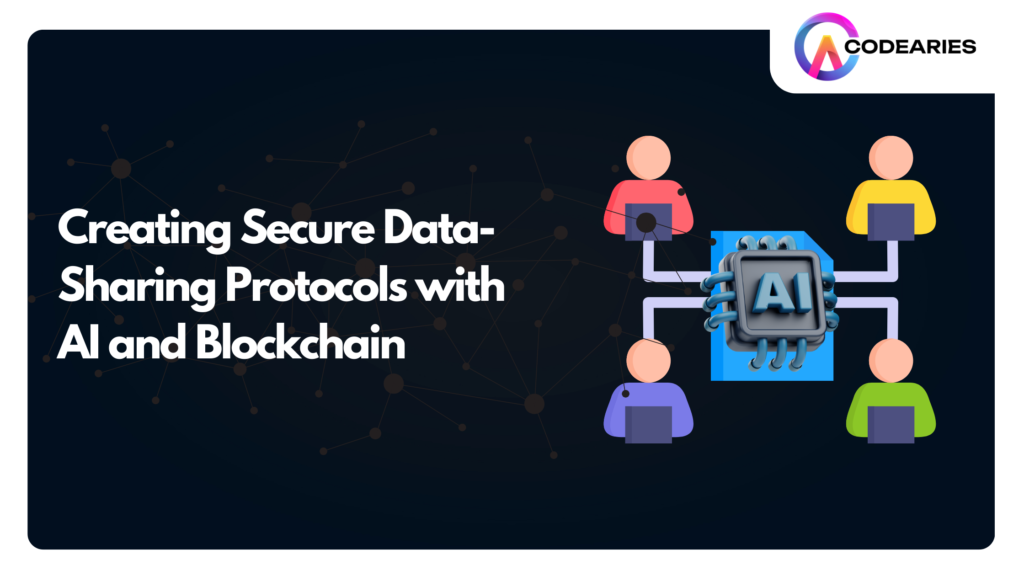
Creating Secure Data-Sharing Protocols with AI and Blockchain

In today’s interconnected world, data sharing is pivotal across healthcare, finance, and supply chain management industries. As data continues to grow in value, the need for secure sharing mechanisms has intensified. Data-sharing protocols are guidelines designed to govern the exchange of information between different entities. Their key function is to uphold the principles of data integrity, confidentiality, and accessibility, ensuring that the transmission process remains secure from start to finish. In this article, we explore how data-sharing protocols ensure secure and efficient information exchange. We highlight blockchain’s role in enhancing security through immutability and transparency, and AI’s contributions to improving data quality and predictive analytics. What are Data-Sharing Protocols? Data-sharing protocols are standardized frameworks that manage how data is exchanged between entities. They define data formatting, transmission, and reception methods, ensuring that systems from diverse environments can interact seamlessly. These protocols enable effective collaboration and data-driven decision-making across healthcare, finance, research, and the Internet of Things (IoT) sectors. In terms of revenue, the global data exchange platform service market is projected to reach the value of US$ 1.3 Bn by 2031, expanding at CAGR of 32.9% during the forecast period. Current Challenges in Data Sharing Several issues complicate effective data sharing: Data Privacy and Security: Safeguarding sensitive information from unauthorized access and breaches remains a top concern. Interoperability: Ensuring that different systems, formats, and standards can work together is often complex. Data Quality and Reliability: It is inevitable to ensure that shared data is accurate, complete, and consistent to derive actionable insights. Legal and Regulatory Compliance: Complying with data protection laws like GDPR and HIPAA is crucial to avoid legal and financial repercussions. Trust and Governance: Building trust among data-sharing parties and establishing robust governance frameworks are vital for successful data exchange. Importance of Secure Data-Sharing Secure data-sharing is vital for: Innovation and Collaboration: Enabling access to valuable data facilitates new research, business ventures, and collaborative projects. Improved Decision-Making: Comprehensive and reliable data enhances decision-making processes and strategic planning. Economic Benefits: Opens up new business opportunities. Boosts economic growth. Increases operational efficiency across industries. Public Good: Contributes to societal benefits through improved public health, scientific research, and environmental monitoring. Data-Sharing Protocols and Blockchain At its core, blockchain is a decentralized digital ledger that records transactions across a network of computers. It ensures immutability, meaning it cannot be altered once data is recorded. This feature makes blockchain an ideal solution for secure and transparent data sharing. How Blockchain Enhances Security Blockchain strengthens data-sharing security through: Immutability: Data cannot be altered or deleted once recorded. Transparency: All transactions are visible, ensuring data accuracy. Decentralization: Data is spread across a network, reducing attack risks. Cryptographic Hashing: Unique identifiers protect data privacy. Consensus Mechanisms: Only validated transactions are added to the ledger. Key Features of Blockchain for Data Sharing Blockchain introduces several features that enhance data-sharing capabilities: Smart Contracts: Automated contracts written in code that execute and enforce agreements without intermediaries, streamlining data-sharing processes. Tokenization: Converts data into digital tokens, facilitating ownership management, transfer, and tracking of data assets. Interoperability: Provides a standardized, common platform that enables seamless data sharing across different systems and organizations. Privacy-Preserving Techniques: Methods like homomorphic encryption and zero-knowledge proofs allow data to be shared while maintaining privacy. Auditability: Offers a transparent, verifiable record of all data transactions, supporting compliance and accountability. By incorporating these features, blockchain can create a more secure, transparent, and efficient data-sharing framework, overcoming many limitations of traditional approaches. The Intersection of AI and Blockchain in Data Sharing Though distinct technologies, AI and blockchain complement each other in data-sharing protocols. AI provides intelligence and analytics, while blockchain ensures data integrity and immutability. Role of AI in Data Management AI enhances data-sharing by: Quality Assessment: Analyzing data for inconsistencies and errors to ensure reliability. Anomaly Detection: Spotting unusual patterns to identify potential security threats. Governance: Enforcing data governance policies for compliance and ethical standards. Integration: Facilitating data integration from various sources for easier sharing and analysis. Automation: Handling routine data tasks to allow focus on strategic activities. Machine Learning Algorithms for Data Privacy Machine learning enhances data privacy through the following: Federated Learning: Training models on decentralized data to protect privacy while improving accuracy. Differential Privacy: Adding noise to data to safeguard individual privacy while enabling helpful analysis. Homomorphic Encryption: Performing computations on encrypted data to maintain privacy during processing. AI’s Contribution to Predictive Analytics in Data Sharing AI-driven predictive analytics provides: Forecasting: Anticipating future trends based on historical data. Risk Assessment: Identifying risks and vulnerabilities in data-sharing systems. Optimization: Finding effective ways to share and use data efficiently. Personalization: Customizing data-sharing experiences to meet individual needs. Integrating AI with blockchain enhances data-sharing systems, making them more secure, efficient, and insightful. The Role of Smart Contracts in Data Sharing Smart contracts are digital agreements with terms encoded into software deployed on a blockchain network. When specified conditions are fulfilled, they automatically execute and enforce agreed-upon actions. These contracts eliminate the need for intermediaries by directly implementing the agreed terms. How Smart Contracts Facilitate Trustless Sharing Smart contracts, which are self-executing agreements coded directly into the blockchain, are pivotal in enabling trustless data sharing: Automation: They automate data-sharing tasks, reducing reliance on intermediaries and minimizing human error. Transparency: The terms of these contracts are visible on the blockchain, fostering openness and building trust among parties. Enforceability: Contracts automatically execute when predefined conditions are met, ensuring compliance without manual intervention. Security: Designed with built-in security features such as encryption and access controls, they safeguard sensitive information. Efficiency: They streamline workflows, cutting costs and enhancing operational efficiency. Use Cases of Smart Contracts in Data Protocols Smart contracts find application in various data-sharing contexts: Data Access Control: They can restrict data access based on set conditions or roles. Data Licensing: They manage licensing and royalties, ensuring fair compensation for data creators. Data Exchange: They automate the data exchange processes, including payment and delivery. Data Privacy Compliance: They enforce data privacy regulations, such as GDPR and HIPAA, ensuring legal compliance. Supply

Scroll to Top
Popuo Image