

Institutions are finally stepping into the DeFi arena, and it’s about time! The landscape has evolved from just experimental yield farms to a robust infrastructure that provides genuine yields, tokenized real world assets, and compliant pathways that align with existing regulations. With clearer guidelines, institutional grade custody, KYC enabled access, and DeFi products that mirror familiar financial instruments like ETFs, money markets, and repos, banks, funds, and corporations can now confidently allocate significant capital at scale.
What changed DeFi from wild west to institutional venue
In the early days, DeFi was largely the playground of anonymous teams, unaudited contracts, and retail investors chasing yields, which kept regulated institutions at a distance. However, several key developments have shifted the risk reward equation. Regulated options like spot crypto ETFs and DeFi themed ETFs are now giving institutions the on ramps they need to fit their investment mandates. For instance, a European pension fund made headlines by investing in a regulated DeFi ETF using Coinbase Custody in early 2025. Meanwhile, DeFi’s total value locked (TVL) surged back above $123 billion in 2025, marking a 41% year over year increase, largely fueled by tokenized Treasuries and leading lending protocols like Aave, which alone boasted over $14.6 billion in TVL.
Now, consultancies and banks are starting to view DeFi as a complementary infrastructure that can ease settlement friction and open up new markets, rather than as a shadowy parallel system. Thought leaders from firms like Oliver Wyman and J.P. Morgan are outlining institutional DeFi models that blend smart contracts with essential safeguards for AML, KYC, governance, and custody. This shift in perspective equips risk committees and boards with the language they need to see DeFi as a pathway to enhancement rather than a looming threat.
Regulatory clarity and compliance rails
For many institutions, the biggest hurdle has been the uncertainty surrounding who is accountable for compliance when dealing with decentralized protocols. In recent years, we’ve seen clearer guidelines emerge regarding digital assets and DeFi, thanks to frameworks from the US and EU, along with specific legislation like the CLARITY Act, which have helped to ease concerns about legal risks. Surveys indicate that while a whopping eighty six percent of institutional investors are either investing in or planning to invest in digital assets, the gap between their interest and actual investment is largely due to the complexities of regulations and operations, issues that these new rules are designed to tackle.
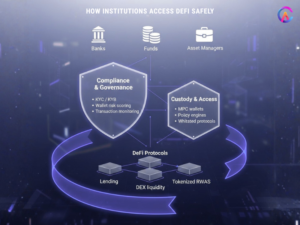
On the technical front, AML and KYC tools for DeFi have made significant strides. Institutions are now employing wallet risk scoring, on chain analytics, and permissioned systems to comply with Bank Secrecy Act requirements while still tapping into protocol liquidity. Guides on AML compliance in DeFi highlight the importance of KYC, KYB, transaction monitoring, and DAO governance design to align with global standards. They also show how projects can incorporate decentralized identity and analytics to keep bad actors at bay without sacrificing the essence of decentralization. This evolving toolkit empowers compliance teams to approve interactions with smart contracts rather than shutting down DeFi altogether.
New products tailored to institutional needs
Institutions are no longer chasing the high APYs that initially drew in retail investors. Instead, they’re on the lookout for scalable, transparent, and well managed returns that can easily fit into their existing portfolios. The DeFi landscape now offers a variety of options to meet these needs. For instance, tokenized real world assets like on chain US Treasuries, commercial paper, and credit products have quickly become one of the fastest growing segments, allowing funds to hold yield-bearing instruments with the benefits of on chain settlement and composability.
Institutional DeFi offerings also encompass regulated DeFi ETFs, structured yield notes, and integrated custody access to lending pools and DEX liquidity. Platforms such as Fireblocks and Coinbase serve as gateways to institutional DeFi, combining multi party computation (MPC) custody, policy engines, and curated protocol lists. This setup enables desks to engage in staking, lending, and liquidity provision with workflows that can be audited. Reports indicate that, spot Bitcoin ETFs like BlackRock’s IBIT could surpass eighty six billion dollars in assets, acting as a bridge for future DeFi exposure through tokenized positions and derivatives.
We’re also seeing the rise of hybrid models that merge traditional finance (TradFi) with DeFi. Banks and asset managers are experimenting with DeFi protocols behind the scenes for lending, trading, or collateral management, all while providing clients with familiar interfaces and documentation. This approach simplifies the complexities of DeFi, wrapping them in institution friendly formats and turning protocols into backend solutions rather than consumer facing brands.
Why institutions care yields liquidity and efficiency
There are several key reasons why institutions are increasingly drawn to DeFi. For starters, the transparency of on chain yields can often surpass what traditional money markets offer, especially when utilizing tokenized treasuries and over collateralized lending instead of those murky structured products. Then there’s the fact that DeFi provides continuous markets with nearly instant settlement, which can significantly cut down on counterparty risk and operational hassles for things like collateral swaps, FX, and basis trades.
Moreover, DeFi opens up new avenues for liquidity. Take asset managers, for instance, they can put tokenized funds or real world assets into automated liquidity pools, tapping into a global pool of investors without having to rely solely on centralized exchanges or OTC desks. Plus, the concept of composability allows institutions to create programmable workflows where collateral can shift automatically between strategies based on set rules, all without the need for intermediaries to manually reconcile ledgers. Banks and hedge funds view this as a chance to prototype next gen infrastructure while still adhering to their risk frameworks.
Remaining challenges and risks
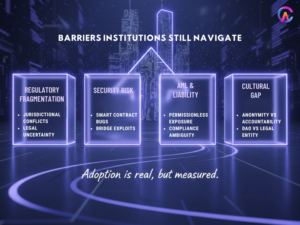
Despite the progress we’ve made, there are still some significant hurdles to overcome. The regulatory landscape is fragmented, meaning that rules vary from one jurisdiction to another, which creates legal and operational challenges for global institutions. When it comes to anti money laundering (AML) and knowing your customer (KYC) practices in truly permissionless protocols, things can get complicated. Some regulators might even shift liability onto front end operators or liquidity providers, even if the control is decentralized.
Security risks are another major concern for institutions. High profile hacks, bridge exploits, and smart contract failures have historically wiped out billions. Although audit practices have improved, the risk is still very much present. Cybersecurity and custody issues frequently come up in institutional analyses of decentralized finance (DeFi), highlighting the urgent need for robust key management and insurance backed protections.
Lastly, there’s a cultural divide to address. Many DeFi communities prioritize anonymity and permissionless access, while institutions need clear counterparties, contracts, and escalation paths. Bridging this divide will likely require permissioned pools, whitelisted participants, and legal structures like on chain special purpose vehicles (SPVs) or regulated issuers that can connect raw protocols with regulated capital.
How Codearies helps institutions and DeFi teams meet in the middle
Codearies is here to bridge the gap between traditional finance and decentralized finance (DeFi), making it easier for DeFi protocols to get ready for institutional adoption while also helping banks, funds, and fintechs create secure pathways into decentralized liquidity. For DeFi founders, Codearies translates regulatory expectations into actionable product and architectural choices, like integrating KYC and KYB layers, selecting compliant custody partners, designing permissioned pools, and providing clear analytics dashboards for risk management teams.
On the development side, Codearies builds smart contracts, front end interfaces, and integration layers that meet institutional standards. This includes everything from role based access controls and whitelisting to audit friendly logging and reporting. The team connects protocols with top notch custody and trading infrastructure, ensuring that allocations can seamlessly flow from traditional systems into DeFi strategies through secure APIs and multi party computation (MPC) controlled wallets.
For institutions looking to explore DeFi, Codearies offers discovery and architecture workshops to pinpoint suitable use cases, such as optimizing treasury yields, distributing tokenized assets, or managing on chain collateral. From there, Codearies crafts proof of concept implementations using carefully selected protocols known for their strong security and compliance features, while also helping to tackle technical hurdles like gas abstraction, network selection, and cross chain risks.
As partnerships develop, Codearies assists in scaling pilot projects into full production deployments. This includes creating internal dashboards for compliance teams, automating reporting for regulators, and providing educational resources for investment committees. By combining technical expertise with a keen awareness of regulatory requirements, Codearies empowers institutions to harness the advantages of DeFi without straying from their governance frameworks.
FAQs
Q1: Why are institutions finally comfortable entering DeFi now?
Institutions are feeling more at ease with DeFi because there’s clearer regulatory guidance, advancements in AML, KYC, and custody tools, plus DeFi now offers regulated products like ETFs, tokenized Treasuries, and permissioned pools that align with their risk frameworks.
Q2: What DeFi use cases interest institutions the most?
The top use cases that catch institutions’ attention include tokenized real world assets, on chain money markets, lending and repo strategies, as well as liquidity provision and derivatives for managing yield and risk on a larger scale.
Q3: How does Codearies help a DeFi protocol become institution ready?
Codearies steps in by integrating KYC and KYB layers, enhancing smart contract security, designing permissioned or semi permissioned products, and connecting to institutional custody and analytics, ensuring that banks and funds can allocate safely.
Q4: Can Codearies assist a bank or fund that wants to pilot DeFi?
Absolutely, Codearies conducts discovery workshops, crafts compliant architectures, picks the right protocols, and builds the necessary integrations and dashboards for risk compliance and investment teams to keep an eye on their on chain exposure.
Q5: What is a realistic timeline for an institutional DeFi pilot with Codearies?
A focused pilot, like a tokenized treasury allocation or a permissioned lending pool integration, can typically be scoped and launched within a few months. Further phases can then expand in size, assets, and protocol coverage as governance comfort increases.
For business inquiries or further information, please contact us at