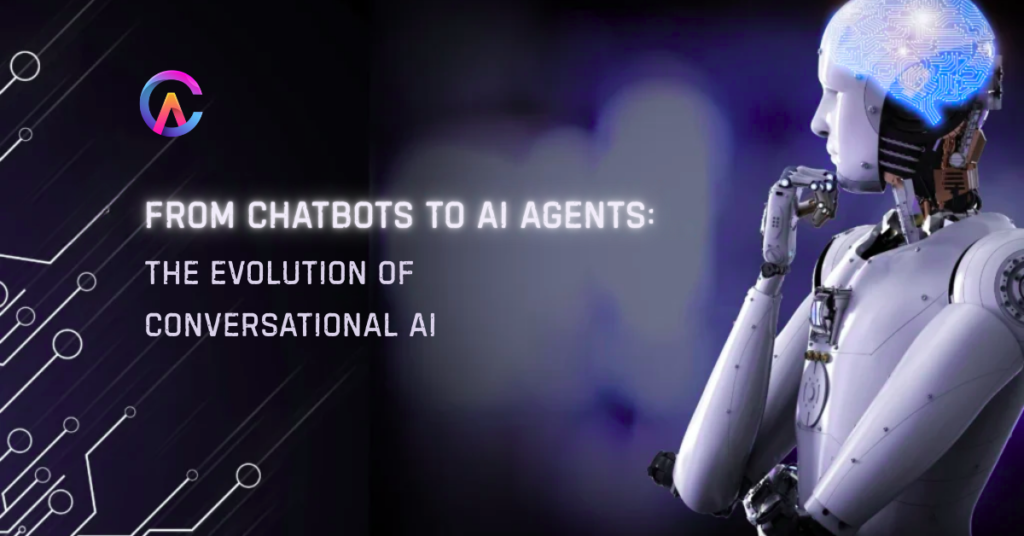
From Chatbots to AI Agents: The Evolution of Conversational AI
Read 11 MinConversational AI has come a long way, evolving from basic rule based chatbots with scripted responses and simple NLP pattern matching to advanced AI agents that can make autonomous decisions, engage in multi step reasoning, and even remember past interactions. These sophisticated systems can handle multi modal interactions, integrate tools, and orchestrate external APIs to execute complex tasks. Take early chatbots like ELIZA from 1966, which used pattern matching to simulate a psychotherapist. They had a limited vocabulary and offered rigid responses. Fast forward to today, and we see the evolution through statistical NLP, machine learning, and transformers, leading to large language models (LLMs) and multimodal foundation models. These advancements have paved the way for agentic architectures that enable conversations that feel human like, with context awareness, emotional intelligence, and the ability to assist proactively in achieving goals. The evolution of conversational AI also focuses on semantic clustering and topical authority, targeting search intent. As we look ahead to 2026, we can see a clear distinction between chatbots and AI agents, with a timeline that highlights the rise of conversational AI, driving SERP featured snippets and AI generated answers, all while optimizing for answer engine signals like Experience, Expertise, Authoritativeness, and Trustworthiness. Going back to the 1960s and 1990s, rule based chatbots relied on keyword matching and template responses, leading to fragile and limited conversations. However, the 2000s brought about a shift with statistical NLP, probabilistic models, intent classification, and entity extraction. The introduction of deep learning and transformers in 2017, with attention mechanisms and self attention, allowed for parallel processing and massive context windows, enabling human like text generation and understanding. Generative AI, like GPT 3 from 2020, and multimodal models such as GPT 4 and Gemini, have integrated vision, language, and audio, creating agentic systems capable of autonomous planning, memory, tool use, and external execution. This represents the pinnacle of conversational AI, allowing for proactive multi step task completion that goes beyond just reactive question answering. Early Era Rule Based Chatbots Pattern Matching Limitations 1960s 1990s The roots of conversational AI can be traced back to ELIZA, created in 1966 by Joseph Weizenbaum at MIT. This early program simulated a psychotherapist using pattern matching, keyword extraction, and template responses, paving the way for human computer interaction, even though it had its technical limitations. ELIZA could recognize phrases, extract keywords, and map them to predefined responses, creating the illusion of understanding through reflective questioning, much like a patient therapist dynamic. However, it struggled with complex queries, context switches, and the emotional nuances of language due to its limited vocabulary. Fast forward to 1972, and we have PARRY, which aimed to simulate a paranoid personality. It used similar pattern matching techniques to engage in conversation and could even pass some rudimentary Turing tests. However, it had a limited emotional range and often fell into repetitive patterns, making it hard to maintain a natural flow in conversation or adapt and learn from interactions. Then came ALICE in 1997, the Artificial Linguistic Internet Computer Entity, which employed pattern matching and heuristic scoring to facilitate natural language conversations. It even won the Loebner Prize but still faced challenges with context memory, had a rigid personality, and struggled with extended multi turn conversations due to its domain specificity. Rule based chatbot characteristics fundamental limitations They rely on keyword pattern matching and rigid template responses, leading to fragile and brittle conversations. Their vocabulary is limited, and they operate on a fixed knowledge base without any learning or adaptation capabilities. They lack context memory, resulting in stateless conversations that reset with every interaction. Their domain specificity restricts them to narrow conversation scopes, often sticking to scripted scenarios. They create an illusion of understanding through reflective questioning, but this is merely surface level pattern recognition. Despite these technical limitations, rule based systems have established foundational paradigms for conversational UIs, interaction patterns, and user expectations, proving their viability as a basis for future advancements in human computer conversation, particularly with the rise of statistical machine learning and transformer based architectures. Statistical NLP Era Intent Classification Entity Extraction 2000s 2010s Statistical natural language processing has completely changed the game for chatbots. We’re talking about probabilistic models, intent classification, named entity recognition, slot filling, and managing multi turn conversations. Remember SmarterChild from 2001? That AOL and MSN messenger chatbot could handle weather updates, sports scores, movie times, and even basic tasks, but it relied on statistical models for intent classification and had pretty basic context management, which limited its domain coverage and personality engagement. Fast forward to Siri in 2011 with the Apple iPhone 4S, which brought statistical NLP into the mix with intent classification and integration with Wolfram Alpha. It could manage location aware services, calendar appointments, and reminders, but it still struggled with natural conversation, especially in multi turn contexts, emotional intelligence, and dealing with different accents and noisy environments. Then there’s Google Now from 2012, which evolved Google Search with contextual cards and predictive assistance, but it also faced limitations in being proactive and often just reacted to queries. Statistical NLP chatbot advancements persistent limitations Intent classification and probabilistic models for dialogue state tracking in multi turn conversations Named entity recognition, slot filling, and parameter extraction for structured data Context management with limited memory and conversation history Domain specific integrations like Wolfram Alpha, APIs, calendars, and location services Reactive assistance that lacks proactivity and struggles with personality engagement and natural conversation flow Statistical NLP lays the groundwork for enterprise chatbots, powering customer service FAQ bots, e-commerce assistants, and banking virtual agents. However, there are still challenges when it comes to natural conversation, especially in narrow domains and scripted flows, which are crucial for establishing the commercial viability of conversational interfaces.. Voice Assistants Era Multimodal Conversational Interfaces 2010s Early 2020s Back in 2015, Amazon introduced the Echo devices, which kicked off a race in the voice assistant arena alongside Google Home, Microsoft’s Cortana, and Apple’s Siri. These platforms have evolved to dominate the consumer landscape, focusing on