Smart Contracts

AI + Smart Contracts: Automating Complex Agreements
AI, Blockchain

AI + Smart Contracts: Automating Complex Agreements

Read 10 MinAI smart contracts are transforming blockchain automation by combining artificial intelligence, natural language processing, and large language models. These systems create self operating agreements that can autonomously interpret natural language terms, execute multi step workflows, and adapt to conditions using external data oracles for dispute resolution and governance decisions. Unlike traditional smart contracts, which rely on rigid, hardcoded logic with static parameters and struggle with complex conditional agreements in the face of real world uncertainties, AI enhanced contracts offer dynamic interpretation and context awareness. They enable adaptive execution and autonomous dispute resolution, achieving up to 95 percent automation for enterprise grade agreements in areas like supply chain finance, legal contracts, DeFi protocols, and DAOs. With semantic clustering and topical authority, AI smart contracts are designed to target search intent in blockchain automation, especially as we look toward 2026. Smart contract agents and natural language contracts are set to drive featured snippets in search engine results, optimizing for AI generated answers and enhancing signals of Experience, Expertise, Authoritativeness, and Trustworthiness (EEAT) while ensuring clarity in autonomous agreements within the Web3 legal tech landscape. On the other hand, hand coded Solidity and Vyper smart contracts can stretch into thousands of lines, often becoming brittle under complex conditions and failing to handle real world complexities. AI systems, however, excel at processing natural language contracts and integrating multimodal data through external oracles like Chainlink, API3, and Witnet. This leads to autonomous decision making and multi agent collaboration, resulting in self executing and self amending agreements that maintain legal enforceability and economic finality in blockchain settlements. Smart Contract Fundamentals Deterministic Execution Trust Minimization Smart contracts are self executing codes that are deployed on the blockchain, automatically enforcing the terms of agreements once certain conditions are met. This process eliminates the need for intermediaries like lawyers, notaries, and escrow agents, which helps maintain trust while minimizing costs and ensuring economic finality and resistance to censorship. Platforms like Ethereum, along with EVM compatible chains such as Polygon, Arbitrum, Optimism, BNB Chain, Avalanche, and Solana, utilize languages like Rust to ensure that programs execute deterministically, meaning that the same inputs will always yield the same outputs. This guarantees mathematical certainty and tamper proof immutability, which is crucial for transferring billions of dollars with confidence. The use of upgradeable proxy patterns, like UUPS and transparent proxies, allows for logic updates while preserving the storage state and contract addresses. This governance mechanism strikes a balance between flexibility and the rigid immutability that is often a tradeoff in enterprise adoption and longevity. Smart contract core principles blockchain automation Deterministic execution: identical inputs lead to identical outputs, ensuring mathematical certainty. Trust minimization: achieving economic finality and censorship resistance by eliminating intermediaries. Immutability: being tamper proof and publicly auditable, which builds confidence in billion dollar value transfers. Upgradeable proxies: UUPS governance offers flexibility for enterprise longevity. Composability: think of it as building blocks for DeFi protocols that allow for permissionless innovation. Smart contracts are driving a staggering $4 trillion in DeFi total value locked (TVL), powering NFT marketplaces, DAOs, and supply chain automation, all while laying the groundwork for programmable money and enhancing AI driven complex agreement automation. Natural Language Contract Authoring AI Interpretation Engines AI driven natural language processing tools like GPT 4, Gemini, and Claude can take plain English legal agreements and break them down to extract key terms, conditions, obligations, timelines, contingencies, and dispute resolution clauses. They can even generate executable smart contract code in languages like Solidity, Vyper, and Move, all while keeping the legal intent intact and ensuring proper technical implementation. These advanced legal language models are fine tuned to handle contract law, focusing on jurisdiction specific clauses and regulations like GDPR, MiCA, and SEC, which helps maintain compliance and enforceability across borders. With their contextual understanding, these tools can clarify ambiguous language, identify conflicting clauses, and suggest necessary adjustments, ensuring that contracts are complete and executable. This can cut down manual legal coding time by up to 90%, reducing reliance on developers.  Natural language authoring AI interpretation advantages Extracting plain English legal terms and generating executable smart contracts Ensuring compliance with jurisdiction specific regulations like GDPR, MiCA, and SEC for cross border enforceability Disambiguating context, resolving conflicts, and clarifying clauses Analyzing contracts in various formats, including PDF, DOCX, and even scanned documents Keeping track of version control and monitoring contract evolution through semantic diffing AI authoring can preserve 98% of the legal intent while boosting development speed by tenfold, allowing enterprise legal teams to deploy contracts rapidly. Autonomous Execution Agentic Smart Contracts Multi Step Workflows Agentic smart contracts break down complex agreements into manageable tasks, allowing for autonomous execution, planning, and integration with external tools like Chainlink’s CCIP for cross chain messaging and real world data feeds, such as weather updates, IoT sensors, supply chain events, and legal judgments. These multi agent systems consist of specialized agents that handle negotiation, execution, monitoring, and dispute resolution, all working together to achieve a system level agreement without needing human intervention, thus maintaining operational autonomy. The reasoning process involves step by step evaluations, counterfactual analyses, risk assessments, and autonomous decision making, all while ensuring deterministic execution, legal enforceability, and economic rationale for sophisticated agreements. Agentic execution multi step agreement automation Workflow decomposition sub tasks autonomous planning execution orchestration Tool integration oracles Chainlink CCIP real world data automation Multi agent collaboration negotiation monitoring dispute autonomous resolution Chain thought reasoning counterfactual risk assessment decision making Self execution self amending dynamic condition adaptation Agentic contracts execute 85 percent agreements autonomously preserving enterprise grade reliability dispute reduction operational efficiency. Dynamic Adaptation Context Awareness Self Amending Contracts AI smart contracts are designed to keep an eye on external factors like market prices, supply chain hiccups, and regulatory changes. They can automatically adjust terms within set governance limits, ensuring that agreements remain flexible while still adhering to the strict rules of smart contracts. For instance, parametric insurance can trigger automatic payouts for weather events, flight delays, and supply chain issues based on predefined conditions, all
How Enterprises Are Using Blockchain Beyond Cryptocurrencies
Blockchain

How Enterprises Are Using Blockchain Beyond Cryptocurrencies

Read 5 MinBlockchain has moved beyond the limitations of cryptocurrency, becoming a vital part of enterprise infrastructure that drives trillion dollar coordination across various industries. Fortune 500 companies are now using permissioned networks to eliminate issues like reconciliation fraud and operational silos, resulting in billions of dollars in measurable ROI each year. By 2026, mainstream adoption will enable seamless handling of supply chain traceability, digital identity, tokenization, and compliance workflows, all without the need for token speculation. Supply Chain Traceability Complete Transformation With immutable ledgers, we can track everything from raw materials extraction to manufacturing, shipping, and delivery. This not only prevents counterfeiting but also speeds up recalls and builds consumer confidence in an instant. IoT sensors monitor temperature, humidity, and location during handling, while blockchain ensures tamper proof audit trails that are accessible to manufacturers, distributors, retailers, and regulators, all at the same time, completely eliminating the need for endless phone calls and email chains. Smart contracts automate payments, delivery confirmations, and quality verifications, with insurance claims processed in real time. ESG compliance becomes a breeze, as verifiable carbon footprints and provenance are tracked effortlessly for regulatory reporting. Counterfeit drugs and luxury goods are a thing of the past, with product authenticity guaranteed and mathematically proven across the enterprise in real time. Digital Identity Frictionless Enterprise Access Gone are the weeks spent on manual KYC verification, now, it takes just minutes to obtain instant blockchain attested credentials. Employees, suppliers, and customers can present verifiable qualifications, while zero knowledge proofs confirm attributes without revealing sensitive data, ensuring privacy compliance and maintaining a competitive edge. Decentralized identifiers foster trust networks across enterprises, making supplier onboarding, employee certifications, and customer identity verification seamless and reusable. This approach cuts redundant verification costs by 80%, transforming supplier management and making performance histories accessible across the entire network permanently. Real World Asset Tokenization Liquidity Revolution Imagine trillions of illiquid assets being fractionalized and traded, with programmable settlements that are completely transforming corporate treasuries. By tokenizing invoices, we can unlock instant liquidity for supply chain payments, slashing working capital cycles by 70%. Receivables financing platforms are now operating 24/7 with automated discounting, and thanks to oracle verified risk assessments, everything runs flawlessly. Now, think about intellectual property rights being fractionalized, allowing for royalty distribution governed by smart contracts. This means real time transparency for content creators, with fractional ownership shares that can be traded in secondary markets. Usage tracking and licensing revenue splits are automated, and cross border settlements happen instantly, completely eliminating currency risk. Data Integrity Regulatory Compliance Platforms With immutable audit trails, we can satisfy SOC2 and GDPR requirements for financial reporting, establishing a single source of truth that permanently eliminates manual reconciliation, duplicate entries, and endless disputes. Cross border payments and collateral management become seamless, as shared ledgers cut operational costs by 30%, instantly restoring institutional confidence. In healthcare, patient data interoperability is enhanced through consent and cryptography, ensuring tamper proof provenance. Providers can collaborate securely on clinical trials, with immutable research guaranteeing reproducibility. The medical supply chain benefits from drug authenticity checks and temperature tracking, effectively eliminating counterfeits, while insurance claims are processed instantly with verified data. Enterprise Workflow Automation: Perfect Coordination Smart contracts are designed to streamline complex business processes involving multiple parties, completely removing the need for manual intervention. With automated workflows for cross border trade, letters of credit, and bills of lading, blockchain technology ensures that documents are verified for authenticity, guaranteeing payment and conditional delivery. Plus, with oracle verified dispute resolution and smart contract arbitration, the entire process becomes efficient and transparent. In vendor management, procurement contracts, and supplier performance, payments are automated through IoT document feeds, allowing for seamless milestone verification. This creates a flawless system of penalties and rewards linked to performance, enhancing supplier scoring and reputation. All of this operates within enterprise networks that support accessible governance, voting, and amendments, all within decentralized permissioned networks that are perfectly balanced. How CodeAries Powers Your Enterprise Blockchain Success CodeAries delivers complete enterprise blockchain solutions transforming business operations and trusted infrastructure. Build permissioned networks using Hyperledger Fabric and Enterprise Ethereum, striking the perfect balance between transparency, privacy, and regulatory compliance. Deploy end to end supply chain solutions with IoT integration, smart contracts, and dashboards for multi party coordination, all set for production Implement verifiable credentials, decentralized identifiers, and zero-knowledge proofs for seamless onboarding of suppliers at an enterprise scale. Tokenize invoices, intellectual property, emissions credits, and real world assets on platforms that ensure programmable settlements and optimized liquidity while maintaining compliance. Automate workflows for cross border trade, royalty distribution, and claims processing with oracle verified triggers that institutions can rely on. Create platforms for data integrity with immutable audit trails that meet SOC2 and GDPR standards, managing financial and healthcare records at enterprise volume. Manage IoT data with sensor authentication, ensuring provenance and utilizing edge computing and Layer 2 scaling to meet enterprise needs flawlessly. Ensure interoperability with bridges for cross chain coordination, fostering unified ecosystems with governance, scalability, and maintainability in production. Provide monitoring and alerting through CI/CD pipelines, guaranteeing 99.99% uptime and institutional reliability. Transform siloed processes into a trusted, transparent, and efficient infrastructure, establishing a competitive advantage that lasts. Contact CodeAries to deploy your production blockchain solutions right away. Frequently Asked Questions Q1: What supply chain challenges does blockchain completely eliminate? Blockchain tackles issues like counterfeit prevention, recall efficiency, ESG provenance, and multi party reconciliation, effectively wiping them out for good. With IoT, it creates verified, tamper proof trails. CodeAries is all about building production platforms that automate smart contracts at an enterprise scale, ready to deploy in an instant. Q2: How does blockchain transform digital identity management? It introduces verifiable credentials, zero knowledge proofs, and reusable KYC processes, allowing for instant validation while keeping privacy intact. This gives businesses a competitive edge without compromising security. CodeAries’ DID frameworks create enterprise ecosystems and cross company trust networks that are operational right away. Q3: Which enterprise assets benefit the most from tokenization? Tokenization is a game changer

How AI Is Reinventing DeFi Through Autonomous Smart Contracts
AI, Blockchain

How AI Is Reinventing DeFi Through Autonomous Smart Contracts

Read 8 MinAI is shaking up the world of DeFi by transforming smart contracts from rigid rule based systems into flexible, self sufficient entities that can gauge market conditions, learn from data, and adjust their actions with minimal human oversight. Gone are the days of fixed interest rates, strict collateral requirements, and manual strategy crafting. Now, DeFi protocols are beginning to harness AI agents to enhance liquidity yields, manage risk, and execute trades in real time, making decentralized finance not only more efficient but also a bit more intricate and risky. This evolution paves the way for exciting new applications like self optimizing lending pools, autonomous market makers, and dynamic liquidation systems, but it also brings up important concerns about transparency, trust, and governance, especially when the code can adapt through learning. From static smart contracts to autonomous agents Traditional DeFi smart contracts operate on set logic, if the collateral ratio dips below a certain point, liquidate, if the price feed indicates X, then adjust the rate to Y. While these contracts are powerful, they lack the ability to adapt to context. Enter AI driven autonomous smart contracts, which introduce three key enhancements. They can gather more data from on chain activities, cross chain movements, and off chain signals. They learn from this data using techniques like reinforcement learning or predictive analytics. And they take action by tweaking parameters, choosing strategies, or initiating flows without waiting for manual governance decisions. In practical terms, this means that the behavior of protocols can evolve over time. Lending platforms can identify the best collateral factors for various assets by monitoring volatility and user actions. Automated market makers can adjust their fee structures based on changing volumes and volatility. Liquidation bots can determine which positions to liquidate when gas prices surge or liquidity is low. The outcome is a more agile DeFi ecosystem that functions less like a static spreadsheet and more like a constantly evolving trading desk, all built on chain. Where AI plugs into the DeFi stack AI isn’t here to take over smart contracts at their core. Instead, smart contracts continue to serve as the reliable foundation for managing asset custody and settlement. Typically, AI finds its place in agents that interact with or adjust these contracts. A few interesting patterns are starting to emerge. One of these patterns involves AI governed parameters. In this setup, governance determines which metrics an AI agent can manage, like interest rate curves, fee multipliers, or reward schedules. The agent operates off chain but regularly updates on chain contracts with new values through secure configuration calls. Another pattern is AI powered executors. These agents monitor the markets and carry out transactions such as arbitrage rebalancing or liquidations, all while adhering to predefined cap rules and safety checks stored on chain. A third pattern features AI enhanced oracles and risk engines. Oracles can use anomaly detection to weed out unreliable price data, while risk engines can predict overall protocol risk through simulations and machine learning. These components don’t directly hold assets, but they significantly influence how smart contracts respond to real world events. AI optimized lending and liquidity Lending protocols are among the biggest winners when it comes to AI. Currently, most lending markets depend on static risk parameters like loan to value ratios, liquidation thresholds, and reserve factors, which governance updates periodically based on human analysis. This method is often slow and can lead to overreactions. With AI, protocols can continuously assess risk for each asset, user cohort, and market condition. For instance, the system can learn that a specific token tends to become highly volatile during major events and can automatically tighten collateral requirements in advance. It can also identify concentration risk when one borrower dominates a pool and adjust incentives to encourage a more diverse mix of lenders or borrowers, reducing that risk. When it comes to liquidity, AI can really help determine how much of the reserves should be lent out versus what should be kept as a safety net. It can also create dynamic interest curves that adjust based on usage and volatility in a nonlinear fashion, enhancing capital efficiency without compromising safety as much as traditional static curves tend to do. Smarter automated market makers Automated market makers (AMMs) initially relied on straightforward bonding curves that don’t need a centralized order book, but they often face issues like impermanent loss and can be less effective in volatile or thin markets. With AI driven liquidity management, these AMMs can become significantly smarter. An AI agent can continuously track volume fluctuations and order flow, making real time decisions about where to allocate liquidity along a curve or across various pools. It might shift liquidity closer to the current price during stable market conditions and spread it out more when volatility increases. Additionally, it can adjust fees on the fly, raising them during turbulent times to better reward liquidity providers and lowering them during quieter periods to draw in more traders. Over time, an AI powered AMM can learn the microstructure patterns of the market on each chain and trading pair, uncovering optimal configurations that would be nearly impossible to fine tune manually. For liquidity providers, this means potentially higher net returns and reduced uncompensated risk. For traders, it can lead to less slippage, especially with long tail assets. AI driven liquidations and risk mitigation Liquidations are one of the most delicate functions in DeFi. If they’re too aggressive, users face unnecessary liquidations, if they’re too slow, protocols can end up with bad debt. Traditional liquidation bots operate on basic rules, often competing against each other and wasting gas in the process. With autonomous smart contract ecosystems, AI agents can plan liquidations in a more strategic manner. They can simulate future price movements and gas conditions to determine the best timing and order for liquidating positions. They can also route liquidations across multiple decentralized exchanges (DEXs) to minimize slippage and even coordinate partial liquidations to protect user health and reduce systemic shock. AI isn’t

DeFi Security: The Biggest Risks and How Modern Protocols Solve Them
Blockchain

DeFi Security: The Biggest Risks and How Modern Protocols Solve Them

Read 7 MinDeFi security is that crucial balance between the freedom of open programmable finance and the risk of devastating losses. Right now, billions of dollars are locked up in smart contracts that anyone can access, which makes these systems incredibly powerful but also attractive targets for savvy attackers. Why DeFi security is such a hard problem In decentralized finance, we swap out trusted intermediaries for code. This means: Research and industry reports indicate that DeFi and cross-chain protocols are responsible for most of the crypto losses, with individual exploits often racking up tens or even hundreds of millions of dollars in a single event. As the total value locked increases, attackers become more driven and inventive. The main risks can be grouped into several categories: bugs in smart contracts, economic attacks, vulnerabilities in cross-chain systems, failures in oracles and price feeds, governance exploits, and compromises on the user side. Smart contract bugs the core technical threat Once smart contracts are deployed, they can’t be changed, so any coding error can turn into a permanent vulnerability. Studies of DeFi hacks consistently show that flaws at the contract level are a primary attack vector, especially in unaudited or forked code. Common patterns Modern protocols address this through Yet, despite these measures, reports from 2025 still indicate that flaws in smart contracts are leading to losses in the hundreds of millions, particularly among smaller projects that bypass thorough reviews. Economic and market manipulation attacks In the world of DeFi, it’s all about the interplay of code and economics. Even contracts that are flawlessly coded can be vulnerable if their incentives or assumptions are shaky. Key vectors Security guidance now emphasizes Economic exploits can be particularly elusive during code reviews, as they often arise from the interactions between contracts, markets, and the capital of attackers. Cross chain bridges and interoperability risks Cross-chain bridges and messaging layers are some of the most targeted elements in the DeFi space. They often manage large pools of assets that represent various networks, making them incredibly attractive targets. Looking ahead to 2025, reports indicate that cross-chain exploits could lead to over a billion dollars in stolen funds, with multi-chain hacks affecting otherwise unrelated protocols through their shared bridges or custodial components. Typical issues Modern mitigations include Despite these advancements, many risk frameworks now categorize bridge exposure as a distinct risk, necessitating stricter limits. Oracle and data feed vulnerabilities When it comes to oracle and data feed vulnerabilities, oracles bring off-chain data, such as prices, into on-chain contracts. If this data is inaccurate or can be manipulated, it can lead to mispriced collateral or incorrect redemptions. Common failures Best practice today Oracle manipulation continues to represent a significant portion of DeFi exploits, especially when projects skimp on their data infrastructure Governance and admin key risks Many DeFi protocols kick off with admin roles that allow a core team to upgrade or control parameters. This setup brings about two main types of risks: Research into DeFi governance incidents shows that token voting systems can be manipulated, especially when liquidity is high but participation is low. Modern countermeasures Additionally, protocols are increasingly separating treasury control from core contract control to limit the potential damage. User side and infrastructure threats Even if the protocol is secure users and supporting infrastructure can be attacked Security reports indicate that phishing and private key theft account for a significant portion of total crypto losses, even when on-chain contracts remain uncompromised. Mitigations include Ultimately, security in DeFi is a shared responsibility between the protocol and its participants. How modern protocols design with security in depth These days, leading DeFi teams are shifting towards a defense-in-depth approach instead of just depending on a single audit or safety measure. Here are some common strategies they’re using: Both academic and industry reviews highlight that while DeFi is still in its early and somewhat unstable stages, a mix of strong engineering, adversarial testing, and continuous monitoring can significantly boost resilience over time. How Codearies helps DeFi teams reduce security risks Codearies is here to support DeFi founders and teams who want to move quickly without compromising on security. What Codearies typically does Threat modeling and architecture review Secure smart contract development Audit preparation and coordination Security operations and monitoring User and governance safety The goal isn’t just to pass an audit; it’s about building a protocol that can stand strong against evolving threats. Frequently asked questions Q1 What is the single biggest risk most new DeFi projects underestimate? A lot of teams don’t realize that even the tiniest logic errors or lapses in access control can result in a complete loss of funds once their protocol goes live. It’s not just about those rare zero-day bugs; often, it’s simply about missing checks or having poor upgrade paths. Codearies tackles this issue by implementing early-stage threat modeling and conducting thorough reviews of privileged functions. Q2 Are audits enough to keep a DeFi protocol safe? While audits are essential, they alone aren’t enough. They help minimize risk, but they can’t guarantee safety, especially as protocols change and integrate with others. Continuous monitoring, controlled feature rollouts, and bug bounties are equally crucial. Codearies supports teams in establishing a comprehensive security lifecycle. Q3 How can we reduce risk around cross chain features? Whenever possible, it’s best to keep the core value and logic on the most secure base layer and treat bridges as tools with limited exposure, complete with caps and circuit breakers. Opt for proof-based or well-tested bridge systems instead of custom experiments. Codearies assists in designing those boundaries and selecting safer interoperability stacks. Q4 What can we do to protect users even if our contracts are secure? It’s important to invest in front-end and wallet safety, provide clear transaction previews, establish strong branding around official links, and promote security education. Think about integrating with wallet security tools and offering optional insurance. Codearies often helps teams create easy-to-understand safety guides and design user experiences that gently steer users away from risky actions. Q5 When

The Future of Smart Contracts Beyond Ethereum in 2026
Blockchain

The Future of Smart Contracts Beyond Ethereum in 2026

Read 5 MinSmart contracts are changing how the digital world operates. They provide transparency, automation, and trustless interactions for many areas, including finance, gaming, supply chain, and healthcare. For years, Ethereum has been the leading smart contract platform, driving the rapid growth of DeFi, NFTs, tokenization, and more. However, as technology and the market progress, 2026 will see smart contracts move beyond Ethereum and thrive in a growing multichain ecosystem. What will the next stage of smart contracts look like outside of Ethereum? How will new platforms, frameworks, and trends redefine possibilities in business, security, and user experience? Ethereum’s Ongoing Evolution and Its Limits Ethereum is still the largest and most widely used smart contract platform. The network’s updates, like Ethereum 2.0 and proto danksharding, are improving scalability, security, and energy efficiency. The transition to Proof of Stake, lower gas fees, and advanced Layer 2 solutions like zk rollups, optimistic rollups, and danksharding will help Ethereum scale toward widespread use, potentially handling 100,000 transactions per second. New data structures, such as Verkle trees and stateless clients, will make running Ethereum nodes easier and more efficient.   Yet, Ethereum has limitations. High transaction fees and network congestion can be problematic, especially during peak times. The ecosystem also faces increased regulatory scrutiny, and as competition grows, other blockchains are starting to attract developers and users with their own unique advantages. The Rise of Multichain Smart Contract Platforms By 2026, the era of Ethereum being the sole playground for smart contracts will be gone. New platforms are finding their niches based on scalability, programmability, governance, or native interoperability.​ Here are the leading smart contract ecosystems that are growing quickly:  In 2026, developers will view protocol choices not as a zero sum game but as tools for different markets and use cases. Key Innovations Defining the Future of Smart Contracts The Business Value of Expanding Beyond Ethereum Choosing the Right Platform in 2026 In this multichain environment, success relies on clearly matching use cases to the right platform. Highmfrequency games or on chain AI might lean towards Solana or Avalanche. Regulated DeFi and composable DAOs could thrive on Polkadot or Cosmos. Projects needing formal verification or eco credentials may choose Cardano or Algorand. Many businesses will adopt a multichain strategy, deploying different features across Layer 1 and Layer 2 chains and using bridges or dApp aggregators to create a unified user experience.  The Path Forward for Smart Contracts By 2026, smart contracts will prioritize interoperability, modularity, and security just as much as they do any single chain’s scale. This shift will create new models in finance, insurance, digital identity, supply chain, healthcare, and entertainment, each leveraging the best features of multiple blockchains based on their needs for risk, speed, privacy, and innovation.   Developers and businesses that embrace this cross chain era and select appropriately sized platforms for each workload will receive the greatest benefits. How Codearies Empowers You in the Multichain Smart Contract Era At Codearies, we lead in smart contract innovation and help businesses move beyond Ethereum to thrive in a multichain world. Our services include: Partner with Codearies to harness the full power of next generation smart contracts and create solutions that are future proof, interoperable, and ready for global growth. Frequently Asked Questions Q1: Which blockchains should I use beyond Ethereum? We provide guidance based on your needs, considering speed, cost, regulatory fit, security, and ecosystem reach to recommend the best chains or hybrid models. Q2: Can Codearies build smart contracts that work across multiple networks? Yes, our solutions for cross chain and bridging unify assets and actions across Ethereum, Solana, Avalanche, Polkadot, Cosmos, and more. Q3: How can I make sure my smart contracts are secure as the ecosystem changes? We apply formal verification, modular design, and frequent audits using both automated and manual methods to keep your code safe. Q4: Will AI really help with smart contract development? AI now plays a central role in rapid prototyping, code translation, and risk analysis, significantly speeding up development cycles and reducing errors. Q5: What ongoing support do you provide after launch?  We offer continuous monitoring, upgrades, compliance checks, integration of new chains, and dedicated troubleshooting to keep your contracts current and effective. For business inquiries or further information, please contact us at  contact@codearies.com  info@codearies.com 

How Blockchain Is Shaping the Future of Gaming
Blockchain, Gaming

How Blockchain Is Shaping the Future of Gaming

Read 4 MinThe gaming industry is leading the way in technology, evolving quickly and changing how we play, own, and interact in virtual worlds. One major technology driving this change is blockchain, a decentralized digital ledger that aims to transform game design, ownership, economies, and player engagement.   As we look toward 2025 and beyond, blockchain’s effects on gaming are significant and varied. It opens up new possibilities for player empowerment, creativity, and economic opportunity. This blog will examine how blockchain is influencing the future of gaming, explain its main applications, and show how Codearies helps gaming companies use this groundbreaking technology to create next-gen experiences. The Gamer’s Paradigm Shift: From Play-to-Own and Beyond In traditional gaming models, players spend time and money but often do not own the digital items they earn. Virtual items are locked within games and controlled by centralized servers, often disappearing or losing value if a game closes. Blockchain changes this situation by enabling:   This change moves gaming from mere consumption to active participation, blurring the lines between players, creators, and entrepreneurs. Key Areas Blockchain Is Disrupting Gaming 1. NFTs: Digital Scarcity and Provenance Non-Fungible Tokens (NFTs) are unique digital items secured on a blockchain. In gaming, NFTs prove the rarity and ownership of in-game assets, enabling:   NFT-based games like Axie Infinity have shown how ownership and trading can create lively player-driven economies.. 2. Play-to-Earn (P2E) Models Play-to-earn changes time spent gaming into real economic value. Players earn valuable cryptocurrencies or NFTs by: This model creates incentives for engagement and sustains player communities economically. 3. Decentralized Gaming Platforms and DAOs Blockchain allows decentralized autonomous organizations (DAOs) to govern games collectively. Players vote on updates, rules, and economic decisions. This shifts power from centralized publishers to active communities, encouraging co-creation and trust.   In some cases, entire gaming platforms operate on the blockchain, hosting thousands of games with interconnected economies and shared ownership rules. 4. Smart Contracts Automating Gameplay and Economies Smart contracts enable game actions, such as asset transfers, loot drops, and staking rewards, to happen automatically and transparently, without needing human input. This guarantees:   These self-executing contracts power decentralized item marketplaces and financial systems in games. 5. Metaverse Integration and Virtual Economies Virtual worlds like Decentraland and The Sandbox use blockchain for land ownership, governance, and digital commerce. This creates lasting metaverses where users can socialize, shop, play, and build.  Blockchain rewards creators and participants in these worlds with tokenized economies, opening new revenue streams and interactive experiences. Benefits for Players and Developers Players Developers/Companies True ownership and control New business models and revenue streams Ability to monetize skills/assets Access to global player economies Cross-platform experiences Transparent, automated asset management Enhanced engagement and loyalty Reduced cheating and fraud risk Dynamic, evolving game worlds Community-driven governance and innovation Overcoming Challenges Despite its promise, blockchain gaming faces hurdles: How Codearies Empowers Gaming Innovators At Codearies, we support the future of gaming by providing tailored blockchain solutions that combine innovation, user-friendliness, and compliance. Whether you are starting an NFT collectible game, developing a DeFi-driven metaverse, or integrating play-to-earn economics, we offer complete support. Our Capabilities: FAQs Can Codearies help build blockchain-based games from scratch? Absolutely. We design, develop, and launch fully customized blockchain gaming platforms that fit your vision and audience. What blockchains do you work with for gaming projects? We primarily use Ethereum, Solana, Polygon, Avalanche, Binance Smart Chain, and private chains, choosing based on scalability, costs, and ecosystems. How do you handle wallet integration and user onboarding? We focus on smooth, secure onboarding with layers that protect users from crypto complexity, including social logins and custodial wallet options. How does Codearies support NFT implementations? We develop minting platforms, marketplaces, royalty systems, staking, and yield farming solutions that are fully customizable for your game’s economy. Are Codearies solutions compliant with global regulations? Yes, compliance is essential. We tailor our systems and processes to meet GDPR, KYC/AML, and industry-specific requirements across different regions.

The Dark Side of Blockchain: Illegal Activities & How to Stay Safe
AI

The Dark Side of Blockchain: Illegal Activities & How to Stay Safe

Read 4 MinBlockchain technology has transformed industries by providing transparency, decentralization, and security. However, it is also susceptible to misuse. Blockchain and cryptocurrencies have become tools for various illegal activities, including money laundering, fraud, ransomware, and illegal marketplaces. As the blockchain ecosystem grows, it is crucial to understand the risks and learn how to protect yourself. In this blog, we explore the darker side of blockchain, identify the types of illegal activities enabled by crypto, and offer practical tips for staying safe. Additionally, discover how Codearies assists businesses in developing secure and compliant blockchain solutions. The Spectrum of Illegal Activities in Blockchain 1. Money Laundering and Terrorism Financing The pseudonymous nature of blockchain attracts launderers looking to hide the origins of illicit funds. Criminals convert dirty money into cryptocurrencies and use decentralized exchanges or tumblers (mixers) to anonymize transactions. They then convert the crypto back into fiat currency, often crossing borders. Recent reports indicate that billions of dollars flow through illicit crypto addresses each year. For example, platforms like Garantex have faced fines for facilitating funds linked to ransomware groups and other criminal networks. Various groups also use digital assets to finance terrorism, taking advantage of the challenges in tracking these transactions. 2. Fraud and Scams From Ponzi schemes to fake ICOs, blockchain has become a haven for fraudsters. High-profile cases like BitConnect, OneCoin, and Centra led to millions—sometimes billions—of dollars being stolen or lost due to false promises and manipulation. Complex scams such as “pig butchering” and phishing are constantly evolving, targeting inexperienced users. Criminal marketplaces like Huione Guarantee allow the sale of hacking tools and fake verification services. 3. Ransomware and Extortion Malicious actors demand crypto payments to unlock encrypted data or stop attacks. The inability to reverse and the quick nature of crypto transactions make ransom payments effective and hard to track. Ransomware groups like Conti, LockBit, and NetWalker have channeled millions through crypto exchanges despite sanctions and enforcement efforts. 4. Darknet Markets and Illegal Goods Blockchain has played a significant role in supporting darknet markets like the infamous Silk Road. Digital currencies facilitate transactions related to drugs, weapons, illegal wildlife trade, counterfeit documents, and materials for child exploitation. With varying levels of security and anonymity, criminals trust cryptocurrency as a means to hide their tracks. 5. Market Manipulation and Insider Trading Manipulative tactics like wash trading, spoofing, and pump-and-dump schemes can skew prices and mislead investors on crypto exchanges. While regulatory bodies are increasing their enforcement efforts globally, there are still gaps in regulation. How to Stay Safe in the Blockchain World 1. Use Reputable Platforms Stick to well-known, regulated exchanges and wallets with strong security measures. 2. Follow Security Best Practices Utilize hardware wallets for large amounts, enable multi-factor authentication (MFA), avoid sharing private keys or seed phrases, and be cautious of phishing attempts. 3. Conduct Due Diligence Before investing or interacting with new projects, thoroughly evaluate the team, technology, tokenomics, and community. Watch out for exaggerated claims or guaranteed returns. 4. Leverage Blockchain Analytics Organizations and informed users can use tools like Chainalysis, Elliptic, or CipherTrace to track suspicious transactions and verify counterparties’ legitimacy. 5. Stay Educated Cybercriminals are always finding new ways to cheat. Stay updated on emerging tactics like deepfakes, social engineering, and phishing campaigns. 6. Work with Trusted Partners Collaborate with blockchain development experts who emphasize security, compliance, and transparency throughout the technology lifecycle. The Role of Regulation and Enforcement in 2025 Regulators worldwide are stepping up: How Codearies Helps Businesses Secure Blockchain Projects At Codearies, we understand that trust and security are essential for successful blockchain adoption. Our clients, ranging from fintech startups to large enterprises, rely on us to design, develop, and protect their blockchain systems. Our comprehensive approach includes: Ultimately, our goal at Codearies is to create blockchain systems that foster innovation while ensuring resilience, transparency, and user safety. Frequently Asked Questions How does Codearies ensure security in blockchain projects? We combine top audits, ongoing monitoring, and secure design principles so we can address and minimize vulnerabilities before they become problems. Can Codearies help with regulatory compliance related to blockchain and crypto? Yes, we implement KYC and AML modules, ensure compliance with GDPR, and keep updated on local and international regulatory changes. What are the common types of crypto-related fraud we should watch for? It’s essential to recognize phishing, rug pulls, Ponzi schemes, wash trading, and unauthorized access attempts. Codearies builds defenses to protect against these threats.  Does Codearies provide post-launch security support? Definitely, We maintain continuous monitoring through analytics, threat detection, incident response, and patching to keep your platform secure over time. How can users protect themselves from crypto scams? Use hardware wallets, enable MFA, never share sensitive information, verify all communications, and avoid offers that seem too good to be true. Codearies helps brands educate their users on staying safe.

How to Evaluate a Blockchain Project Before Investing
Blockchain

How to Evaluate a Blockchain Project Before Investing

Read 5 MinBlockchain technology has led to the creation of thousands of projects across various sectors, including finance, gaming, supply chain, digital identity, real estate, and entertainment. While these opportunities are enticing, they come with risks such as hacks, scams, hype-driven surges, and abandoned ventures. If you’re thinking about investing in a blockchain project, it’s crucial to distinguish future disruptors from mere speculation or, worse, fraudulent schemes. This guide will help you evaluate blockchain projects effectively so you can make informed, data-driven investment choices. Why Careful Evaluation Matters Unlike traditional markets, blockchain operates without borders and moves quickly. While this fosters accessibility and innovation, it also: Taking a methodical, skeptical, and research-driven approach to investing is not just wise; it’s essential. Step 1: Understand the Project’s Vision & Problem Statement Start with fundamental questions:              Projects that tackle clear, significant, and unresolved issues tend to be stronger.  Clarity, necessity, and differentiation should stand out in mission statements and whitepapers. Step 2: Assess the Team & Advisors Every successful crypto project has a top-notch team behind it. Check for: Step 3: Scrutinize the Technology A solid blockchain project relies on technical soundness and innovation.  Step 4: Analyze Tokenomics and Utility The project’s token should serve a purpose beyond speculation:  Step 5: Size Up the Community & Ecosystem Strong projects attract active, knowledgeable communities. A healthy, passionate community is an early sign of genuine momentum. Step 6: Evaluate the Roadmap & Development Progress Beware vague, perpetual “coming soon” promises. Step 7: Investigate Security & Compliance Security is non-negotiable: Step 8: Study Market Position & External Factors Step 9: Assess Transparency & Culture Projects that acknowledge missteps and share failures indicate a mature culture. Step 10: Make an Informed Investment Decision Before investing, ask yourself: Invest what you can afford to lose—no matter how excited you are. Red Flags to Watch For How Codearies Helps You Evaluate and Launch Blockchain Projects With Confidence Navigating the blockchain landscape can be challenging. Codearies empowers investors, businesses, and innovators to make smart decisions and create leading solutions through effective evaluation frameworks, technical know-how, and risk management. Our Services Include: Due Diligence Reports & Research: We provide impartial analysis that covers technology, tokenomics, team, security, legal, and market risks. Technical Audits: Our thorough reviews, audits, and security assessments ensure project integrity.   Market & Competitive Analysis: We compare projects against the global blockchain landscape, highlighting strengths, weaknesses, and opportunities.  Advisory & Strategy: We support investor relations, compliance, legal requirements, token launches, and market entry strategies.  Custom Blockchain Solutions: Beyond evaluation, our engineers build, integrate, and improve protocols; we don’t just critique, we create.  Ongoing Monitoring & Reporting: We track the progress of partners and projects, as well as regulatory changes and technical developments, to reduce risks and optimize outcomes continuously.   At Codearies, we aim to bring clarity, security, and business value to all blockchain activities—whether you’re investing, partnering, or building. Frequently Asked Questions (FAQs) Can Codearies help me spot scams and “rug pulls” before I invest? Absolutely! We have a thorough, multi-layered due diligence process that covers code audits, team verification, tokenomics, and governance models to help you avoid projects with hidden risks. Does Codearies perform ongoing monitoring after project evaluation? Yes. We provide continuous insights and reports on project health, code changes, market fluctuations, and regulatory developments, with real-time alerts for investors and partners. Can Codearies audit projects I’ve already invested in? Certainly. We conduct retroactive technical and operational audits to verify the security, integrity, and transparency of any blockchain project and identify issues before they escalate.  How does Codearies handle regulatory and KYC compliance for blockchain investments? Our legal team ensures that all evaluation criteria and project launches comply with relevant laws regarding securities, KYC/AML, and data privacy, reducing regulatory risks for investors.  Do you help with launching my own blockchain or token project? Yes! In addition to evaluation, we design, develop, and launch custom blockchain solutions, from utility tokens to DeFi protocols and NFT platforms, while providing world-class user experience, security audits, and compliance support throughout the project lifecycle. 

Beyond Bitcoin: Top Blockchain Projects to Watch in 2025
Blockchain

Beyond Bitcoin: Top Blockchain Projects to Watch in 2025

Read 4 MinBlockchain in 2025 goes beyond Bitcoin or a way to speculate on cryptocurrency. The last few years have seen a surge of new platforms addressing real-world issues. These include decentralized financial services, gaming economies, digital identities, cross-chain applications, supply chain tracking, and sustainability. As more people adopt these technologies, both established and new projects are changing how value, identity, and data move in the digital space.   Here is an in-depth look at the most significant blockchain projects and tech trends that are important to follow as we move past the era of “just Bitcoin.”  Top Blockchain Projects and Ecosystems Shaping 2025 1. Ethereum (ETH) and Layer 2 Ecosystem 2. Solana (SOL) 3. Polkadot (DOT) & Modular Architectures (E.g., Celestia, Polygon 2.0) 4. Ripple (XRP) 5. Binance Launchpad & DeFi Launch Platforms 6. Web3 Gaming and Metaverse Projects (E.g., Banger, Derby Stars, VulcanVerse) 7. Flare Network 8. Decentralized Identity & Data Projects 9. NFT Platforms Beyond Art 10. Sustainable and Enterprise-Focused Blockchains Emerging Blockchain Technology Trends for 2025 How Codearies Helps You Harness Next-Gen Blockchain Innovation As the blockchain landscape expands and evolves, collaborating with an experienced partner is crucial. At Codearies, we help businesses, startups, and enterprises leverage the most relevant blockchain technology for practical use cases.  Our Services Include: Whatever your vision, Codearies blends deep blockchain know-how with practical business expertise. We help you move beyond buzzwords—unlocking real value, speed, and scalability. Frequently Asked Questions (FAQs) What makes a blockchain project “worth watching” in 2025? Projects with unique technology, real-world adoption, interoperability, and a supportive developer/community ecosystem stand out. Codearies helps you evaluate use cases and choose the right technology stack. Can Codearies help with multi-chain or cross-chain dApps? Absolutely. We specialize in cross-chain architecture using top interoperability protocols like Polkadot, Cosmos, and Flare, ensuring your application isn’t limited to a single blockchain. Is it too late for enterprises to enter blockchain in 2025? Not at all. With new trends like modular blockchains and Blockchain-as-a-Service, adoption is more achievable than ever. Codearies can help your business start quickly and securely.   How does Codearies stay ahead of fast-moving trends? Our engineers and researchers are always engaged with the latest technology. They attend global conferences, contribute to open-source projects, and test new solutions, ensuring your projects benefit from updated expertise.  I want to build a gamified/NFT project—can you handle both tech and business strategy? Yes! Codearies offers end-to-end service: we design tokenomics, create smart contracts, build user experiences, and support go-to-market strategies. We help ensure your project succeeds technically and in the market.

10 Real-World Use Cases of Blockchain You See Every Day
Blockchain

10 Real-World Use Cases of Blockchain You See Every Day

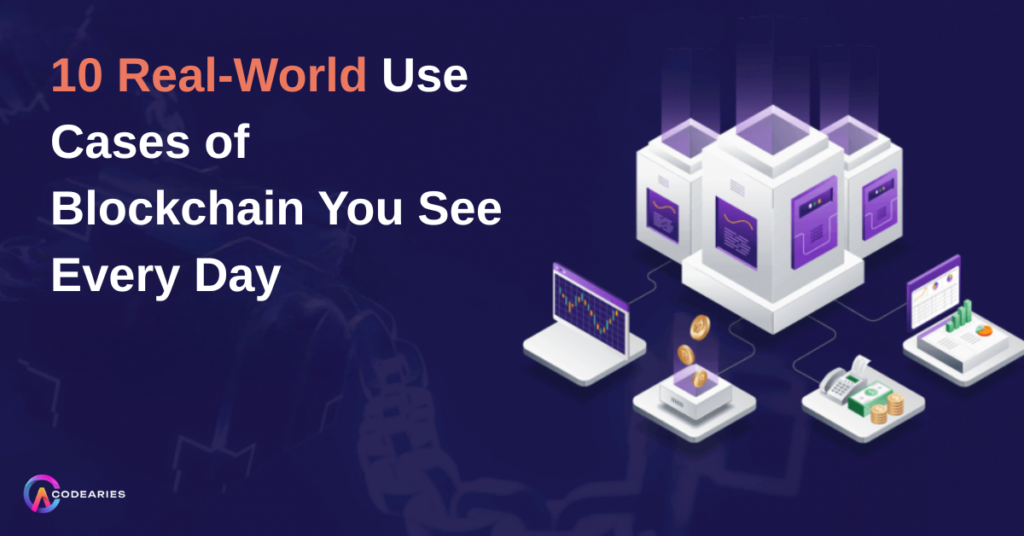
Read 4 MinWhen you hear the word blockchain, you might think of Bitcoin, Ethereum, or NFTs. However, blockchain has grown beyond cryptocurrency. It’s not just about coins; it’s quietly changing industries you encounter every day.   From the food you eat to the apps you use to vote, blockchain works behind the scenes, bringing transparency, security, and efficiency to daily life.   Let’s explore 10 real-world blockchain applications you’ve likely encountered—even if you didn’t notice it.   1. Food Safety & Supply Chain Transparency Where You See It: Grocery stores, food delivery, product QR codes.   How it Works:   Blockchain records each step of a product’s supply chain, from farm to fork. This helps consumers and retailers trace the origin, storage, and journey of food products in real-time.   Real-World Example:   Walmart and IBM Food Trust reduced recall time from 7 days to seconds. Nestlé, Carrefour, and Unilever use blockchain for supply chain traceability.   2. Digital Identity & KYC Verification Where You See It: Bank apps, airline check-ins, online platforms.   How it Works:   Blockchains support Self-Sovereign Identity (SSI), allowing users to control and share their identity securely without storing personal data on centralized servers.   Real-World Example:   Microsoft ION is a decentralized ID platform built on Bitcoin. Civic and uPort are used in finance, healthcare, and border control.  3. Cross-Border Payments & Remittances Where You See It: Sending or receiving money, gig platforms, freelancer payments.   How it Works:   Blockchain lowers fees and delays by removing intermediaries in international transactions.   Real-World Example:   RippleNet (XRP), Stellar, and USDC are used by MoneyGram and Western Union. Wise and PayPal now use blockchain for faster settlements.   4. Healthcare Data Management   Where You See It: Medical records, EMR apps, prescriptions.   How it Works:   Patients store their health records in a digital wallet. Medical providers access this data through encrypted, permissioned smart contracts.   Real-World Example:   MediLedger tracks drug authenticity. BurstIQ and Healthereum leverage blockchain for patient data control.  5. Secure Online Voting   Where You See It: Shareholder votes, university elections, expat ballots.   How it Works:   Blockchain ensures permanent and auditable voting logs, which improves trust and transparency in digital elections.   Real-World Example:   Estonia uses blockchain to support national IDs and digital voting. Voatz is used in U.S. elections for secure absentee voting.   6. Real Estate & Land Registry   Where You See It: Property transactions, rental contracts, title deeds.   How it Works:   Blockchain digitizes title records and uses smart contracts to streamline property sales, rent agreements, and verification.   Real-World Example:   Propy facilitates blockchain-based home transactions. Pilot programs are underway in Sweden, Georgia, and India for digital land records.   7. Digital Content & NFTs   Where You See It: Music platforms, digital art, in-game items.   How it Works:   Creators issue NFTs to confirm ownership of digital content and earn royalties transparently.   Real-World Example:   Audius streams music on blockchain. OpenSea, Rarible, and Magic Eden are used by millions to trade NFTs daily.   8. Loyalty Programs & Rewards  Where You See It: Shopping apps, airline miles, cafe rewards.   How it Works:   Tokens on blockchain replace isolated point systems, offering users real-time rewards that can be used across multiple vendors.   Real-World Example:   Singapore Airlines’ KrisFlyer integrates blockchain with partner outlets. Chanticleer Holdings used blockchain for cross-brand restaurant rewards. 9. Ethical Product Sourcing & Fashion  Where You See It: Product labels, smart tags, sustainable goods.   How it Works:   Blockchain tracks every phase in the product lifecycle, allowing consumers to verify that labor, materials, and logistics are ethical and eco-friendly.   Real-World Example:   Everledger tracks diamonds to confirm they’re conflict-free. The Aura Blockchain Consortium includes LVMH, Prada, and Cartier to verify product authenticity.   10. Transparent Donations & Charity  Where You See It: Nonprofits, disaster relief, giving apps.   How it Works:   Blockchain ensures donations are delivered and used transparently, reducing fraud and increasing donor trust.   Real-World Example:   Binance Charity and GiveTrack show real-time donation tracking.   How Codearies Can Help You Build Real-World Blockchain Solutions  At Codearies, we turn blockchain from a buzzword into a business advantage.   From traceability in supply chains to decentralized identities, tokenized loyalty systems, or payment automation, our engineering, strategy, and compliance teams make it happen.  Our Expertise Covers: Blockchain Consulting & Strategy We link real business challenges to scalable blockchain solutions. DeFi & Wallet Development Build next-generation fintech platforms with crypto wallets, payments, and smart contract integration Track & Trace Systems  Using blockchain and IoT to verify product origin, ensure sustainability, and enable digital twins.  NFT Marketplaces & Content Platforms  Create tokenized IP platforms for art, fashion, music, and gaming with built-in royalty smart contracts. Custom Loyalty & Reward Systems  Cross-brand point wallets powered by smart tokens that work across partnerships. Digital ID and KYC Solutions Self-sovereign identity and KYC modules for finance, healthcare, and public services. No matter the use case, Codearies offers the blockchain design, development, and ongoing support to bring your idea to life.   Explore or build with us: https://codearies.com/  Frequently Asked Questions (FAQs)   Is blockchain practical for everyday business use?   Yes. Blockchain has moved beyond proof-of-concept. Codearies builds real-world blockchain systems across retail, fintech, logistics, and media used by thousands every day.   Can we integrate blockchain into existing apps? Absolutely. We specialize in adding blockchain features—such as traceability, NFT minting, and wallets—to mobile and web platforms without disrupting your current setup.  How is blockchain better than a traditional database?  It stores permanent, verifiable, and decentralized records, which is perfect for situations needing transparency, shared access, or tamper-proof logs.   Do users need technical knowledge to engage with blockchain apps? Not with Codearies solutions. We design simple, mobile-friendly user interfaces that hide the complexity behind secure wallets and wallets-as-a-service APIs.  How long does it take to launch a blockchain product?   Depending on the scope, MVPs can be delivered within 6 to 12 weeks, with plans for ongoing features, security audits, and governance.

Scroll to Top

Have A Project In Mind?

Popuo Image